
Disability Insurance: How It Works, What It Costs, and How to Get Covered
A plain-English guide to protecting your paycheck while you’re healthy enough to do it.

- Disability insurance pays you a monthly benefit, usually 60 to 70 percent of your income, when a covered illness or injury keeps you from working.
- Illness, not accidents, drives roughly 90 percent of long-term claims. Back problems, cancer, heart disease, and mental health conditions lead the list.
- The policy’s definition of disability, own-occupation versus any-occupation, is the single most important sentence in the contract. It sets the test your claim has to pass.
- Social Security disability has a strict qualification standard and a modest benefit. The SSA projects the average payment at about $1,630 a month for 2026.
- Pay your premiums with after-tax dollars and your benefits are generally tax-free.
- Paid if you can’t work
- Self-employed? Jason helps
- Own-occupation options
- Shopped for your exact job
- Free quotes, no commitment
- Just Jason, never a stranger
Your information goes to Jason. Not a call center. Not a lead list.
Disability insurance replaces a portion of your income when an illness or injury keeps you from working. The Social Security Administration estimates that a 20-year-old worker has about a 1 in 4 chance of becoming disabled before reaching retirement age. Yet fewer than 1 in 5 adults own any disability insurance, even though nearly half say they need it. A private disability insurance policy is built to keep that income coming when your health can’t, and it’s coverage you choose and own on your terms, while you’re well enough to qualify.





What Is Disability Insurance and How Does It Work?
What’s disability insurance, in plain terms? A contract that pays you a monthly benefit, usually 60 to 70 percent of your income, when you’re sick and can’t work, or hurt and can’t do your job. You’ll sometimes see this type of insurance sold as disability income insurance; the two names mean the same thing. The money arrives every month like a paycheck, and you can spend it however your life requires: the mortgage, groceries, medical bills, even your retirement savings.
Every policy runs on four moving parts, and once you understand them, the rest of this subject gets much easier.
- The monthly benefit is the dollar amount the insurer pays you each month while you qualify as disabled under the policy’s terms.
- The elimination period is the wait between the day you become disabled and the day benefits begin. It works like a deductible measured in days instead of dollars. Common choices are 30, 60, 90, or 180 days, and 90 is the most common. The clock starts on the date of the disabling event, not the date you file your claim.
- The benefit period is how long payments continue once they start: two years, five years, ten years, or all the way to age 65 or 67.
- The definition of disability is the language that decides whether your claim qualifies in the first place. We’ll cover it fully below, because it deserves its own section.
A claim itself is straightforward. When an illness or injury keeps you from performing your job duties, you file a claim supported by statements from your doctors. The insurance company reviews the medical evidence against your policy’s definition of disability. If you qualify, the elimination period runs its course, and then you receive benefits every month. Those benefits continue for as long as you remain disabled, up to the end of your benefit period.
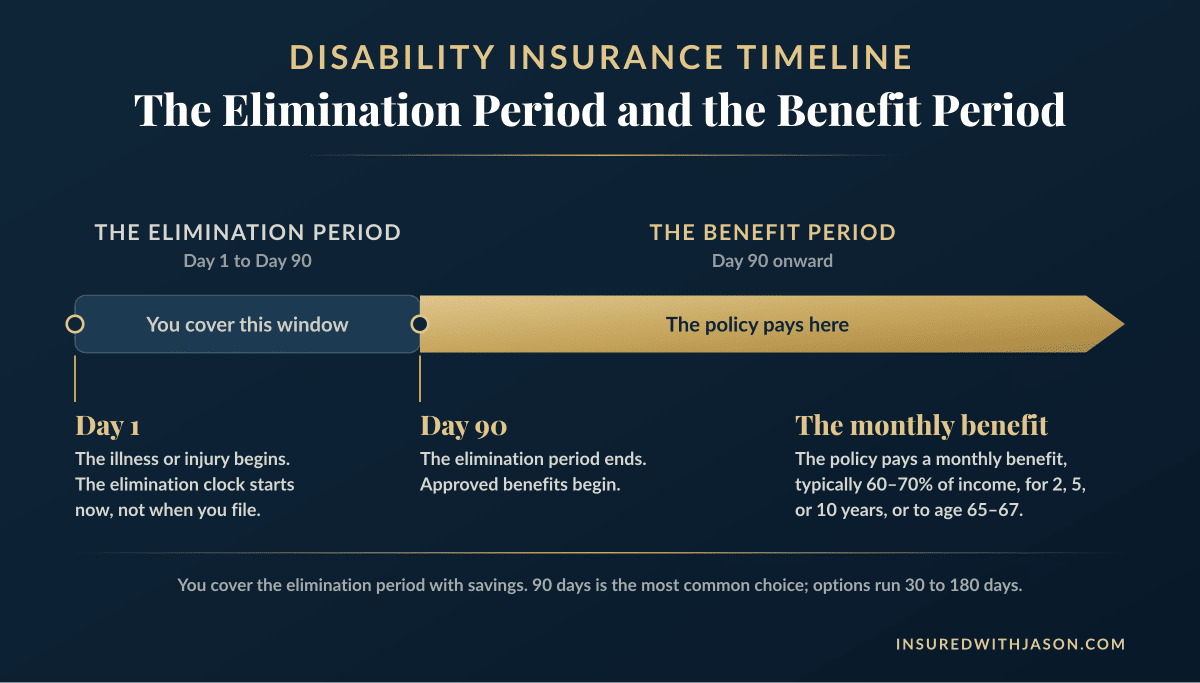
The life of a claim: you cover the elimination period with savings, then the policy pays through the benefit period.
The Types of Disability Insurance
There are two ways to sort disability insurance: by how long it pays, and by where you get it. Both decisions shape what you actually have when you need it.
Short-Term vs. Long-Term Disability Insurance
Short-term disability insurance covers temporary setbacks. Benefits on a short-term disability policy typically begin within zero to fourteen days and replace roughly 40 to 70 percent of income for three to twelve months. It’s most often offered through an employer and used for surgical recoveries, serious injuries, and maternity leave.
Long-term disability insurance is the coverage that protects your career. Here’s how long-term disability insurance works: after a 90-day elimination period in most policies, benefits pay for years, or all the way to retirement age, when a serious or permanent disability keeps you out of work for an extended period. Short-term coverage gets you through a bad season. Long-term coverage is what stands between a lasting condition and losing everything you’ve built.
| Short-term disability | Long-term disability | |
|---|---|---|
| When benefits start | 0 to 14 days after the disabling event | After the elimination period, typically 90 days |
| How long benefits last | 3 to 12 months, up to 2 years at most | 2, 5, or 10 years, or to age 65 or 67 |
| Income replaced | Roughly 40 to 70 percent | Typically 60 to 70 percent |
| Built for | Surgical recovery, injuries, maternity leave | Serious illness or injury that keeps you out of work for years |
Typical policy designs; exact terms vary by carrier and contract.
Group Coverage vs. an Individual Policy
Where you get it matters just as much. Many employers offer group coverage as a benefit, and it’s easy to get and often inexpensive, but it comes with real limits. A long-term group disability plan usually pays a percentage of base salary only, so bonuses and commissions don’t count, and the benefit is capped at a fixed monthly maximum. If your employer pays the premium, the benefits are taxable when you need them. And the coverage ends when the job does. Leave, get laid off, or change companies, and the protection stays behind. And don’t assume you have it in the first place: Census data shows only about 31 percent of private-industry workers have long-term disability coverage through their job at all.
An individual policy works the other way around. You own it, so it follows you through every job and career change. You choose the benefit amount, the elimination period, the benefit period, and the definition of disability. And when you pay the premiums with after-tax dollars, the benefits generally arrive tax-free.
| Individual coverage (you own it) | Group coverage (through work) | |
|---|---|---|
| Who owns it | You | Your employer |
| Portability | Follows you through every job | Ends when the job ends |
| Income covered | Up to 60 to 70 percent of total income, including variable pay | A percentage of base salary, capped at a monthly maximum; bonuses and commissions usually excluded |
| Tax on benefits | Generally tax-free when you pay with after-tax dollars | Taxable if the employer pays the premium |
Tax treatment per IRS rules on disability insurance proceeds; see the taxes section below.
Who Needs Disability Insurance?
Anyone whose household runs on a paycheck. That includes professionals whose income depends on specialized skills, tradespeople whose income depends on their body, self-employed people with no employer plan behind them, single-income families, and anyone without at least six months of savings to bridge a long stretch out of work. If that describes your house, you likely need disability coverage, and the best time to set it up is while you’re healthy.
The risk is also far bigger than most of us believe. LIMRA research finds that half of all employees put their own odds of a disability at 10 percent or less. The Social Security Administration puts the real number near 25 percent, and the rest of the data backs it up.
An illness or accident will keep about 1 in 5 workers out of work for a year or more before age 65, and at age 42, a worker is four times more likely to become seriously disabled than to die during their working years.
Sources: Social Security Administration · Council for Disability Awareness
And the claims data doesn’t look the way most people picture it. Musculoskeletal disorders such as back pain, degenerative disc disease, and arthritis lead the list at roughly 26 percent of long-term claims. Cancer follows at about 15 percent, injuries at 11 percent, and mental health and heart conditions sit close behind at around 9 percent each. Accidents cause fewer than 10 percent of long-term disability claims. These are the conditions a doctor brings up at a routine checkup, and they can develop in any line of work, at a desk or on a job site.
The duration surprises people just as much as the causes. A typical 35-year-old has a 24 to 38 percent chance of being disabled for three months or longer during their working career, and the average disability for that profile lasts 82 months. That’s nearly seven years of bills arriving on schedule while the paycheck doesn’t. (Council for Disability Awareness)
I can tell you from my own life how fast this goes from a statistic to your reality. I had a strong six-figure career and no reason to think it could end. It ended in a single moment, and the income ended with it. I’ll share that story a little further down.
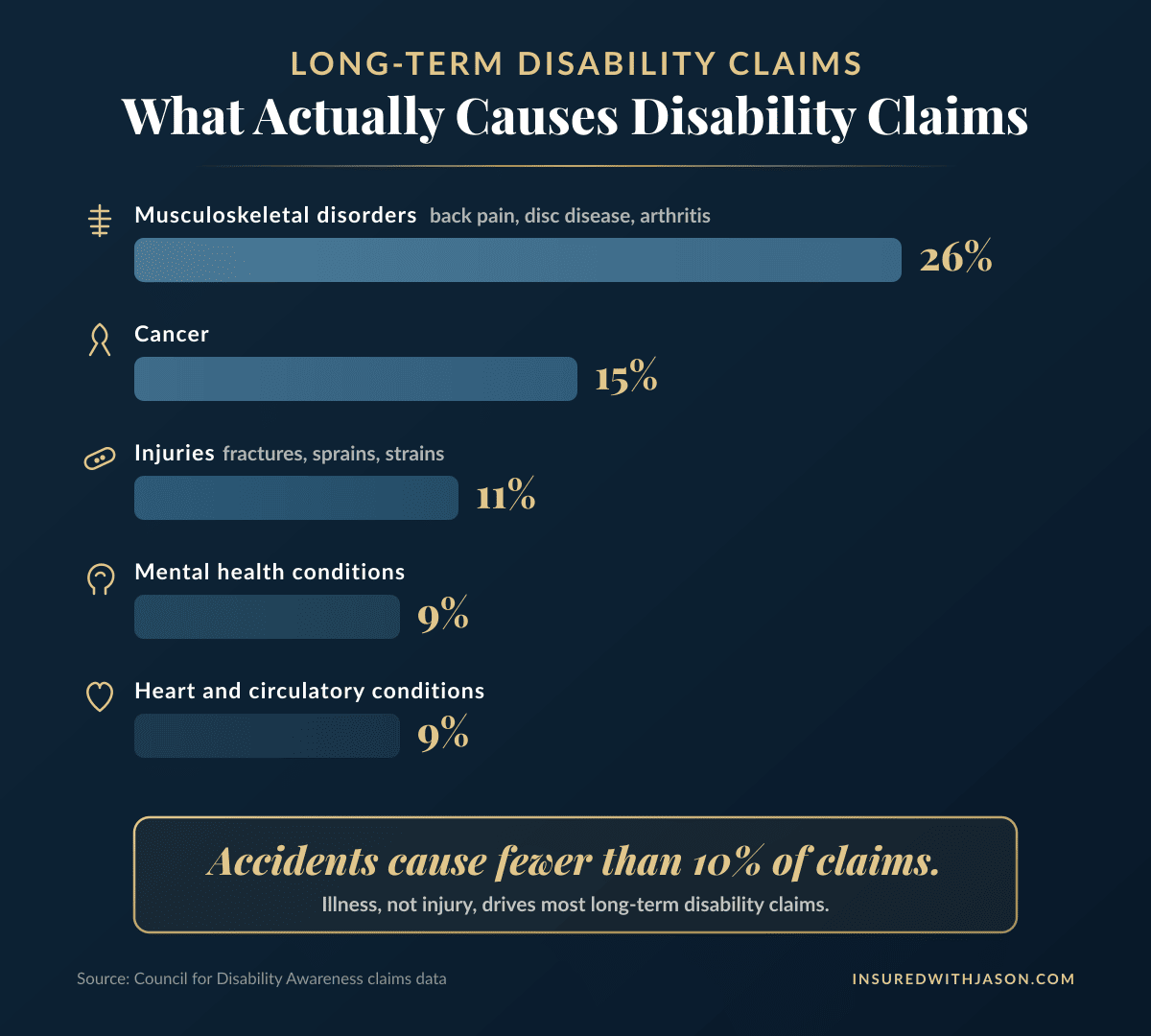
Accidents cause fewer than 10 percent of claims. The conditions that actually take people out of work are illnesses.
Own-Occupation vs. Any-Occupation: The Definition That Decides Your Claim
The definition of disability is the most important sentence in any disability insurance policy, because it sets the test your claim has to pass.
Own-occupation is the stronger definition. You’re considered disabled if you can’t perform the main duties of your own job, the one you held when the disability began. A surgeon who develops a hand tremor can no longer operate. Under an own-occupation policy, she’s disabled and her disability benefit is paid, even if she goes on to teach or consult in a different role.
Any-occupation is the stricter test. You’re only considered disabled if you can’t do any job you’re reasonably suited for by education, training, and experience. That same surgeon could be denied, because she can still work in some capacity, even at a fraction of her former income.
There’s also a middle option. Transitional own-occupation pays when you can’t do your own job, but reduces the benefit if new earnings would push your total income above what you made before.
Own-occupation costs more, and for anyone whose income depends on specific skills, it’s often worth every dollar. On a long-term disability policy, the cheaper definition saves money on the premium and gives up certainty at the exact moment you’d need it most.
Many employer long-term disability plans pay under an own-occupation standard for the first 24 months of a claim, then switch to the any-occupation standard.
At the two-year mark the insurer re-evaluates whether you can do any job at all, and benefits can end even if you can never return to your real career. Most people don’t learn this is in their plan until it happens.
How Much Disability Insurance Do You Need?
Aim for a monthly benefit of 60 to 70 percent of your gross income. That’s also the most carriers will issue. Because benefits from a policy you pay for yourself are generally tax-free, 60 to 70 percent of gross pay lands close to your normal take-home pay, which is generally enough to maintain your standard of living. Insurers stop there on purpose: a benefit that fully replaced your income would remove the financial reason to recover and return to work, so no carrier offers one.
To find your personal floor, add up the monthly bills that don’t pause when you’re unable to earn: housing, utilities, food, transportation, insurance premiums, and minimum debt payments. That total is the least your benefit needs to cover. If you have a disability insurance plan at work, subtract what it would actually pay, and the gap that remains is what a private policy needs to fill.
Want your number?
Tell me about your work and your bills · No pressure · A real answer
How Much Does Disability Insurance Cost?
Plan on roughly 1 to 3 percent of your annual income per year. That’s a general estimate, not a quote, but it’s a reliable place to start. For someone earning $100,000, that works out to about $1,000 to $3,000 a year, or roughly $83 to $250 a month, for the coverage that protects all of it.
| Annual income | Estimated annual premium | Estimated monthly premium |
|---|---|---|
| $30,000 | $300 – $900 | $25 – $75 |
| $50,000 | $500 – $1,500 | $42 – $125 |
| $100,000 | $1,000 – $3,000 | $83 – $250 |
| $150,000 | $1,500 – $4,500 | $125 – $375 |
| $200,000 | $2,000 – $6,000 | $167 – $500 |
Estimates based on the typical 1 to 3 percent of income range. Actual premiums vary by age, health, occupation, and policy design.
Several factors set the actual price of disability insurance policies:
- Age. Younger applicants lock in lower rates, and rates climb as you wait.
- Health history. Pre-existing conditions can mean higher premiums, exclusions, or a modified offer.
- Occupation. Carriers price by the risk of the work itself, so more physical jobs generally cost more to insure.
- Benefit amount. A bigger monthly benefit costs more.
- Elimination period. Waiting longer for benefits to start lowers the premium.
- Benefit period. Coverage to age 65 costs more than a five-year benefit, and protects far more.
- Tobacco use. Smokers pay meaningfully more for the same coverage.
Common riders on disability insurance include three you’ll see on nearly every quote. A residual disability rider pays a partial benefit when you can still work but your income drops, in proportion to your loss of income. A cost-of-living adjustment rider, or COLA, raises your benefit each year during a long claim to keep pace with inflation. And a future increase option lets you raise your coverage as your income grows, without new medical underwriting.
Private Disability Insurance vs. Social Security Disability Insurance
Social Security Disability Insurance, or SSDI, is the federal program working people fund through payroll taxes, and it’s a genuine safety net for those who qualify. It’s also worth understanding exactly what it does and doesn’t do before counting on it as your plan.
The qualification standard is strict. To be approved, you must be unable to perform any substantial work, and your condition must have lasted, or be expected to last, at least twelve months or be expected to result in death. There’s a mandatory five-month waiting period before benefits can begin. Roughly a third of initial applications are approved, and a denied claim moves into reconsideration and hearings, a process that can stretch a year or more.
The benefit itself is modest. The Social Security Administration projects the average monthly SSDI payment at about $1,630 for 2026, with a maximum of $4,152 for workers with long, high-earning careers. For someone earning $70,000 a year, the average benefit would replace roughly a quarter of their income, a number that may fall well short of the bills it needs to cover.
A handful of states also run mandatory short-term disability programs that replace part of a paycheck for a limited number of weeks. They’re a bridge for temporary setbacks, not long-term income protection.
Private disability insurance works from the opposite direction. You choose the benefit amount, the waiting period, and the definition of disability, and the approval work happens at application, while you’re healthy, instead of after you’re hurt. The two can work together: SSDI as the public floor, and a private policy as the protection you actually planned.
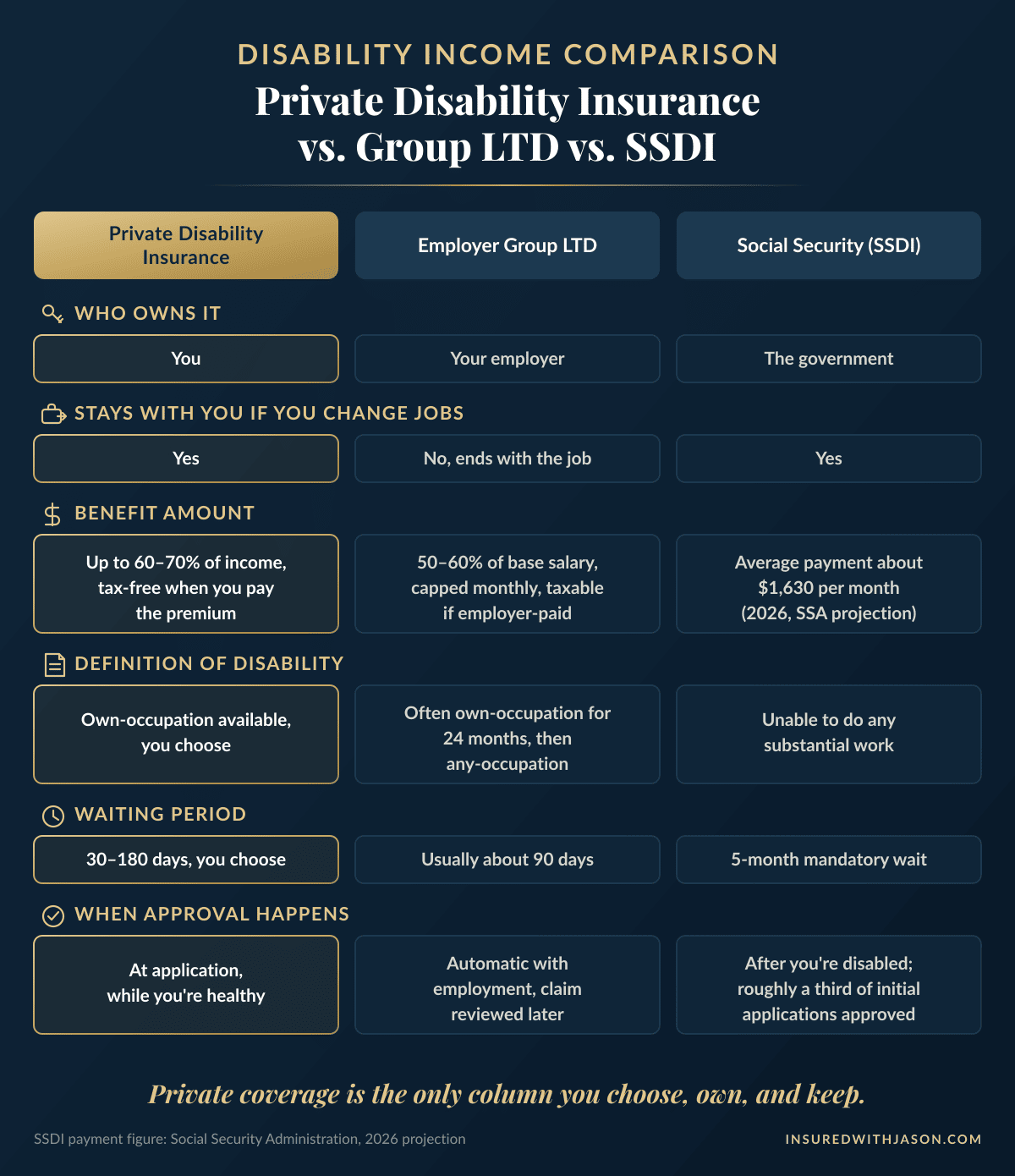
Three sources of disability income, side by side. Only one of them is owned, chosen, and kept by you.
Disability Insurance for the Self-Employed and Business Owners
If you work for yourself, there’s no employer plan in the background. The whole job of protecting your income is yours, and so is the freedom to do it right. Disability insurance can help you build that protection on your own terms, with coverage that fits the way you actually earn.
Self-employed buyers usually need two answers. An individual disability policy protects the household: it replaces your personal income so the mortgage and the groceries are covered. A business overhead expense policy, or BOE, protects the business: it reimburses fixed costs like rent, utilities, and employee payroll while you’re unable to work, so the company you built is still standing when you’re ready to come back. BOE premiums are generally deductible as a business expense, and the benefits are taxable to the business.
How Are Disability Insurance Benefits Taxed?
One clean rule covers almost every case: whoever pays the premium, and with what kind of dollars, decides how the benefit is taxed.
Pay the premiums yourself with after-tax dollars, the way an individual policy normally works, and the disability insurance benefits you receive are generally tax-free. If your employer pays the premium, or you pay it with pre-tax dollars through work, the benefits are taxable as ordinary income. Split arrangements get split treatment. The IRS spells out the rules in plain terms.
| Who pays the premium | How the benefit is taxed |
|---|---|
| You, with after-tax dollars | Generally tax-free |
| Your employer, or you with pre-tax dollars | Taxable as ordinary income |
| Split between you and your employer | Split in proportion: the employer-funded share is taxable, your after-tax share is not |
Per IRS rules on disability insurance proceeds. One note on SSDI: those benefits may be taxable, at least in part, depending on your total household income.
How to Get Disability Insurance
Getting covered comes down to seven steps, and a good broker carries most of the weight.
- 1Your NumberFigure your monthly benefit need
Add up your fixed bills, compare the total to 60 to 70 percent of your gross income, and note any gap your group coverage at work would leave.
- 2The WaitChoose your elimination period
Match it to your savings. If you can cover 90 days of expenses, the 90-day wait usually offers the best balance of price and protection.
- 3The DurationChoose your benefit period
Coverage to age 65 or 67 protects against the worst case: a condition that ends a career, not just a season.
- 4The LanguageAsk for the own-occupation definition
Especially if your income depends on specialized skills, this is the language to insist on.
- 5Shop The MarketCompare carriers through an independent broker
Underwriting standards, occupation classes, and rider options differ from one insurance carrier to the next, and a broker shops them all so the policy fits you, not the other way around.
- 6The ReviewComplete underwriting
Expect health questions, permission to review medical records, sometimes a brief exam, and income verification. Pre-existing conditions may bring an exclusion or a modified offer rather than a decline.
- 7Lock It InReview the policy at delivery
Confirm the definition of disability, the benefit amount, the elimination and benefit periods, and any exclusions. Most states give you a free-look period, typically 10 to 30 days, to return the policy for a full refund.
My mother has multiple sclerosis. I watched the disease take her strength a little at a time, until it took her occupation, and then her ability to do any work at all.
My turn at losing my income came without warning. I had a fantastic career as a locomotive engineer, doing work that I loved for a very respectable six-figure income. One day, heading south to New York City, a tree was down across both tracks, and it destroyed the locomotive, my back, and my career.
The income stopped that day. No notice, no safety net, no help on the way. In the four years since, every dollar I’ve earned is one I generated myself, while my body keeps teaching me new limits each time I try to rebuild.
I’m not telling you this for sympathy. I’m telling you because I know now what I didn’t know then: this is protection you can only buy while you’re healthy. If you have the means and it’s been on your mind, look into it now. Your independence, your family, and your future self are all on the line.
Key disability insurance terms, explained
Disability insurance: frequently asked questions
The questions people ask me most, answered plainly.
When do long-term disability benefits start?+
After the elimination period ends, typically 90 days from the date of the disabling event, and once the claim is approved. The first check often arrives about a month after that, so plan on bridging roughly 120 days with savings.
Can I get disability insurance with a pre-existing condition?+
Often, yes. Underwriters may approve as applied, approve with a higher premium or a shorter benefit period, or attach an exclusion rider that carves the specific condition out of coverage. Severe conditions can be declined, which is one more reason to apply while you’re healthy. Group plans at work usually don’t underwrite individual members, so they may cover pre-existing conditions up to plan limits.
Is disability insurance worth it?+
For most working people, the math is hard to argue with. About 1 in 4 workers will face a disability before retirement, and coverage typically costs 1 to 3 percent of income per year. The real question is whether your savings, your spouse’s income, and any group coverage could pay your household’s bills for years without your paycheck. If the answer is no, the protection disability insurance provides may be one of the most useful things you ever buy.
Can I have more than one disability insurance policy?+
Yes. Many people hold two insurance policies at once, layering an individual policy on top of group coverage at work. Carriers coordinate benefits so your combined coverage stays near their limits, usually around 70 to 80 percent of income, which is why applications ask about existing policies.
What’s the difference between disability insurance and workers’ compensation?+
Workers’ compensation only covers what happens on the job. Disability insurance covers an injury or illness no matter where or how it happens, on the clock or off.
Does disability insurance cover mental health conditions?+
Generally, yes. Mental health conditions are among the leading causes of long-term claims. Be aware that many group plans, and some individual policies, cap mental health benefits at 24 months even when the condition continues, so it pays to read that section of the contract before you buy.
Does disability insurance cover pregnancy?+
Short-term disability commonly covers recovery from delivery and complications of pregnancy. If you apply while already pregnant, the pregnancy is usually treated as a pre-existing condition, so the time to set up coverage is before you need it.
What is high-limit disability insurance?+
Coverage for high earners whose income runs past standard carrier caps, written through specialty markets to push the total benefit closer to the 60 to 70 percent target.
Let’s put real numbers on protecting your income
You now have the full picture: what disability insurance does, what it costs, how much to get, and the one sentence in the policy that matters most. The next step is to put real numbers on it. Tell me about your work, your income, and your budget, and I’ll shop the market and show you exactly what protecting your paycheck would cost. No pressure and no obligation, just numbers you can decide with.
This article is for educational purposes only and is not legal, tax, or financial advice. Coverage availability, policy terms, and premiums vary by state, carrier, and individual circumstances. Statistics are drawn from sources believed reliable as of the publication date. Please speak with a licensed professional about your specific situation before making a decision.
Shopped for your exact job