
Burial Insurance for Parents: How to Buy a Policy for Your Mom or Dad
The complete guide for the son or daughter doing the buying: the consent rules, the costs by age, who controls the policy, and how to set it up right.

- Yes, you can buy a policy on your mom or dad. Two things make it legal: insurable interest, which a child automatically has in a parent, and your parent’s consent. They know, they agree, they sign.
- You can own it, pay for it, and be the beneficiary, or your parent can own their own policy with you as their guide. Either way, the premiums draft straight from the payer’s bank account. Both setups are normal, and insurance companies handle them every day.
- The owner controls the policy. Full stop. If you own the policy, nobody can change the beneficiary, cancel it, or let it quietly disappear. Not a sibling, and not the parent, because control belongs to the owner under the contract itself.
- No medical exam, ever. Most policies ask your parent a few health questions on a phone call. Some ask none at all.
- A funeral with viewing and burial runs a median of about $8,300 (National Funeral Directors Association), and that’s before the cemetery, the travel, the missed work, and the final bills that arrive after.
- The cost depends on age and health. For $10,000 of coverage on a healthy non-smoker, plan on roughly $40 to $80 a month at 60, $65 to $135 at 70, and $125 to $220 at 80. Ranges, not quotes, and locking in earlier locks in cheaper.
- Your parent has a short to-do list. Answer the health questions honestly, take one phone call, and sign. Everything else, the shopping, the paperwork, the payments, can be yours.
- Siblings have options. Split the benefit on one policy, name co-owners, or each take out a separate policy of your own. All of it works.
- Health issues? Most qualify
- Declined? Jason has next steps
- New policies up to age 85
- Fits a Social Security budget
- Free quotes, no commitment
- Just Jason, never a stranger
Your information goes to Jason. Not a call center. Not a lead list.
Families arrive at burial insurance for parents from two directions. Sometimes a parent has the money but wants their son or daughter beside them through the process. Sometimes the parent has nothing set aside, and the child decides to fund a policy so the funeral bill never becomes a family crisis.
Both paths end in the same place, a small whole life insurance policy on your mom or dad, and this guide covers both start to finish: the rules, the costs by age, and how to structure it so the right person stays in control.





Can You Buy Burial Insurance for Your Parents?
Yes, you can buy burial insurance for your parents, and sons and daughters do it every single day. The law asks for two things. First, insurable interest, which means the person buying would suffer a real loss if the insured person died. A child buying for a parent is one of the clearest cases there is, and no insurance company will question it. Second, consent. Your mom or dad has to know about the policy, agree to it, and sign the application, a requirement written directly into state insurance law. There’s no legal way around that, and honestly, you wouldn’t want one. Consent is the rule that keeps strangers from profiting off anyone’s death.
That’s the whole legal gate. Once your parent is on board, you can handle everything else yourself: the shopping, the paperwork, the payments, and the ownership of the policy. Or, if your parent is footing the bill on their own coverage, you can be the researcher and the second set of eyes while they run their own application. Both are everyday arrangements, and the rest of this guide covers both.
One quick note before we go on. This page is for the son or daughter buying coverage on a parent. If you’re a parent looking into coverage for yourself so your kids never carry this bill, our main burial insurance guide is the better starting point.
Why Adult Children Put Burial Insurance on Their Parents
Adult children buy burial insurance on their parents because a parent’s death costs far more than the funeral bill, and most of that cost lands on the kids. Start with the funeral itself. The National Funeral Directors Association’s 2023 study puts the median cost of a funeral with viewing and burial at about $8,300, with cremation services running around $6,280, and the cemetery adds more on top. Those bills arrive within days, not months.
Then comes everything the funeral home never invoices. Most employers give three to five days of bereavement leave, and only about one company in five offers more than that. Grief doesn’t fit in five days. If your work demands a clear head, and I spent years running locomotives, where it absolutely did, there will be days you simply cannot go in. Vacation time burns fast, and once it’s gone, the missed days come out of your paycheck. Meanwhile your parent’s final bills, their medical charges, and sometimes probate costs all arrive while your own rent and car payment keep coming due.
A burial insurance policy exists for exactly that collision. It puts tax-free cash in the beneficiary’s hands quickly, usually within days of the claim, so the family can handle the funeral and the aftermath without borrowing, draining savings, or passing a hat.
The typical paid bereavement leave for an immediate family member. Only about 1 in 5 companies offers more, while the bills and the paperwork of a parent’s death go on for months.
Source: International Foundation of Employee Benefit Plans
A quick look at real options, from an independent broker who shops the whole market.
What Your Parent’s Burial Policy Covers
A burial policy on your parent pays a lump sum to the beneficiary, and the beneficiary can spend it on anything the family needs. Burial insurance, also sold as final expense insurance or funeral insurance, is a small whole life insurance policy, usually between $5,000 and $30,000 of coverage. The insurance company doesn’t earmark the money or send it to the funeral home unless you arrange that. It sends a check to the person named on the policy.
In practice, families use it for the funeral and burial or cremation, the cemetery costs, leftover medical bills, small debts, travel for family, and the income the household loses while everyone steps away from work. Whatever isn’t spent stays with the beneficiary. That flexibility is the point: the money meets the moment, whatever the moment turns out to be.
The payout from a burial policy is generally income-tax-free and typically arrives within days of an approved claim.
That speed is the whole design. Final expenses come due in the first week or two, so the product is built to pay fast and let the family decide where every dollar goes.
Who You Can Buy Burial Insurance For: Your Parents, In-Laws, and Stepparents
You can buy burial insurance for your own parents outright, and covering a spouse’s parents works too, with one smart adjustment. Blood does the legal work for your own mom and dad. A child’s insurable interest in a parent is presumed, so the only requirement left is their consent.
For in-laws, think of it the way most couples actually live it. You and your spouse notice her mom is getting older with nothing set aside, and you decide together, as a household, to take care of it. The clean structure is for your spouse, the blood child, to be the owner, since their insurable interest is automatic. The premium can still come out of your joint account, and either of you can do the legwork. You might be reading this page because it landed on your to-do list, and that’s exactly how it should work: the family decides together, and the blood child signs as owner.
Stepparents sit closer to the in-law situation than the blood one. The relationship alone may not satisfy every company, and documenting real financial ties, a shared household or support you provide, strengthens the case. This is one of those spots where an independent broker earns their keep, because placing the application with the right company the first time beats a decline on your record.
And one more thing worth knowing for families with more than one child: nothing stops each sibling from taking out their own separate policy on the same parent. These are small policies. Sibling A holding a contract doesn’t void sibling B’s right to their own, because each policy stands on its own insurable interest and its own consent.
If I’m paying for the policy, who’s in control?
How a Burial Policy on Your Parent Is Set Up: You Own It, They’re Insured
Every burial policy has three roles, and they don’t have to be the same person: the owner, the insured, and the beneficiary. The insured is your parent. Their age and health set the price, and their passing is what the policy pays on. The owner is whoever controls the contract. The beneficiary is whoever receives the money. When a child buys for a parent, the most common structure is the child as owner, payor, and beneficiary, with mom or dad as the insured. Insurance companies see this every day.
Here’s the part that should put you at ease. Ownership rights are written into the policy itself, and they belong to the owner alone. The owner names the beneficiary, changes the beneficiary, keeps the policy in force, or cancels it. The insured holds none of those rights unless they’re also the owner. So if you own the policy on your mom, she cannot change the beneficiary to your sister, and your sister can’t change it to herself. Ten years of your payments stay pointed exactly where you pointed them. Whoever pays as owner is the one calling the shots, and that’s the law of the contract in every state.
The same rule cuts the other way, and it’s worth saying plainly. If your parent has the means and owns their own policy with you helping as the guide, then your parent holds the controls, including the right to change beneficiaries. Both setups are legitimate. The lesson is that control follows the owner line on the application, not the payments, so put the right name on that line the day you apply. And when a parent-owned policy needs a binding promise behind it, there’s a tool for that: naming an irrevocable beneficiary, which the owner can’t remove without that beneficiary’s written agreement.
Siblings who want to fund a policy together have two clean paths. The simple one: a single owner, the beneficiary split between the siblings, and the premium settled between yourselves each month. The guaranteed one: joint ownership, which some companies offer, where both owners hold equal rights and neither can act without the other. If trust between the payers is even a question, co-ownership answers it.
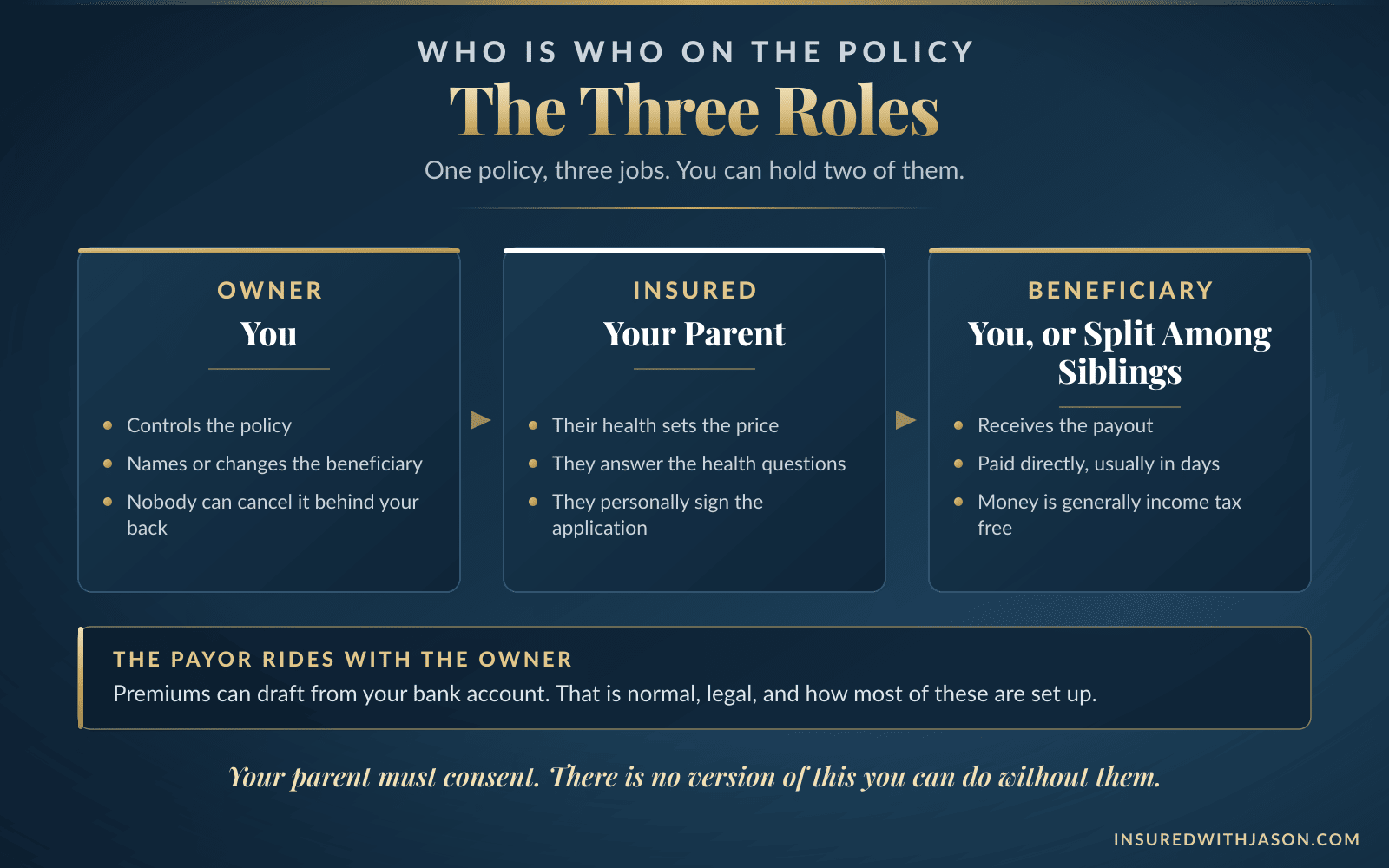
The owner controls the policy, the parent is the insured, and the beneficiary receives the money. Three roles, one structure, set at the application.
Control follows the owner line on the application, not the payments. Put the right name on that line, and the policy stays pointed exactly where you pointed it.
My sister says we’d pay in more than the policy is even worth. Is she wrong?
Say a sister does the math out loud: Mom is 70, and if she lives to 95 the premiums come to more than double the benefit. Her arithmetic is right, and here is how I think it through anyway. This isn’t a savings account anyone is trying to beat, it’s insurance against next week, and the alternative carries a price nobody prices out. Somebody puts the funeral on a credit card at around twenty percent, loses work on top of it, and then carries that debt against their own credit, their own house plans, their own child’s schooling. Run all of that to the end and my rough estimate is that the alternative lands far closer to the premium total than anyone expects, and only in the version of the story where Mom actually reaches 95.
What would change my answer: real savings sitting there that would cover the whole cost without touching anyone else’s finances. That’s a fair reason to skip it. The honest self-check on the other side is that the comparison assumes somebody sets that same premium aside every month for twenty-five years and never touches it, and that habit would usually already be in place if it were going to be.
What Your Parent Has to Do to Get Covered
Your parent’s to-do list is short, but it can’t be delegated: agree, answer the health questions, and sign. No matter who shops for the policy or who pays for it, the insured person has to provide their own information, their legal name, date of birth, and Social Security number, personally answer the health questions on most policies, and sign the application themselves, whether that’s an e-signature or a voice signature on a recorded call.
In real life, this is cooperation, not conflict. When a child is funding the policy, most parents are simply grateful, and when a parent asked their child to help in the first place, the participation is the whole point. The health questions usually happen on a short phone call with the agent or the insurance company, and here’s a detail that smooths the road for private parents: mom can answer those questions directly on the call, to the professionals, without reciting her prescription list to her kids. Her health stays her business, and the application still gets done.
Plan for the process to take one conversation and one phone call. That’s genuinely it on their end.
Different companies treat the same health profile very differently. Shopping the market is how you win.
Paying for Your Parents’ Burial Insurance When They Can’t Afford It
Nothing in the law or the underwriting requires your parent to pay for their own policy, so when they can’t afford it, you simply pay it yourself. As the owner, you list your own bank account on the application, the premium drafts automatically every month, and your parent never has to budget a dime. Insurance companies are completely comfortable with this. It’s one of the most common ways these final expense policies get funded.
If a brother or sister wants to share the cost, keep the machinery simple. One sibling owns the policy and carries the payment, and the other sends their half each month however your family already moves money. The insurance company gets one clean payment from one account, and your family settles the rest at the kitchen table. And as covered above, if you’d both rather have it in writing, ask about joint ownership and split the beneficiary designation down the middle.
What Happens to Your Parent’s Burial Policy If You Stop Paying
If a payment gets missed, the policy doesn’t vanish that day, because every state requires a grace period, and most set it at 30 or 31 days. That floor comes from state insurance law, not company kindness, and a few states go further, with California requiring 60 days. During the grace period the coverage stays fully in force. If the insured were to pass away inside that window, the claim still pays, minus the premium that was owed.
Let the grace period run out, though, and the policy lapses. Getting a lapsed policy back usually means paying the missed premiums and sometimes answering new health questions, and at an older age or with new health issues, reinstatement can cost real money or fail entirely. So treat the payment the way these policies are actually set up: an automatic draft from a checking account, with the insurance company holding your current address and phone number so nothing important ever goes to a dead mailbox.
One more piece of housekeeping that protects everything: ask about naming a contingent owner when you apply. If something happened to you before your parent, the policy would pass to the person you chose instead of drifting, and the coverage you built for your family would keep standing.
Most companies require an automatic draft from a checking account when the policy is put in place, to prevent this exact thing.
Missed bills and lengthy hospital stays are how coverage used to slip away. Somebody has a medical emergency, then rehab, and the payment gets forgotten at exactly the worst time. The auto-draft solved it: the policy pays itself every month, whether anyone is thinking about it or not.
What will a policy on my mom or dad actually cost?
Burial Insurance Costs for Parents Over 60, 70, and 80
For $10,000 of coverage on a healthy non-smoker, expect roughly $40 to $80 a month for a parent at 60, $65 to $135 at 70, and $125 to $220 at 80. Those are market ranges, not quotes, and your parent’s actual premium depends on their age, gender, health, tobacco use, and the company. Women pay noticeably less than men at every age. Coverage amounts on these final expense policies typically run from $1,000 up to $50,000, and most companies issue new policies up to age 85, with a handful going higher.
How much is burial insurance for parents each month?
Here’s the fuller picture for a healthy non-smoking parent with $10,000 of coverage: about $25 to $50 a month at 50, $40 to $80 at 60, $50 to $100 at 65, $65 to $135 at 70, $90 to $175 at 75, and $125 to $260 across the 80 to 85 range. Read that list again and you’ll see the honest urgency in it. The same policy costs roughly two and a half times more at 70 than at 50, because the rate locks to your parent’s age the day the policy starts, and it never rises after that. Every birthday you wait is a permanently higher price.
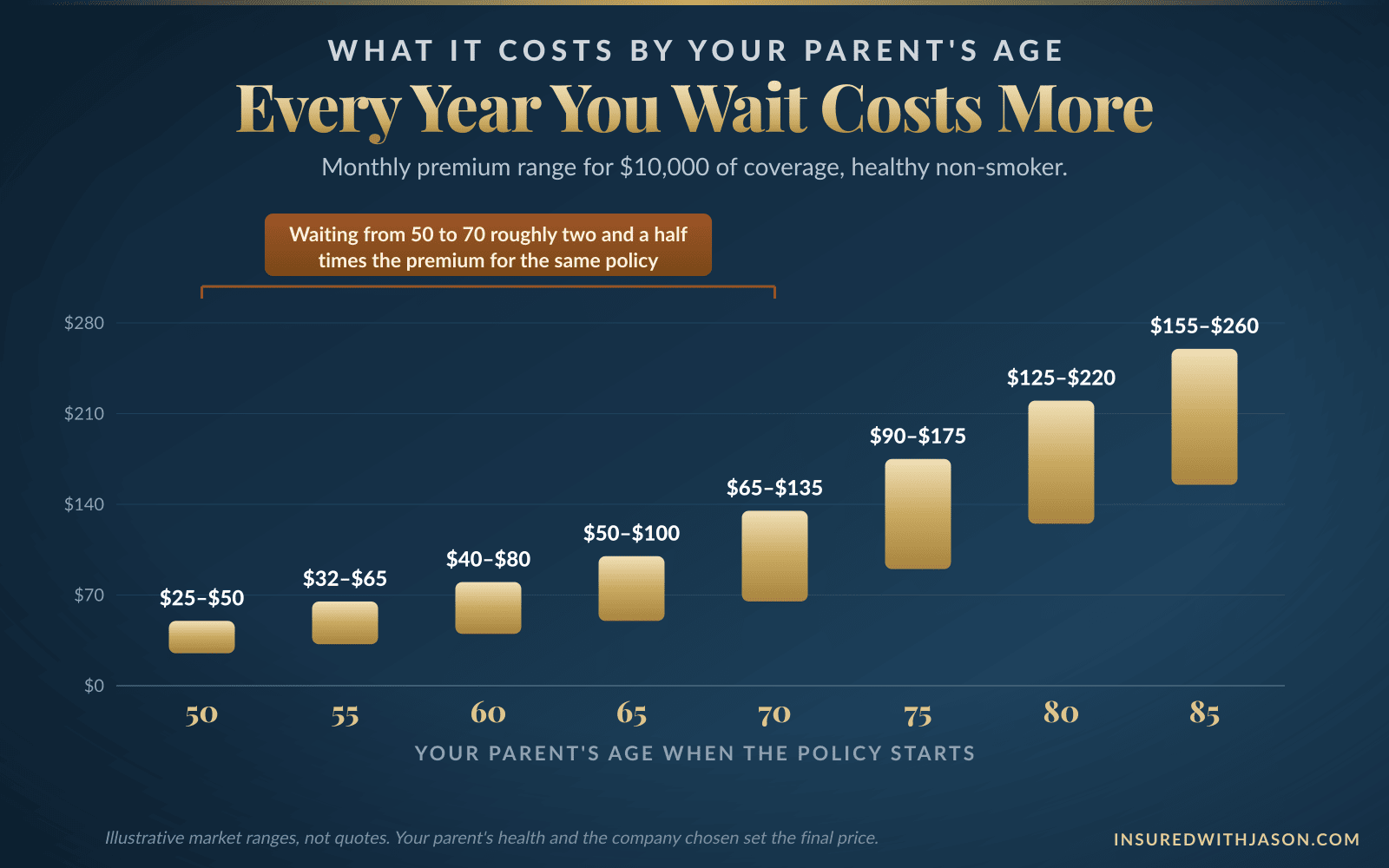
Monthly premium ranges for $10,000 of coverage on a healthy non-smoker. The rate locks at your parent’s age on day one and never rises.
The four types of burial insurance your parent could land in
Age is only half the price. The other half is who qualifies for final expense insurance at which tier, and this is the most underreported cost driver in the whole category. There are four tiers. Level benefit is the healthiest tier: a short health questionnaire, the full benefit from day one, and the lowest price. Graded benefit takes milder health questions and pays a growing share of the benefit over the first two years, commonly around 30 to 40 percent in year one and 70 to 80 percent in year two, before the full amount after that. Modified benefit works on a similar graduated schedule for more serious or recent conditions. And guaranteed issue life insurance asks no health questions at all, accepts everyone in the age range, and charges the most, with a full two-year waiting period as the trade-off.
Here’s the part most people skip, and it changes everything about how you shop. The same 72-year-old with controlled diabetes can land in level pricing at one insurance company and graded at another, because every company scores health differently. The difference between tiers at the same age and coverage amount can top 50 percent. One insurance company’s answer is never the market’s answer, and that’s exactly why an independent broker compares them all before your parent applies anywhere.
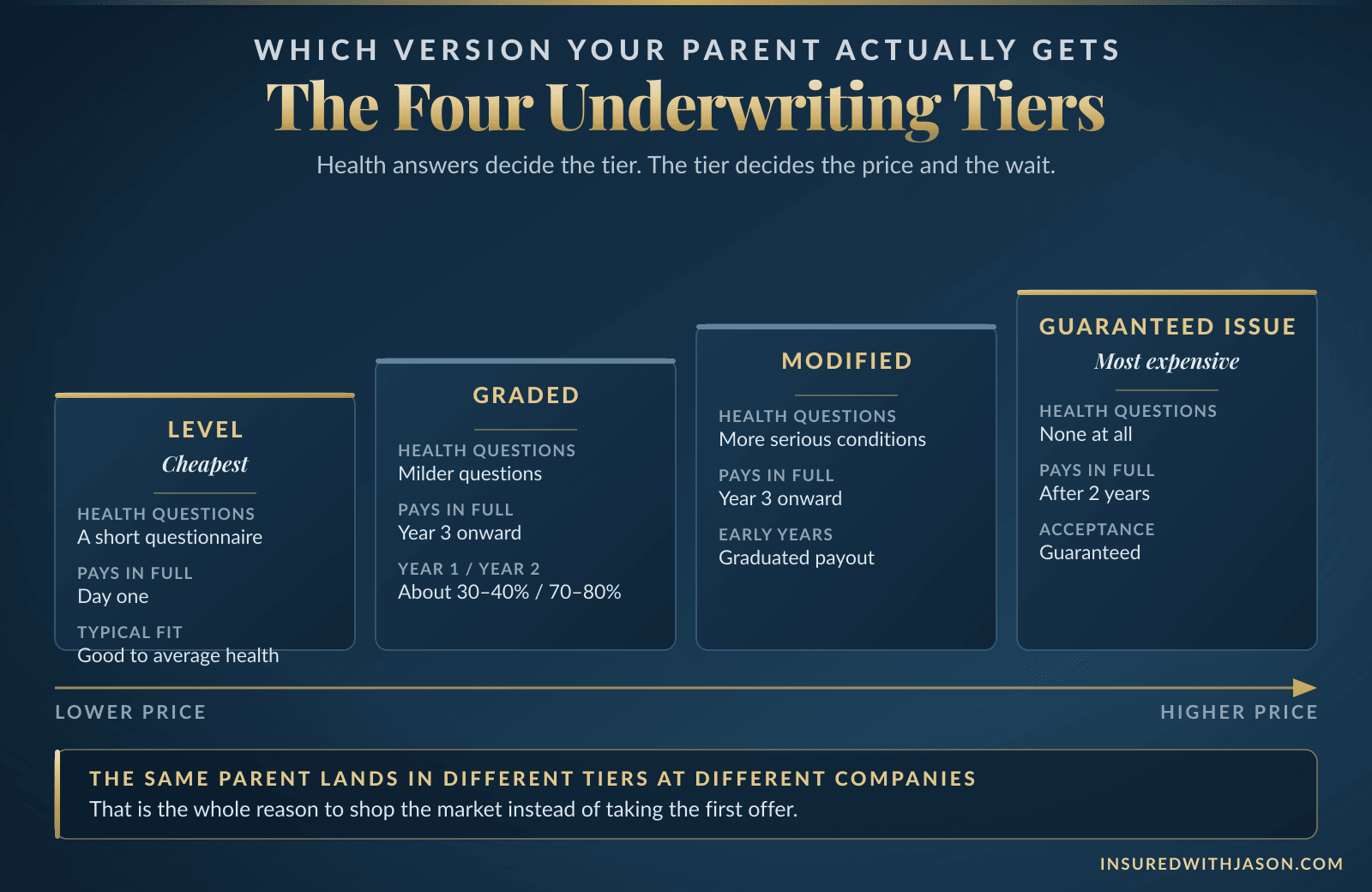
Four tiers, one product. The tier your parent lands in drives the price as much as their age does, and it varies by company.
The two-year waiting period, explained honestly
Let’s clear up the scariest phrase in this market. A waiting period means that for the first two years of a graded or guaranteed issue policy, a death from natural causes doesn’t pay the full benefit. On guaranteed issue, the beneficiary instead receives all the premiums back, often with interest added. And there is no such thing as a policy with no health questions and no waiting period. Any pitch claiming both at once is describing something that doesn’t exist, and you should walk away from it.
But here’s the detail almost nobody tells families, and it takes real weight off: accidental death typically pays the full benefit from day one, even during the waiting period. The waiting period applies to natural causes. If your parent is healthy enough to answer health questions, a simplified issue policy skips the waiting period entirely, full coverage from the first day, at a lower price. Guaranteed issue is the right tool only when health rules everything else out, which is exactly what the comparison below shows.
| Simplified issue | Guaranteed issue | |
|---|---|---|
| Health questions | Yes, a short questionnaire | None at all |
| Medical exam | Never required | Never required |
| Waiting period | None if approved | Always 2 years for natural causes |
| Accidental death in first 2 years | Full benefit (no waiting period) | Typically full benefit from day one |
| Natural death in first 2 years | Full benefit | Refund of premiums, often plus interest |
| Typical cost for the same coverage | Lower | Higher, often 50% or more |
| Best fit | A parent who can answer health questions honestly | A parent declined elsewhere or with serious recent conditions |
Both are types of whole life insurance with premiums that never increase. Which tier a parent qualifies for varies by company, which is why the market gets shopped before anyone applies.
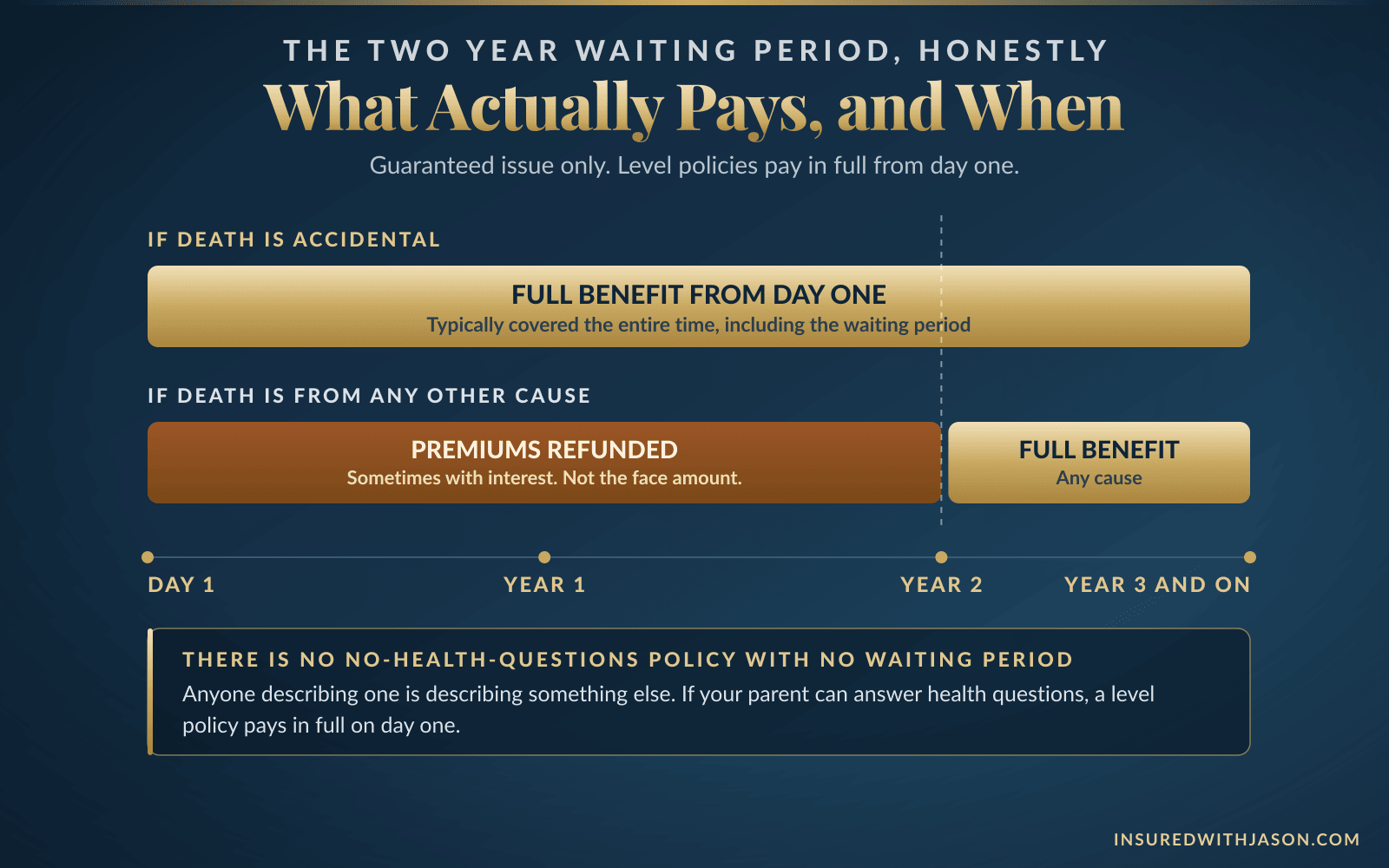
What a guaranteed issue policy actually pays and when, including the accidental-death coverage that runs at full strength from day one.
The premium is set by their age when the policy starts, and it never goes up from there.
How to Buy Burial Insurance for Your Parents, Step by Step
Buying a policy on your mom or dad is a one-conversation, one-phone-call process, and here’s the whole road from start to in force. Most families finish it inside a week, and the heaviest lift is the first step, which costs nothing but a little courage.
From the first conversation to a policy in force
Your parent’s required moments are steps 4 and 5. Everything else can be yours.
- 1Start HereTalk with your parent and agree on the plan
Their consent is the legal foundation. Decide together who will own the policy and who the beneficiary will be.
- 2GatherCollect your parent’s basic information
Legal name, date of birth, Social Security number, and a general sense of their health and medications.
- 3ShopCompare the market with an independent broker
The goal is the company that treats your parent’s age and health as its lowest risk, for day-one coverage at the best rate available.
- 4Their MomentYour parent answers the health questions
Usually a short recorded phone call. They can speak with the agent directly, and their answers stay between them and the professionals.
- 5Their SignatureYour parent signs the application
E-signature or voice signature. This one can’t be delegated, no matter who owns or pays.
- 6In ForceSet up autopay and confirm the beneficiary
Premiums draft from the owner’s account, the beneficiary is confirmed in writing, and the policy is working from that day forward.
Approval on these policies is fast. Many companies give a decision the same day, sometimes on the very phone call where the health questions are answered. Once it’s issued, read the policy during the free-look period, the window after delivery when you can cancel for a full refund, and confirm the coverage matches what was sold. Then file it somewhere your family can find it, tell the beneficiary it exists, and let it do its quiet work.
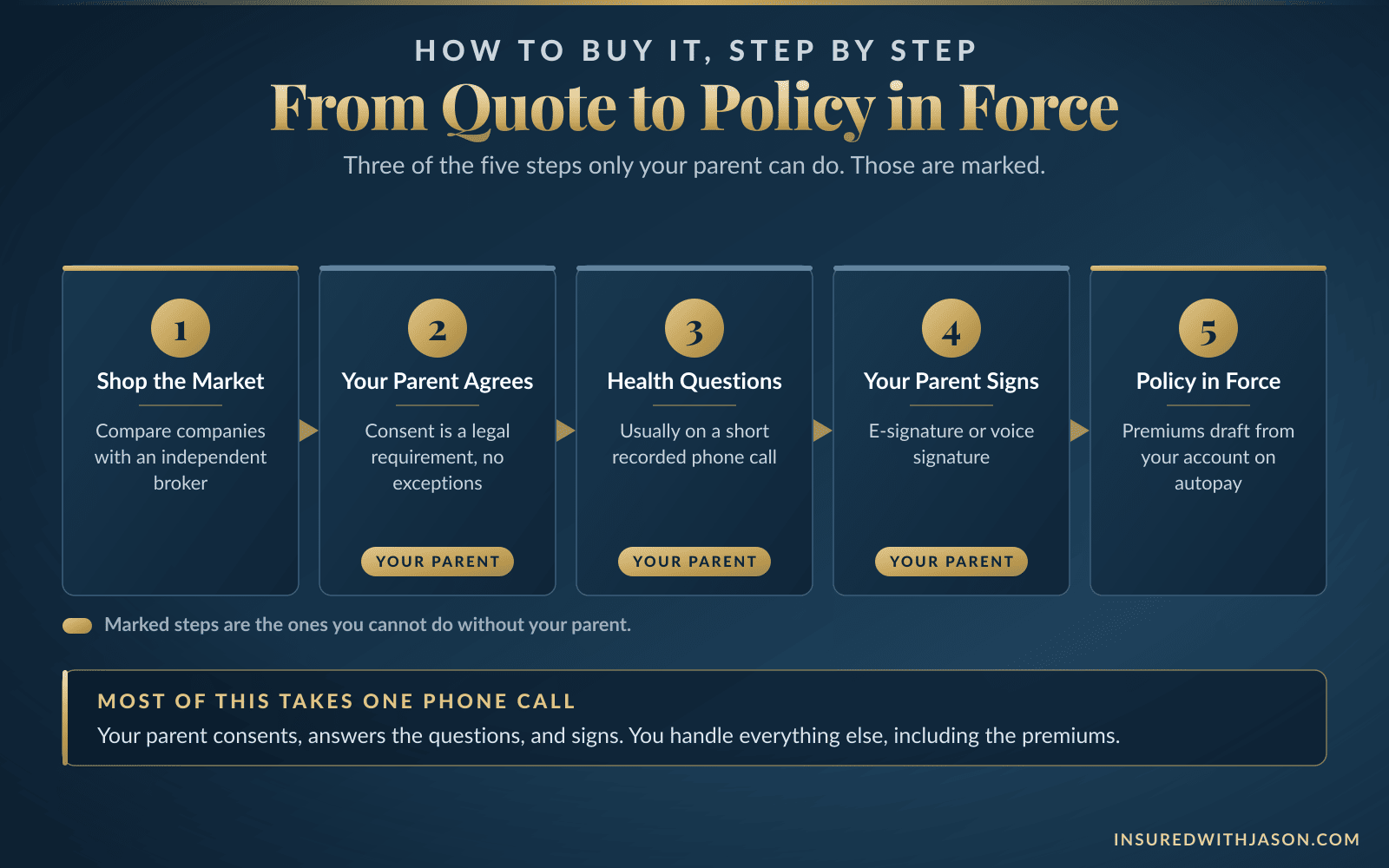
The whole process from shopping to in force, with your parent’s two required moments marked along the way.
Takes about a minute, and your information goes to Jason, not a call center.
How to Talk to Your Mom or Dad About Burial Insurance
The easiest way to talk to your parents about burial insurance is to lead with what it does for the family, not with the subject of death. Something as plain as this works: “I want to make sure that when the day comes, none of us are scrambling over money while we’re grieving. I’ll handle the whole thing. I just need you with me on one phone call.” Most parents hear that for what it is, an act of love, and many are quietly relieved someone finally brought it up. If money is tight for them, make clear it costs them nothing. If they have the means and want to own it themselves, even better: walk the road together and be the guide.
And if your parent isn’t willing? Then the honest answer is that it can’t happen yet, because no one can be insured without their consent, and pushing rarely helps. Let it rest, revisit it gently when the moment is better, and remember that the conversation usually gets easier once a parent understands the policy protects their kids, not the insurance company.
Burial insurance for parents: frequently asked questions
The questions sons and daughters ask me most, answered plainly.
Can I buy burial insurance on my parent without them knowing? +
No. Insurable interest alone is not enough. Your parent must know about the policy, consent to it, and sign the application themselves, and that is a legal requirement in every state, not a company preference.
Do I have to be the beneficiary if I’m the one paying? +
No. Ownership, payment, and the beneficiary are three separate designations. The most common setup has the paying child as both owner and beneficiary, but you can name a sibling, split the benefit among family, or point it anywhere the owner chooses.
Can my parent change the beneficiary if I own the policy? +
No. Only the policy owner can change the beneficiary. If you own the policy on your mom or dad, the beneficiary you named stays put unless you change it, no matter who asks.
What happens if my parent dies during the two-year waiting period? +
On a guaranteed issue policy, a death from natural causes during the first two years pays back all the premiums, often with interest, instead of the full benefit. Accidental death typically pays the full benefit from day one. Simplified issue policies have no waiting period at all if approved.
Can I buy a policy on my mother-in-law or father-in-law? +
Usually yes, with the right structure. The cleanest path is for your spouse, the blood child, to be the owner, since their insurable interest in their own parent is automatic. The household can still fund the premium together and handle the process together.
What if I stop paying the premiums? +
State law gives you a grace period after a missed payment, most commonly 30 or 31 days, during which the coverage stays in force. After that the policy lapses, and reinstating it usually means paying the missed premiums and sometimes answering new health questions. Autopay from a current account prevents the whole problem.
Will my parent need a medical exam? +
No. Burial insurance never requires a medical exam at any tier. Most policies ask a short set of health questions, and guaranteed issue policies ask none at all.
A burial insurance policy saved my financial life at thirty, and I was the last person who should have needed it.
When my dad died, I was earning good money with very little debt, and I still got caught flat-footed. I couldn’t work for a month. My vacation time was gone by February, the paychecks stopped, and the bills didn’t: his medical bills, probate, my rent, my car payment, all at once, during the weeks I could barely think straight. My dad had taken out a policy on himself, and it caught me like an airbag in a high-speed collision. I never should have needed it. I did.
That’s why this page exists. Life doesn’t move in smooth lines, and the moment you need the money most is exactly the moment you’re least able to go earn it. If you’re looking into a policy for your mom or dad, you’re doing for your family what my father did for mine, and I’d be honored to help you do it right.
Let’s find the right policy for your mom or dad
Whichever direction brought you here, a parent who asked for your help or a parent you’ve decided to protect, you now know how this works better than most agents will assume you do. The next step takes about a minute: tell me your parent’s age and the coverage you have in mind, and I’ll shop the whole market for the company that treats their health best. Their rate locks at their age today, and it never goes up from there.
This article is for educational purposes only and is not legal, tax, or financial advice. Coverage, costs, and rules for life insurance plans vary by person, company, and state. Please speak with a licensed professional about your specific situation before making a decision.
Takes about a minute