
Final Expense Eligibility and Qualifications; Who Senior Life Insurance Is For
Age, citizenship, Social Security numbers, and how you pay: the plain-English rules for who can buy burial insurance in the United States.

- Nearly every adult living in the United States has a realistic path to final expense coverage. The product was built to be easier to get than traditional life insurance.
- Most carriers issue policies between ages 50 and 85. Some accept applicants younger, and a few products reach age 90.
- You do not have to be a U.S. citizen. Green card holders are generally treated like citizens, and some carriers accept an ITIN in place of a Social Security number.
- You must live in the United States and be here when you apply.
- Most carriers want premiums paid from a checking or savings account. This is the requirement that surprises people most.
- Gender affects your price, never your eligibility. Women typically pay a little less because they live longer on average.
- Health rarely shuts the door. Guaranteed acceptance policies exist for exactly that reason.
- A true denial is rare. What most people call a denial was actually an approval with a waiting period.
- Health issues? Most qualify
- Declined? Jason has next steps
- New policies up to age 85
- Fits a Social Security budget
- Free quotes, no commitment
- Just Jason, never a stranger
Your information goes to Jason. Not a call center. Not a lead list.
Most people never think about final expense eligibility until the application asks for something they didn’t expect, like a checking account number. That’s the moment a simple purchase turns confusing.
This page walks through who qualifies for burial insurance in plain English: age, citizenship, Social Security number, payment, all of it, so nothing surprises you when you’re ready to apply.





Who Is Eligible for Final Expense Insurance?
Nearly every adult living in the United States is eligible for final expense insurance in some form. This coverage was designed for people who were told no somewhere else: no medical exam, wide age windows, and a short application most people finish in one sitting. The carriers know exactly who needs a small whole life policy for end-of-life costs, and they built the product to say yes.
That doesn’t mean there are no rules. It means the rules are few, and they’re about who you are on paper, not how healthy you feel. If you know where the lines sit before you apply, you put yourself in the best position to qualify with more carriers. And the more carriers you’re likely to qualify with, the more favorable your price choices tend to be.
What Determines Eligibility for Final Expense Insurance?
Five things determine eligibility for final expense insurance: your age, your legal status in the U.S., your identification, where you live, and how you’ll pay the premium. Notice what’s not on that list as a dealbreaker: your health. Health shapes which type of policy you’re matched with and what it costs, but it almost never decides whether you can be covered at all.
The rest of this page takes those qualifications one at a time, in plain English, so you can see exactly where you stand before you ever fill out an application.
Think you can’t get covered? You probably can.
No medical exam · A real answer, fast
How Old Do You Have to Be to Get Burial Insurance?
Most burial insurance carriers issue policies between ages 50 and 85, and a few products reach age 90. Some carriers will start as young as 18 or 40, but the heart of this market is built for people 50 and up.
Inside that window, your age shapes your options. From 50 to 65, you’ll see the widest carrier selection and the lowest premiums. From 66 to 75, access stays broad, though premiums climb with each birthday. From 76 to 85, the field narrows and guaranteed acceptance policies do more of the work, often with lower coverage amounts. Past 85, choices are limited but real: a handful of products still say yes.
One thing every band shares: your rate is set by your age the day the policy starts, and it locks there for life. Waiting doesn’t make coverage cheaper. It never has.
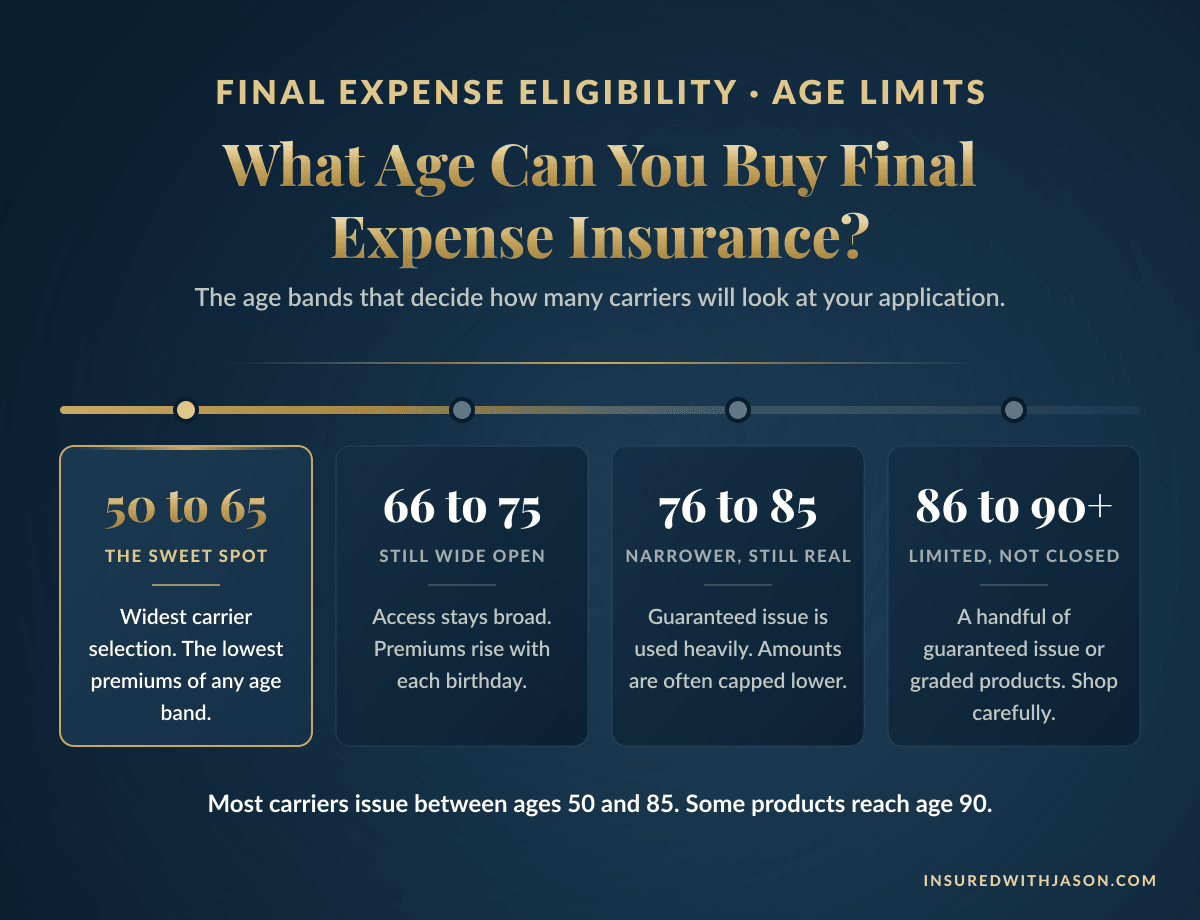
Most carriers issue between 50 and 85, and every age band inside that window still has a path.
I’m 45 and I qualify. Should I lock it in now while it’s cheap?
The price logic is real, and it’s the first thing I’d agree with: a policy bought at 45 is priced at 45 for the rest of your life. But say someone calls me at that age. The question I’d walk through isn’t whether they’d be approved, because they would be. It’s what the money is for. If it’s meant to cover the mortgage, or college, or let a spouse stay home with the kids, we’re talking about the wrong product, and term life deserves a look first.
What would change my answer: what the money is meant to do. Someone who just watched a funeral bill land on a family, and wants their own kids spared that, is looking at exactly what this policy was made for, at 45 or at 75. At 45 I usually think it’s a little early, and I say so.
Do You Have to Be a U.S. Citizen to Get Final Expense Insurance?
No, you do not have to be a U.S. citizen to get final expense insurance. Citizenship itself is not the line. What carriers look for is lawful identification and a real life here in the United States.
Green card holders are generally treated the same as citizens on a burial insurance application. Visa holders who are lawfully present can qualify too, though they may face extra documentation and a shorter list of willing carriers. In those cases, companies often weigh your ties to the U.S.: how long you’ve lived here, your work, your tax filings, and whether you intend to stay.
Even without a Social Security number, a path may still exist, which brings us to the next question.
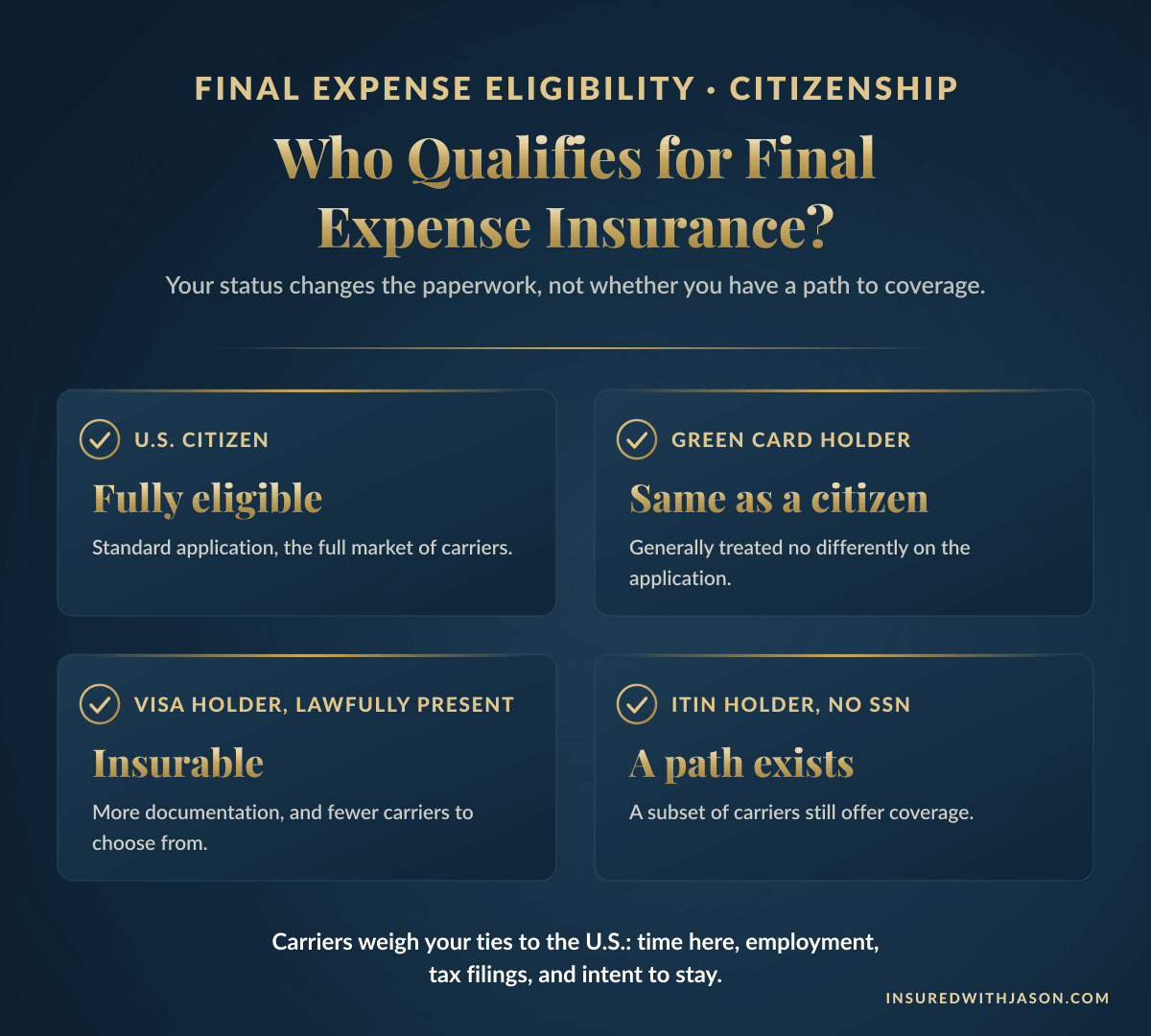
Citizens, green card holders, visa holders, and ITIN holders each have a path to coverage.
Do You Need a Social Security Number to Apply?
A Social Security number is the standard identifier on a final expense application, but it is not the only one. Carriers use your SSN to verify who you are and, later, to process the claim. It’s the default for a reason.
If you can’t get an SSN, a smaller group of carriers accept an Individual Taxpayer Identification Number (ITIN), the number the IRS issues to people who file U.S. taxes but don’t qualify for a Social Security number. Applying with an ITIN typically means showing the IRS ITIN letter, a government photo ID, a year or two of U.S. residency, proof of income or tax filings, and a U.S. bank account for the premiums. Keep filing taxes under that ITIN each year, because it helps keep the coverage in force.
The options are narrower on this path, and that’s where working with an independent broker earns its keep: knowing which companies say yes.
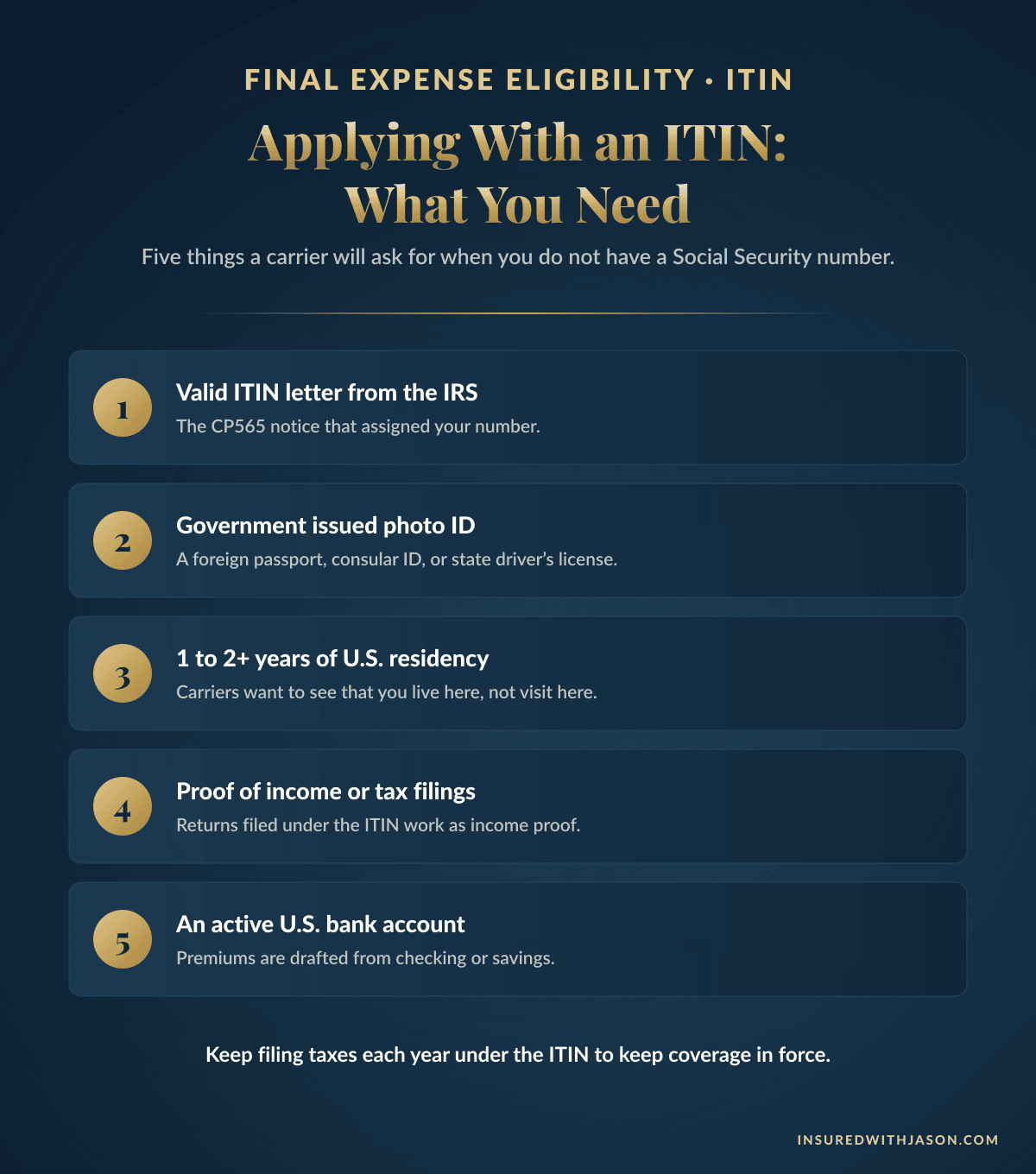
The five things an ITIN applicant needs before applying for coverage.
Do You Have to Live in the United States?
Yes. To buy final expense insurance from a U.S. carrier, you generally must be a U.S. resident, and you must be physically in the country when you apply. State insurance laws require it, and carriers verify it.
Where you live inside the country matters too. Insurance is regulated state by state, so the specific companies and products available to you depend on your state. Two neighbors across a state line can see different menus for the same coverage. That’s normal, and it’s another reason comparing the whole market beats picking the first name you see on TV.
See how much coverage you qualify for.
Most people 50–85 qualify · Find your number
Do You Need a Checking Account to Buy Burial Insurance?
For most of the good carriers, yes: premiums need to come from a checking or savings account by automatic bank draft. This is the eligibility rule that catches more people off guard than any other. Plenty of folks assume they can mail in a check each month or put the premium on a card. With most carriers, you can’t.
There’s a practical reason. Automatic bank payments keep policies from lapsing, and a lapsed policy helps no one, least of all your family. It’s a carrier practice, not a law, but it’s the standard across most of the market.
Very few companies take a credit card or a Direct Express card. A handful do, and I have access to them, but your options on that path are extremely limited. If you have any way to open a basic checking or savings account before you apply, do it. That one step opens up most of the market and its most favorable pricing.
95.8% of U.S. households have a bank account, the highest rate ever recorded.
The FDIC’s 2023 national survey found only about 4.2% of households, roughly 5.6 million, are unbanked, down from a peak of 8.2% in 2011. If you’re in that small group, opening a basic account is usually the single best move you can make before applying.
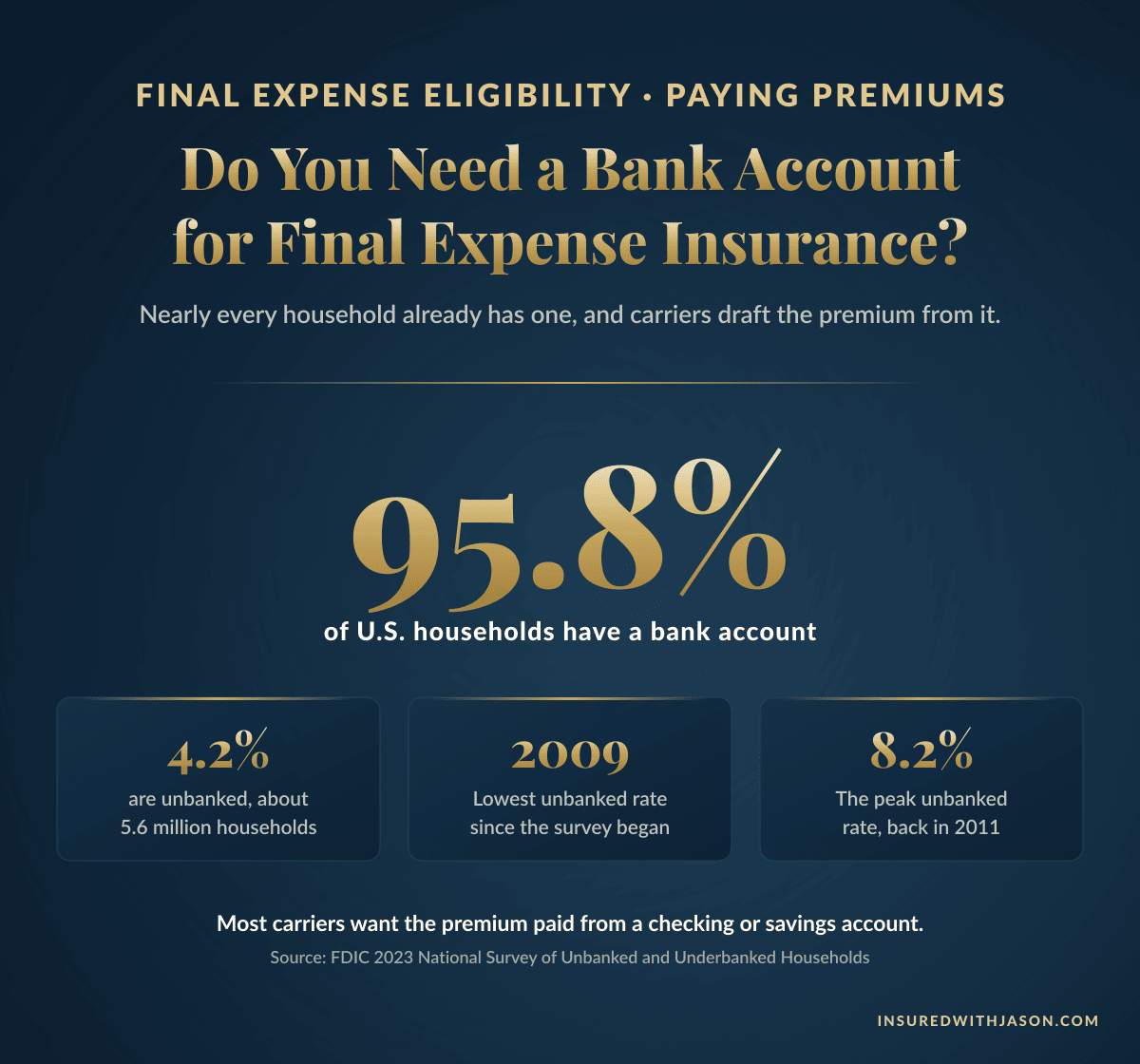
Nearly all American households are banked, and most carriers expect premiums to come from that account.
Does Gender Affect Who Qualifies?
Gender affects your price, never your eligibility. Men and women qualify for the same policies at the same ages. Women typically pay a little less for the same coverage because they live longer on average, and life insurance pricing follows life expectancy.
What carriers cannot use against you: your race, your national origin, or other protected characteristics. Those have no place in underwriting, and they don’t appear on a legitimate application.
Does Your Health Affect Final Expense Eligibility?
Your health shapes which policy you’re offered and what it costs, but it almost never decides whether you can get covered at all. That’s the whole design of this product. Simplified issue policies ask a short list of yes-or-no health questions, no exam and no needles. Guaranteed acceptance policies skip the health questions entirely and accept nearly everyone in the age range, trading a waiting period for that open door.
Condition by condition, the details matter, and they deserve their own space. If you’re managing diabetes, heart history, COPD, or anything else on the usual list, my guide to burial insurance with pre-existing conditions walks through each one. For this page, the answer is simple: health rarely closes the door on final expense coverage.
Can You Buy Final Expense Insurance for Someone Else?
Yes, you can buy final expense insurance for a spouse, a child, or a parent, as long as the person being insured consents and takes part in the application. The law calls this insurable interest: you have to stand to lose something real when that person passes, which family plainly does.
The person being covered is the insured. They answer any health questions themselves, even by phone, and they must agree to the coverage. You can be the owner, pay the premiums, and be the beneficiary. What you can’t do is take out a policy on someone without their knowledge, and no legitimate carrier will let you try.
Worried something on this page rules you out?
No medical exam · Get covered with a real answer
What Can Make You Ineligible for Burial Insurance?
A true denial of burial insurance is rare, and the honest list of dealbreakers is short. Being outside every carrier’s age window. Having no lawful U.S. presence and no acceptable ID, no SSN and no ITIN. Not being in the United States when you apply. Having no way to pay the premium at all. For a small number of carriers, being in hospice or currently hospitalized at the time of application.
Here’s the part almost nobody explains. Many people who believe they were denied were never actually turned down. What they received was a guaranteed acceptance policy with a two-to-three-year graded benefit, meaning the full amount isn’t payable for natural causes until that period passes. That’s not a no. That’s a yes with a waiting period, and it’s a very different thing.
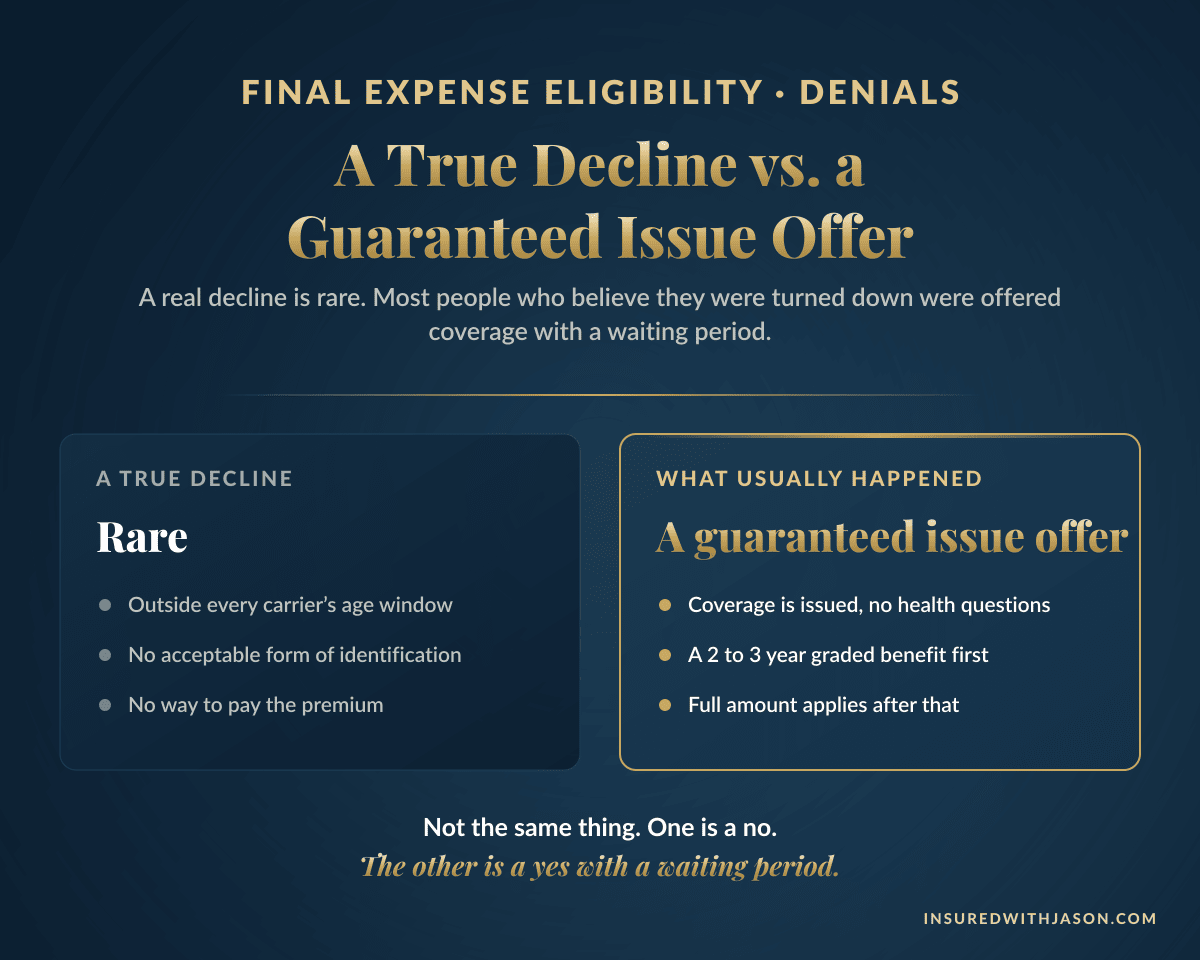
A true decline and a graded-benefit approval are not the same thing, and knowing the difference changes everything.
There’s so much confusion about who this coverage is for, and confusion costs people money.
I talk with people every week who assume they can mail in a check, or who have no idea most carriers want a checking account on file. They find out mid-application, and a simple purchase turns stressful. I’d rather you know all of it before you start.
Because here’s the thing: when you walk in knowing what carriers look for, you and your broker can see which companies you’re most likely to qualify with. And the more of them that would take you, the more favorable your price choices usually are. That’s the whole reason this page exists.
Final expense eligibility: frequently asked questions
The questions people ask me most about qualifying, answered plainly.
Do you have to be a U.S. citizen to get final expense insurance? +
No. Green card holders are generally treated the same as citizens, and lawfully present visa holders can qualify with extra documentation. What carriers require is lawful identification and a real residence in the United States, not citizenship itself.
Can you get burial insurance without a Social Security number? +
Sometimes. A smaller group of carriers accept an ITIN, the IRS taxpayer number for people who cannot get an SSN. You will typically need the IRS ITIN letter, a government photo ID, a year or two of U.S. residency, tax filings, and a U.S. bank account.
Do you need a bank account to buy final expense insurance? +
For most of the market, yes. The majority of carriers want premiums paid by automatic draft from a checking or savings account. Very few take a credit card or a Direct Express card, and the options on that path are extremely limited.
What age can you get final expense insurance? +
Most carriers issue between ages 50 and 85. Some accept younger applicants, and a few products reach age 90. Your premium is set by your age when the policy starts and never rises after that.
Can you be denied final expense insurance? +
A true denial is rare. Most people who believe they were denied actually received a guaranteed acceptance policy with a two-to-three-year graded benefit before the full amount is payable for natural causes. That is an approval with a waiting period, not a no.
Find out exactly where you stand
You now know the qualifications: age, residency, ID, and a way to pay. The next step is seeing which carriers are most likely to say yes to you specifically, because the more of them that would take you, the better your price choices usually get. That’s a five-minute conversation, and it costs nothing.
This article is for educational purposes only and is not legal, tax, or financial advice. Coverage, costs, and rules for life insurance plans vary by person, company, and state. Please speak with a licensed professional about your specific situation before making a decision.
See what you qualify for.