
Burial Insurance Coverage Amounts: How Much Coverage Can You Get, and How Much Do You Need?
Coverage runs from about $1,000 to $50,000. Here’s what each amount really pays for, and how to land on the number your budget can support for life.

- Burial insurance, also called final expense insurance, comes in face amounts from about $1,000 up to $50,000, depending on the insurance company and your age. Most buyers choose between $10,000 and $25,000.
- The bill you’re sizing against is real: a funeral with viewing and burial runs a median of $8,300, or $9,995 with a vault, and cremation with services runs about $6,280 (National Funeral Directors Association).
- $5,000 covers most of a cremation. $10,000 handles a modest funeral. $15,000 to $20,000 funds a full traditional burial with a headstone and final bills. $25,000 and up adds debt payoff or a cushion for a spouse.
- The headstone is the cost families forget: $300 to $6,000 or more, billed separately from the funeral home.
- Government help is small. Social Security pays a one-time $255, and VA burial allowances top out at $2,000 for veterans. These are supplements, not a plan.
- Age shrinks the menu. The maximum coverage amount available steps down as you get older, and funeral costs have historically risen almost twice as fast as everything else.
- The right amount is the one your budget can support through the tough months, for life. A policy you keep beats a bigger one you lose.
- Health issues? Most qualify
- Declined? Jason has next steps
- New policies up to age 85
- Fits a Social Security budget
- Free quotes, no commitment
- Just Jason, never a stranger
Your information goes to Jason. Not a call center. Not a lead list.
Picking a burial insurance coverage amount is not an all-or-nothing decision, and that one idea changes how you shop. Policies run from about $1,000 to $50,000, and every rung on that ladder does something real for your family. The goal is the amount that covers your wishes and still fits your budget in the tough months, because this coverage has to stay with you for life.





What Burial Insurance Coverage Amounts Can You Get?
Burial insurance coverage amounts run from about $1,000 at the low end to $50,000 at the high end, and most people land between $10,000 and $25,000. Not every insurance company offers the whole range. Some start their policies at $2,000 or $5,000, and the biggest amounts are usually reserved for younger applicants. But across the market, that’s the ladder, and every rung on it is a real policy doing a real job.
Here’s what matters more than the menu: this is a type of whole life insurance, so whatever amount you pick is locked in with a premium that never rises and coverage that never expires. You’re not choosing a number for this year. You’re choosing the amount your family receives, tax-free, whenever the day comes. That’s worth getting right, and getting right is exactly what the rest of this page walks you through, band by band.
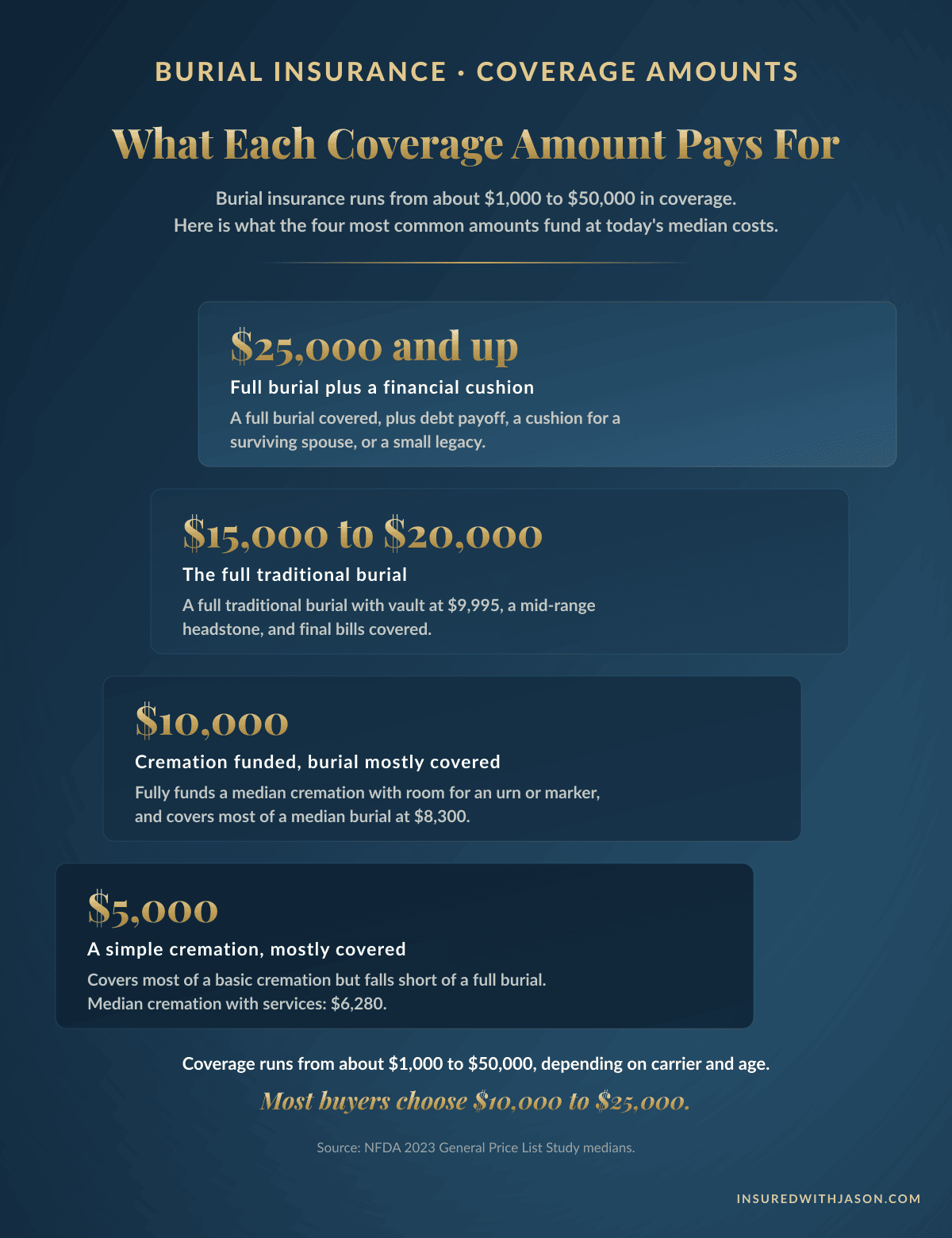
Every rung on the coverage ladder funds something real, from a basic cremation to a full funeral plus a cushion for your family.
What Does $5,000 in Burial Insurance Cover?
A $5,000 policy covers most of a basic cremation and takes a serious bite out of any funeral bill. Cremation with a viewing and services runs a median of about $6,280 according to the National Funeral Directors Association, and a simple direct cremation costs well under that. So five thousand dollars gets a family most or all of the way there, depending on the choices they make.
Where it falls short is a full traditional burial, which starts around $8,300 before the cemetery is even counted. That’s not a knock on the amount. It’s the honest math, so you know exactly what you’re funding. And here’s the part I want you to hear if a smaller policy is what fits: a $5,000 benefit turns an $8,300 bill into a $3,300 one. Your family grieves with a manageable expense instead of a crushing one. That is real protection, and I’ve watched it matter.
Doing something out of love is always better than doing nothing out of fear.
What Does $10,000 in Burial Insurance Cover?
A $10,000 policy fully funds a median cremation with services and covers most of a traditional funeral. It’s the amount where many buyers first feel like they’re truly handling it, and the numbers back that feeling up. Against a $6,280 cremation, ten thousand covers the service completely and leaves room for an urn, a marker, or the travel and flowers that always seem to come up. Against an $8,300 funeral with burial, it covers the funeral home’s bill with a little left toward the cemetery.
What it usually can’t absorb on its own is everything at once: the full funeral, the vault, a nice headstone, and the final bills that surface in the weeks after a death. If your wishes lean toward the complete traditional send-off, the next band up is built for you. If cremation or a modest service is your plan, $10,000 tends to do the whole job with dignity to spare.
What Does $15,000 to $20,000 in Coverage Cover?
Fifteen to twenty thousand dollars funds a full traditional burial, the headstone, and the loose ends, all from one check. The math works like this. A funeral with viewing, burial, and a vault runs a median of $9,995. A single upright granite headstone typically runs $1,499 to $2,999, and a double runs up to about $4,999. Add the small bills that follow a death, some final medical co-pays, a legal filing, the family gathering afterward, and you can see how the whole picture lands comfortably inside this band.
This is the range where your family doesn’t have to choose between honoring your wishes and protecting their savings. Everything is paid, nothing is borrowed, and the decisions get made on love instead of arithmetic. For a lot of the people I work with, that’s the exact definition of done right.
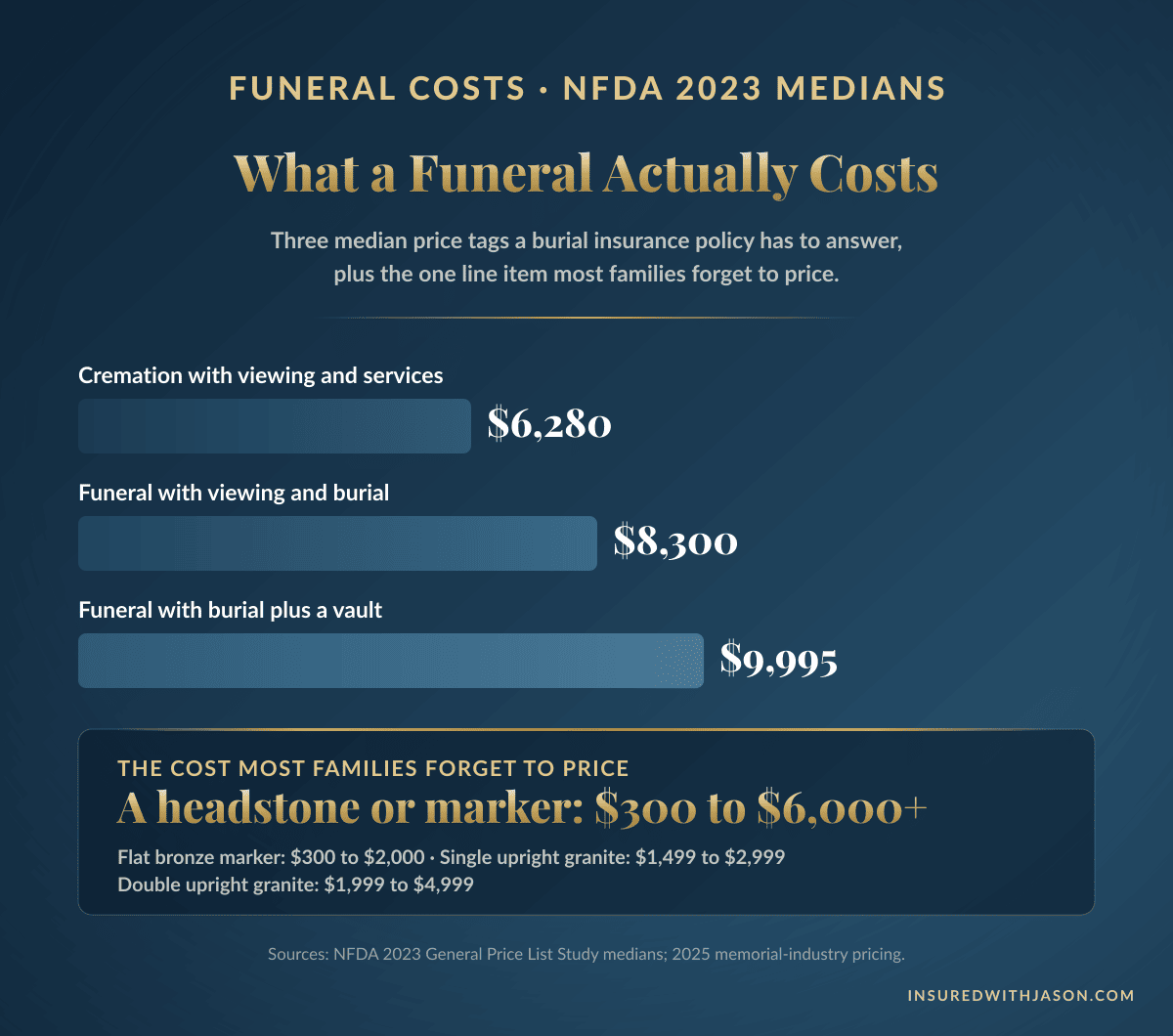
The real bill your coverage amount has to answer, with the headstone broken out as the cost most families forget to price.
See what coverage costs at your age.
Real numbers · No pressure · Takes a minute
When Does $25,000 or More in Coverage Make Sense?
Coverage of $25,000 and up makes sense when you want the funeral handled and something left over. At this level, the policy pays for the complete traditional burial with a premium headstone, absorbs every final bill, and still leaves money behind. For some of the people who choose it, that leftover clears a credit card balance or a medical bill so nothing follows the family around. For others, it’s a cushion that covers a surviving spouse’s expenses for a few months while everything settles. And for some, it’s a small legacy, a last gift with a grandchild’s name on it.
The buyers who land here usually have steady room in the budget, often a pension or other reliable retirement income, and they’ve decided that if they’re doing this, they’re doing more than the minimum. That’s a great reason. The only test that matters is the same one at every rung: the premium has to fit comfortably today and keep fitting for life.
When is more coverage generous, and when is it just a bigger premium?
Say someone tells me they want more than the funeral will actually cost. The instinct is a good one, and here is how I think it through: every dollar above the funeral needs a job with a name on it. The funeral is one job. A semester for a grandchild is another. A cushion so a spouse is not making decisions on a deadline is another. Coverage with a purpose attached to each dollar is a plan, and coverage without one is a bigger premium wearing a plan’s clothes.
What would change my answer: whether the extra dollars have real purposes the person actually holds, and whether the premium still fits in a bad year. Unassigned extra coverage is the over-buying I warn about, and that is worth talking through out loud before anyone signs.
How Do You Choose the Right Burial Insurance Coverage Amount?
You choose the right burial insurance coverage amount by pricing your actual wishes, adding your loose ends, subtracting what’s already set aside, and then testing that number against your budget. Start with the real bill: about $6,280 for cremation with services, $8,300 to $9,995 for a traditional burial, plus $300 to $6,000 for the marker or headstone. Then add your loose ends, meaning any final medical bills, small debts, and a little breathing room for the family in the weeks that follow. Then subtract anything already earmarked, like reachable savings or an existing policy.
Here’s a reassuring fact most people don’t know while they’re adding up those loose ends: in most situations, medical bills left at death are owed by the estate, not by the children personally. Your kids don’t inherit your hospital bill. What they do face, immediately and personally, is the funeral, and that’s the bill this coverage exists to catch.
Now the step that separates a policy that lasts from a policy that lapses. Take the number you landed on and ask one more question: can I afford this premium in a normal month, and can I still afford it in a tough one, with inflation, medications, and the surprise bills that come with living? The amount that passes that test is your true number. In my time helping families with this, the coverage amount usually chooses itself once that honest budget number is on the table. And most people are surprised to find the amount they wanted fits the budget they walked in with.
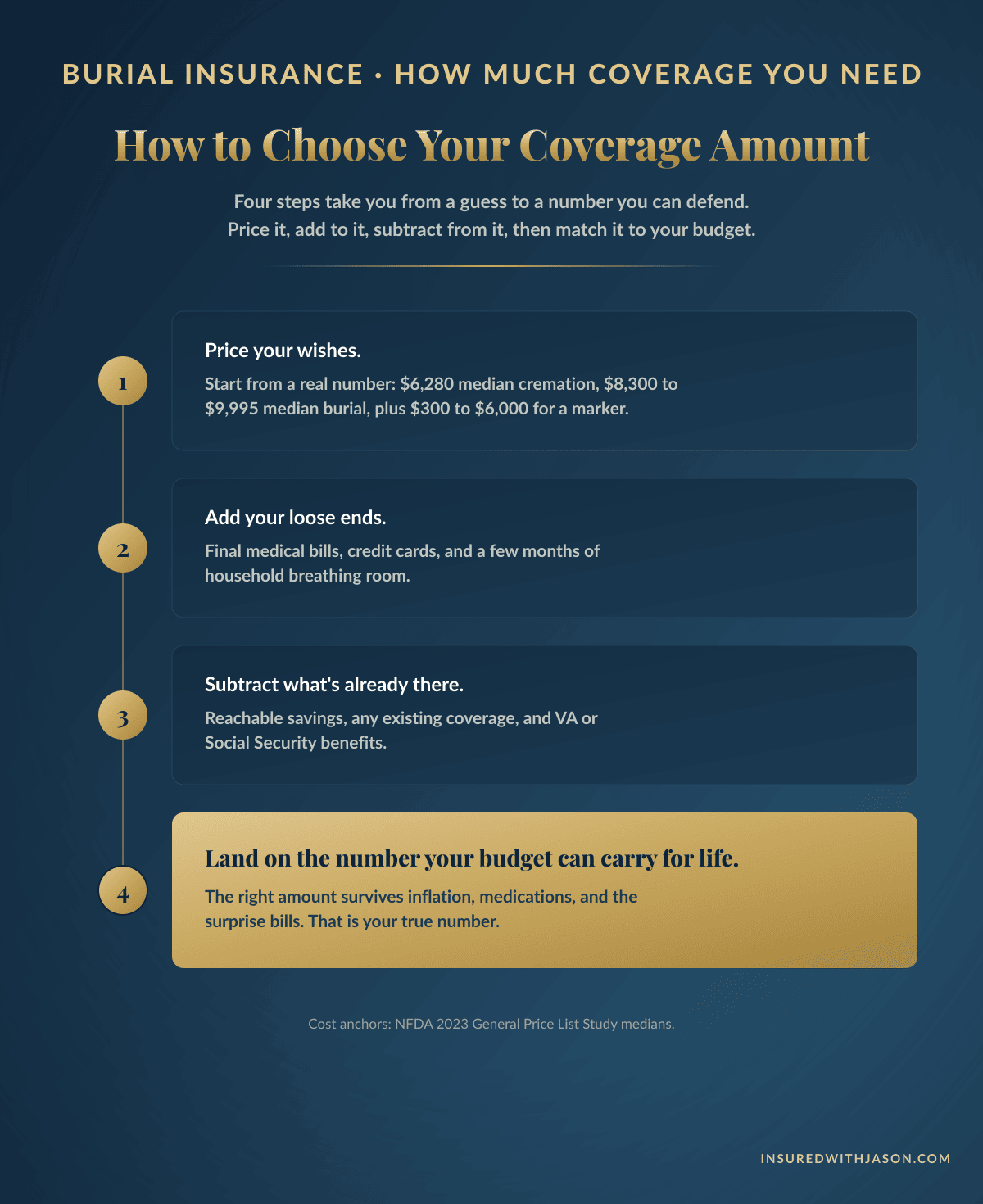
Four steps from a blank page to your true number, built from the real bill up, never down from an ad.
See how much coverage you qualify for.
Most people 50–85 qualify · Find your number
Do VA or Social Security Benefits Reduce How Much Coverage You Need?
A little, but far less than most people expect, so treat them as supplements when you size your policy, never as the plan. Social Security pays a one-time death benefit of $255 to an eligible surviving spouse or child, and that figure hasn’t changed since 1954. Against a median $8,300 funeral, it covers about three percent of the bill. Veterans do better: the VA burial allowance pays up to $2,000 for a service-connected death, or roughly $1,000 for a non-service-connected one, sometimes with a plot allowance on top.
So if you or your spouse served, subtract that allowance in the math you did above. Every honest dollar counts. But no combination of government benefits comes close to covering funerals and final expenses on its own, and families who assume otherwise find out at the worst possible moment. The policy carries the bill. The benefits trim it.
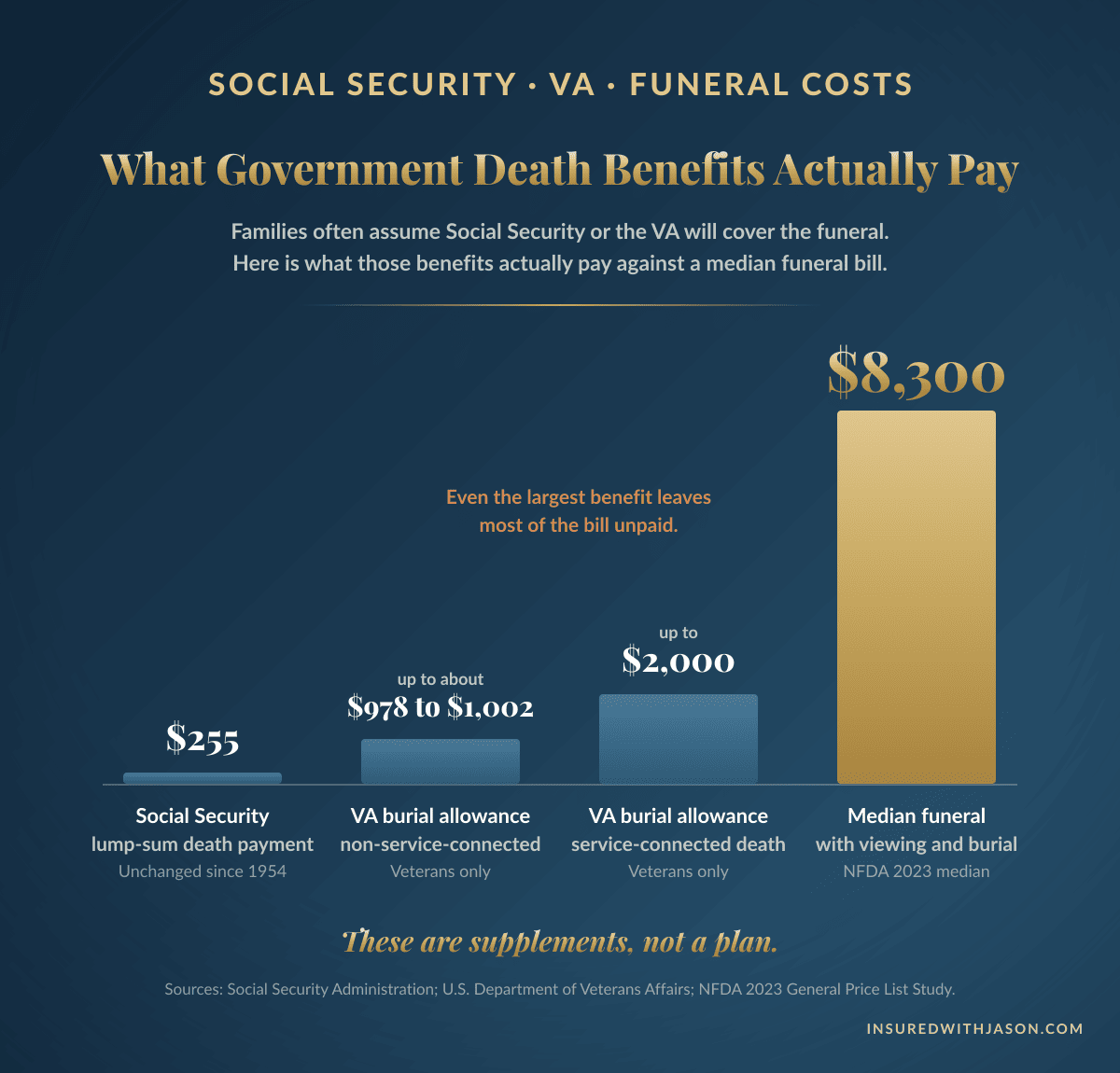
Government death benefits next to a real funeral bill: helpful supplements, nowhere near a plan.
How Does Your Age Change How Much Coverage You Need?
Your age changes the sizing math in two ways most people never hear about: it shrinks the maximum coverage available to you, and it stretches the years inflation has to eat at whatever amount you pick. Start with the ceiling. Many insurance companies cap their largest face amounts by issue age, so the same insurer offering $50,000 to a 60-year-old may cap a healthy 80-year-old at $25,000. Waiting doesn’t just raise the price of burial insurance for seniors. It quietly shrinks the menu.
Then there’s time itself. A policy bought at 65 may not pay out for twenty years or more, and funeral prices have a long history of outrunning everything else. From 1986 to 2017, funeral costs rose 227% while overall consumer prices rose 123%, according to the Bureau of Labor Statistics. Nearly double. So a coverage amount that fits today’s bill perfectly may cover only part of tomorrow’s.
What does that mean for your number at each stage of life? At 60, you might still be sizing for a mortgage tail or credit card balances alongside the funeral, and the full ladder is open to you at its lowest prices. At 70, the loose ends are often smaller but the grandkids are on your mind, and building in a 15 to 20 percent inflation cushion makes real sense. At 80, the house is often paid off and the job is purely the funeral plus a cushion, so nobody sells anything in a panic. Different ages, same principle: buy the amount tomorrow’s bill will need, at today’s locked price.
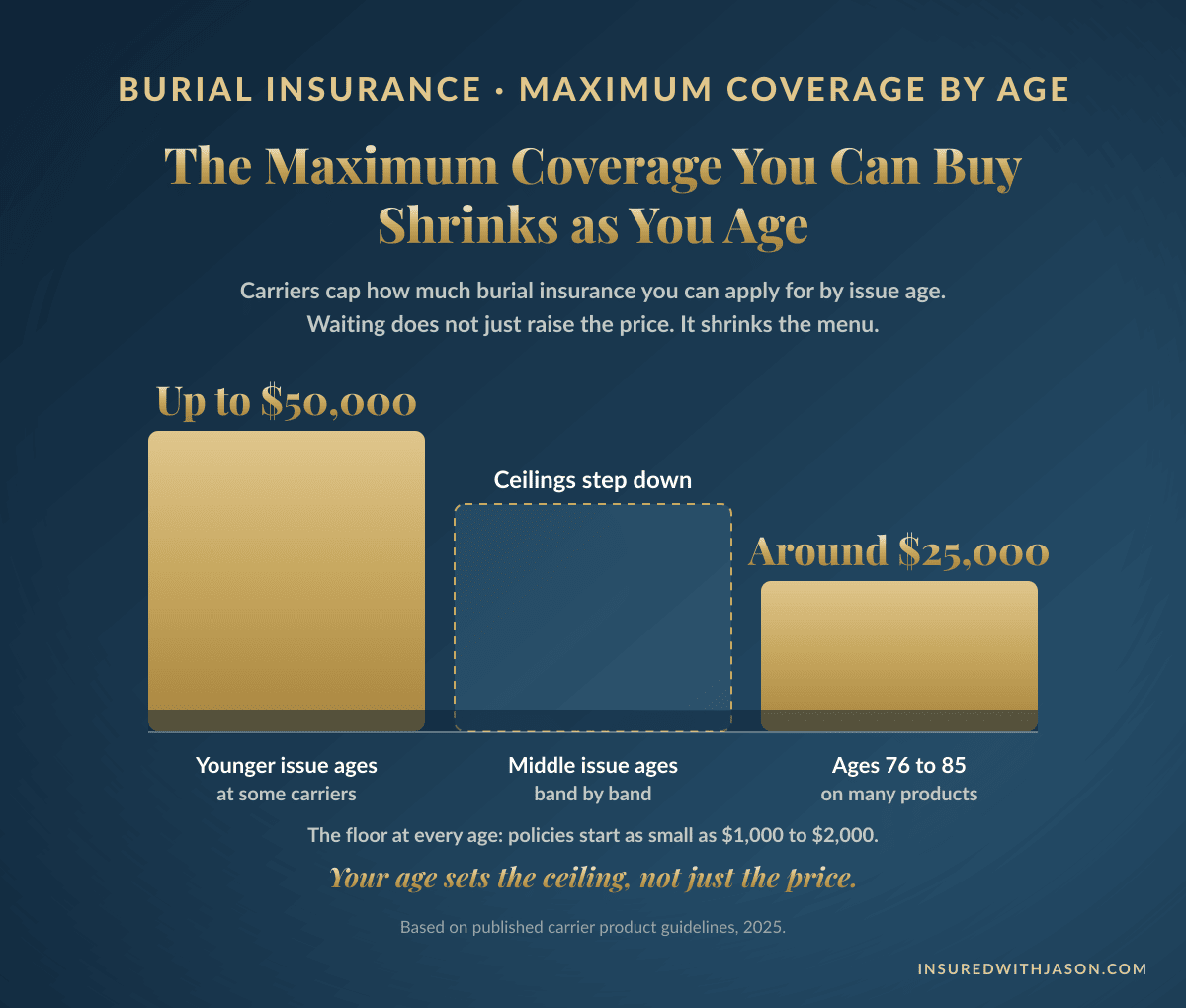
The coverage ceiling steps down as you age, even in perfect health. Waiting shrinks the menu, not just the wallet.
How Does the Coverage Amount Affect Your Monthly Premium?
The premium scales in a straight line with the coverage amount: a $25,000 policy costs about five times what a $5,000 policy costs for the same person. Insurance companies price these final expense policies per $1,000 of coverage, based on your age, gender, health, and tobacco use, then multiply by the amount you choose. That’s good news for your planning, because it means the coverage amount is a dial you control. If a number strains the budget, turning the dial down a notch keeps the protection and restores the comfort. The companion page on what burial insurance costs per month walks through the pricing side in detail.
To give you honest ballpark ranges, a $15,000 policy often runs somewhere around $30 to $65 a month for a non-smoker in their mid fifties, and closer to $130 to $240 a month at 80. These are estimates, not insurance quotes, and your real rate depends on your health and which insurance company treats your situation best. The pattern to take away is the one that never changes: the price is set by your age the day you start and locked there for life, so the same dial costs less the earlier you turn it.
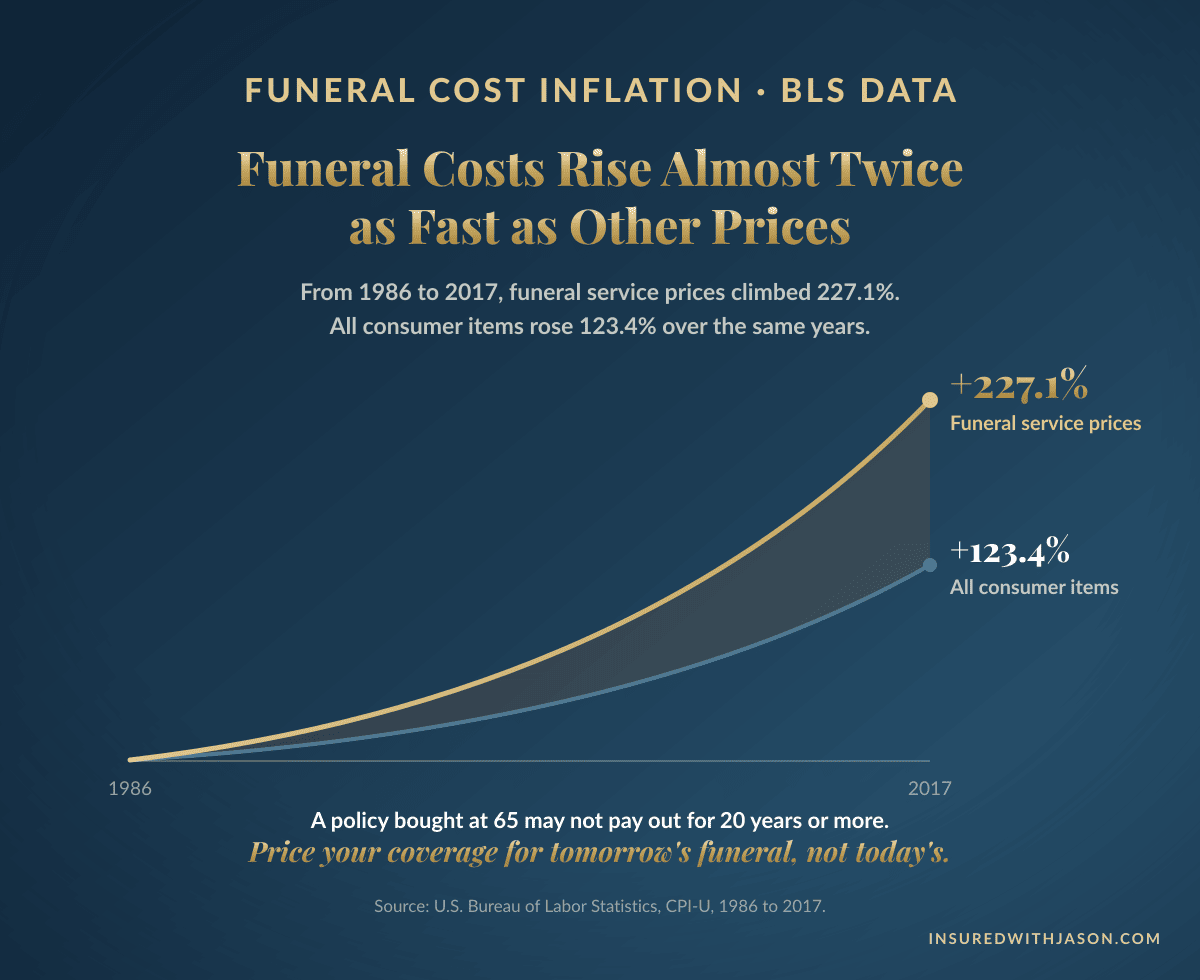
Funeral prices have historically climbed almost twice as fast as everything else, which is why your coverage amount should be sized for tomorrow’s bill.
What Are the Most Common Mistakes When Picking a Coverage Amount?
The most common mistakes are buying more than the budget can support for the long haul, and deciding a small policy isn’t worth having at all. They’re opposite errors with the same root: the decision never fully settled before the purchase. The numbers on lapses tell the story. Industry persistency studies from the Society of Actuaries show that 29% of permanent life insurance policies lapse within three years. Those aren’t people who stopped loving their families. In my experience, they’re mostly people who bought an amount that never truly matched their life, too big to sustain or too small to feel real, or who said yes before they were fully committed. The people who take the time to land on their true number keep their coverage for the long haul. That’s the entire reason this page walks the decision so carefully.
A few more traps worth naming. Sizing to the funeral home’s bill and forgetting the cemetery and headstone are billed separately. Skipping the inflation cushion on a policy that may sit for twenty years. Forgetting to subtract a VA allowance you’ve earned. And the quiet one: buying too much out of love. We all do it, because when you love your family, no amount ever feels like enough. But a policy that strains you while you’re living, or lapses before it’s needed, protects no one. Moderation here is not a compromise. It’s the strategy.
People size their policy to the funeral home’s bill and forget the cemetery and headstone are billed separately.
That’s how a family ends up with the service covered but comes up short on the burial itself. The headstone alone can run $300 to $6,000 or more. Count all of it from the start.
Can You Change Your Coverage Amount After You Buy?
You can usually adjust up or down for a set period of time after purchase, but raising it later typically means adding a second policy priced at your age and health when you add it. These are whole life insurance policies, and the deal is locked the day you start: your amount, your premium, for life. Lowering the face amount is generally allowed and drops the premium going forward, which is a useful safety valve if a budget genuinely tightens. Going the other way isn’t an edit to the old policy. It’s a new one, at your current age, sometimes with new health questions.
Plenty of people do exactly that, and it works fine. A $10,000 policy at 65 and another $5,000 at 72 sit side by side without any problem. But every year between them made that second layer cost more per dollar. Which is one more reason the work you did in the choosing section matters: the closer your first number is to your true number, the less you’ll ever need to revisit it. Pick the rung that fits, settle on it fully, and let the locked price do its quiet work for the rest of your life.
Your beneficiary can spend the money on anything the family needs.
The payout from a burial insurance policy goes to the person you name, tax-free, usually within days. It isn’t restricted to the funeral. Whatever your family needs most in that moment, the money is theirs to use.
What does your number actually cost?
A real answer at your age · Rates lock the day you start
Picking the amount is as much a matter of the heart as it is of the math.
When you love your family, no amount ever feels like enough. I’ve sat with people who wanted to buy more than their budget could hold, out of pure love, and with people who almost bought nothing because a few thousand dollars felt too small to matter. Both deserve the truth: a policy that fits is worth more than a policy that impresses, and a $3,000 benefit that turns an $8,000 funeral bill into a $5,000 one is real help, not a gesture.
I wrote this page so you can find your amount with a clear head, get it, and keep it. That’s the whole job: the right coverage, settled with certainty, standing quietly behind your family for good.
Burial insurance coverage amounts: frequently asked questions
The questions people ask me most about sizing a policy, answered plainly.
What can burial insurance be used for? +
Anything your family needs. The benefit is paid to the person you name, tax-free, usually within days, with no restrictions. Most families use it for the funeral, the cemetery, and final bills, but leftover money is theirs to keep for whatever matters most.
What is the smallest burial insurance policy you can buy? +
Face amounts start as low as $1,000 to $2,000 with some insurance companies, though many set their minimum at $2,000 to $5,000. Small policies are rarely chosen, but they do real work: even a small benefit meaningfully shrinks the bill your family faces.
What is the largest burial insurance policy you can buy? +
Up to $50,000 with some insurance companies, though the biggest amounts are usually reserved for younger applicants. Maximums often step down with age, commonly to around $25,000 by the late seventies and eighties. If you need more than $50,000, a traditional life insurance policy is usually the better tool.
Is $10,000 enough to cover a funeral? +
Often, yes. It fully funds a median cremation with services and covers most of a median traditional funeral, which runs about $8,300 before the cemetery. If your wishes include a burial with a vault and a headstone, $15,000 to $20,000 covers the complete picture more comfortably.
Does Social Security pay for funerals? +
Barely. Social Security pays a one-time $255 death benefit to an eligible surviving spouse or child, an amount unchanged since 1954. It covers about three percent of a median funeral, which is why it should be treated as a small supplement, never a plan.
Can you have more than one burial insurance policy? +
Yes. There’s no rule against holding two or more final expense policies, and adding a second one later is the standard way to increase your total coverage. Each new policy is priced at your age when you buy it, so the earlier layers are always your cheapest ones.
What happens to leftover money after the funeral is paid? +
Your beneficiary keeps it. The full face amount is paid to the person you name regardless of what the funeral actually costs, and anything beyond the final expenses is theirs, tax-free, to use however the family needs.
Let’s find your number together
You know the ladder now, and you know the method: price your wishes, add the loose ends, subtract what’s already there, and land on the amount your budget can support for life. The last step is seeing your real options at your real age, from an independent broker who compares the whole market for you. If you want the wider picture first, start with the overview of final expense insurance. Your rate is set by your age today and locked for life, so the best day to find your rung is the one you’re standing on.
This article is for educational purposes only and is not legal, tax, or financial advice. Coverage, costs, and rules for life insurance plans vary by person, company, and state. Please speak with a licensed professional about your specific situation before making a decision.
Independent broker · No spam calls, ever