
How Much Does Final Expense Insurance Cost Per Month? (And How to Pay Less)
Real monthly rates by age, gender, and coverage amount, what sets your price, and the choices that can save you thousands.

- For $10,000 of coverage, most men between 60 and 75 pay roughly $43 to $113 per month, and women pay less at every age, based on current published rate data.
- Your premium is set by your age and health the day you buy. On a whole life policy it never increases afterward, so waiting is the only thing that raises your price.
- Policies with health questions typically cost 30 to 50 percent less than guaranteed acceptance plans, and they cover you in full from day one.
- The gap between the cheapest and most expensive insurance companies for the same person can top $3,000 over ten years. Comparing the market is where the real savings live.
- Social Security’s death benefit is $255 and hasn’t changed since 1954. A funeral with viewing and burial runs a median of $8,300 before cemetery costs (National Funeral Directors Association).
- Health issues? Most qualify
- Declined? Jason has next steps
- New policies up to age 85
- Fits a Social Security budget
- Free quotes, no commitment
- Just Jason, never a stranger
Your information goes to Jason. Not a call center. Not a lead list.
How much does final expense insurance cost per month? Less than most people fear, and more than the $9.95 deals you see advertised on TV. Real coverage of $10,000 runs a man in his 60s roughly $43 to $66 per month, a man in his 70s roughly $70 to $113, and women pay less at every age.





See your real monthly price.
Real numbers · No pressure · Takes a minute
Final Expense Insurance Cost Per Month by Age and Gender
Your age and gender set the baseline for what final expense insurance costs per month, and the table below shows the real numbers. Each range combines published rate data from two independent 2026 sources for a $10,000 whole life policy at non-tobacco rates with health questions. The low and high ends reflect how differently insurance companies price the very same person, which is a theme we’ll come back to.
| Age | Women | Men |
|---|---|---|
| 50 | $24 – $30 | $31 – $38 |
| 55 | $28 – $36 | $36 – $46 |
| 60 | $33 – $42 | $43 – $53 |
| 65 | $41 – $50 | $54 – $66 |
| 70 | $53 – $64 | $70 – $84 |
| 75 | $71 – $87 | $97 – $113 |
| 80 | $98 – $125 | $135 – $164 |
| 85 | $136 – $155 | $178 – $203 |
Sources: Choice Mutual published quote data (March 2026) and MoneyGeek 2026 rate analysis. $10,000 coverage, non-tobacco, simplified issue. Your rate depends on your age, health, tobacco status, and state.
Read down either column and one pattern jumps out: the monthly price roughly doubles between 60 and 75, then climbs even faster after that. Past 85 the curve gets steep. Published data shows a woman at 90 paying around $300 a month for the same $10,000 policy that costs her $53 to $64 at 70.
Here’s why that matters more than any other fact on this page. These are whole life insurance policies, which means the rate you qualify for on the day you buy is locked for life. It never goes up. The table only hurts you if you keep sliding down it while you think it over.
Your row is a range for a reason.
Find your exact spot in it · No obligation
Average Burial Insurance Cost by Coverage Amount
The average burial insurance cost scales almost in proportion to the coverage amount you choose, which makes right-sizing your policy one of the easiest ways to control the monthly bill. Here’s the same published rate data at three anchor ages and three coverage levels.
| Age & gender | $5,000 | $10,000 | $25,000 |
|---|---|---|---|
| Woman, 60 | $18 | $33 | $76 |
| Woman, 70 | $28 | $53 | $127 |
| Woman, 80 | $50 | $98 | $241 |
| Man, 60 | $23 | $43 | $103 |
| Man, 70 | $37 | $70 | $169 |
| Man, 80 | $69 | $135 | $332 |
Source: Choice Mutual published quote data (March 2026). Non-tobacco rates, rounded to the nearest dollar.
So how much do you actually need? Start with what your final expenses will really run. The National Funeral Directors Association puts the median cost of a funeral with viewing and burial at $8,300, and a funeral with cremation at $6,280, and both figures come before cemetery costs like the plot and marker. For most families, $10,000 to $15,000 covers the funeral with room for smaller end-of-life expenses like final medical bills, and the companion page on how much coverage you need walks that sizing decision through band by band. A simple cremation can be handled well by a $5,000 policy. Buying far more coverage than your funeral arrangements will cost just raises your premium without adding protection you’ll use.
What Factors Determine the Cost of Final Expense Insurance
Six factors determine the cost of final expense insurance, and you have real influence over more of them than you’d think. Every insurance company weighs the same list. Here’s each one in plain English, and what it means for your wallet.
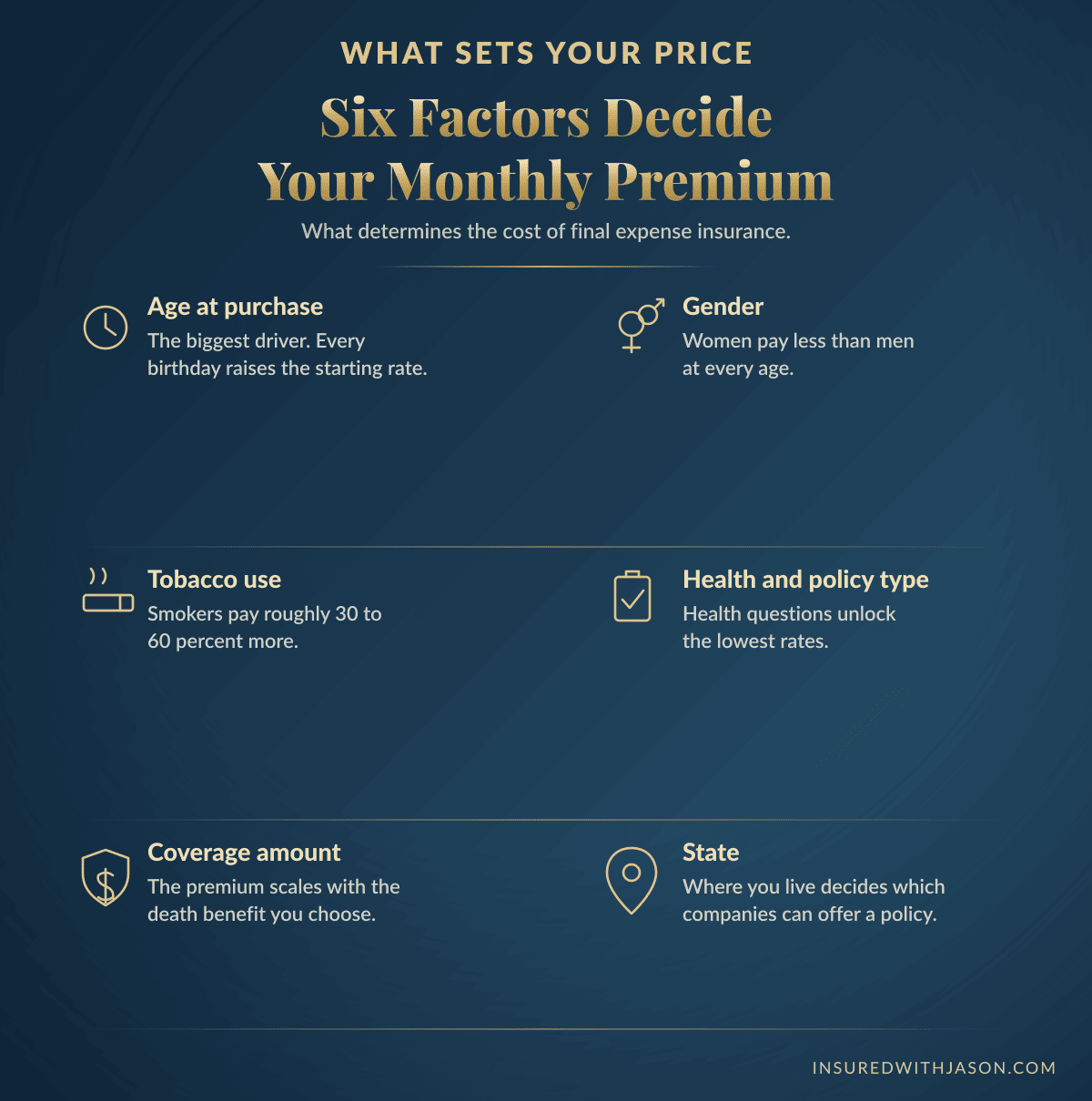
The six factors that set your monthly final expense premium.
Your age on the day you apply
Age is the single biggest driver of your premium, and it’s the one that only moves in one direction. Most companies price every birthday individually, so the rate at 67 is higher than the rate at 66. Once your policy is issued, that age is the age you pay for life.
Gender
Women pay less than men at every age, usually by a wide margin, because women live longer on average and the insurance company collects premiums for more years before paying a claim. It’s actuarial math, not a markup.
Tobacco use
Smokers pay roughly 30 to 60 percent more than non-smokers for the same coverage. If you’ve quit, the question becomes how long ago, and companies look back anywhere from 12 to 36 months. The most important thing is that you’ve stayed off tobacco and you answer honestly. This is also where working with an independent insurance agent earns its keep: if you quit 14 months ago, I’m not going to show you companies that ask about the last three years. I’ll show you the ones that ask about the last twelve.
Your health and the type of policy it qualifies you for
Your health decides which underwriting path you take, and the path moves the price as much as several years of age. Simplified issue policies ask a short list of health questions, with no medical exam, and reward you with the lowest rates and full coverage from day one. Most people qualify, including many with diabetes, blood pressure medication, or a heart history that’s stable. Guaranteed issue life insurance asks no health questions at all, and that certainty costs you: premiums typically run 30 to 50 percent higher, and the policy carries a two to three year waiting period. Die of natural causes inside that window and your family receives a refund of premiums plus interest, not the full benefit.
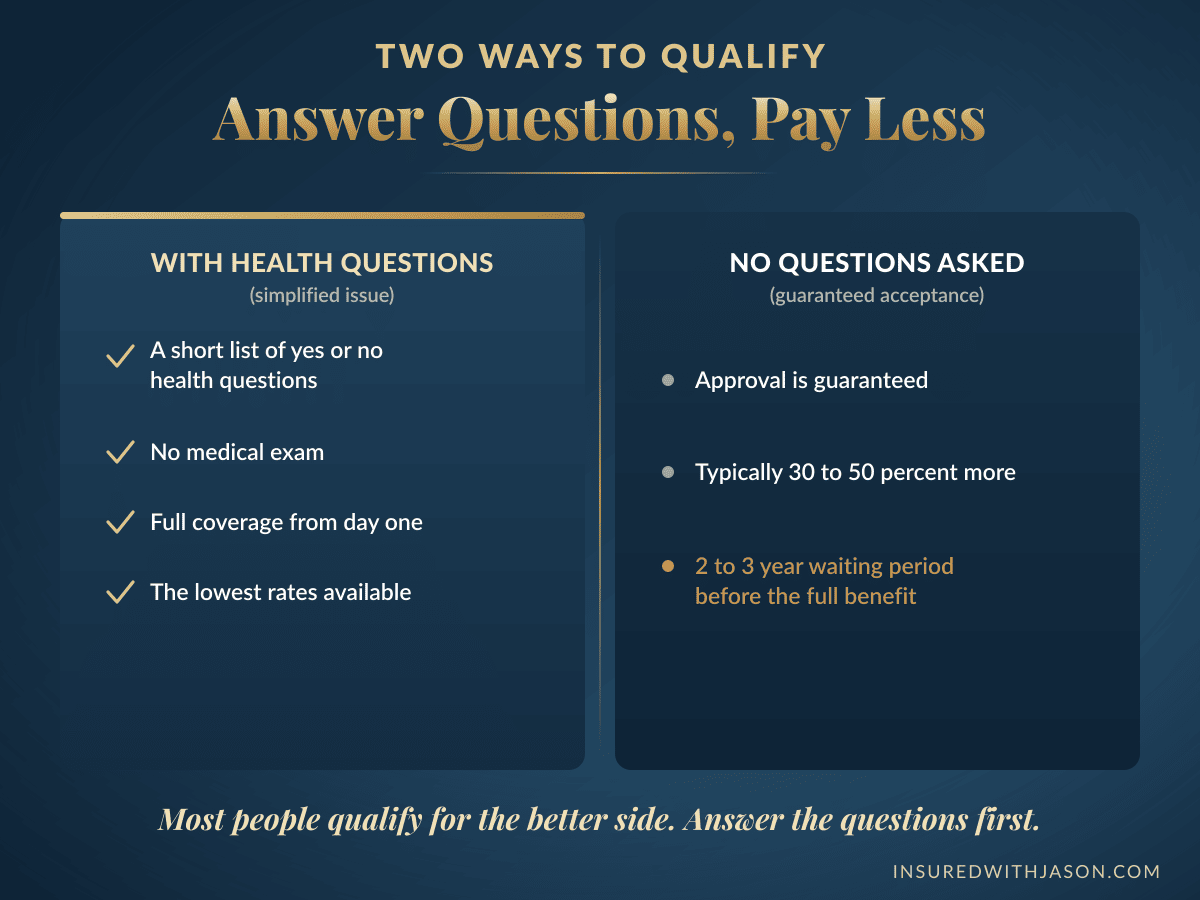
Answering the health questions unlocks lower rates and day-one coverage.
If you take one thing from this section, take this: don’t assume your health pushes you into guaranteed acceptance. Answer the questions first. Plenty of conditions that sound disqualifying still get approved for day-one coverage, and the difference shows up in your premium every month for the rest of your life.
The coverage amount
Premiums scale with the death benefit, as you saw in the table above. A $25,000 policy costs roughly five times a $5,000 policy at the same age. Match the coverage amount to your actual funeral expenses and outstanding bills, and the price takes care of itself.
Your state
Where you live decides which companies can offer you a policy, because insurers choose their states. A company with great rates in one state may not sell in yours at all, which is one more reason a quote built for your situation beats any national table, including mine.
How Final Expense Insurance Prices Compare Across Companies
Life insurance companies price the very same applicant differently, and the spread is wider than most people expect. Here is one published comparison of what a 50-year-old pays for $10,000 of coverage across major carriers. The specific numbers shift with age and health, but the pattern is what to study: same person, same coverage amount, very different prices.
| Company | Women | Men |
|---|---|---|
| AARP | $24 | $33 |
| Transamerica | $24 | $31 |
| Mutual of Omaha | $24 | $31 |
| Americo | $26 | $31 |
| Foresters Financial | $26 | $32 |
| Lincoln Heritage | $26 | $33 |
| Liberty Bankers Life | $26 | $33 |
| American Amicable | $27 | $32 |
| Aflac | $27 | $34 |
| Aetna | $27 | $34 |
| American Home Life | $29 | $39 |
| USAA | $30 | $40 |
| Royal Neighbors of America | $34 | $39 |
| Gerber Life | $34 | $44 |
| Physicians Mutual | $35 | $41 |
| State Farm | $35 | $41 |
| Fidelity Life | $35 | $44 |
| AIG | $39 | $56 |
| AAA | $46 | $58 |
Source: MoneyGeek 2026 rate analysis. Average monthly premiums for 50-year-old applicants, $10,000 coverage, based on sample profiles. Actual rates vary by health, state, and eligibility.
The gap between the top and bottom of that table is $22 a month for women and $27 for men. And the ranking isn’t fixed: the company that’s cheapest at 50 is often not the cheapest at 75, and a health condition can reorder the whole list, because each insurer sets its own underwriting rules. That’s the honest reason no single company is the right answer for everyone, and why the comparison has to be run fresh for your age and your health profile.
The Choices That Can Save You Thousands on Burial Insurance
A handful of choices decide whether you overpay for burial insurance by thousands of dollars over the next decade, and every one of them happens before you sign. Because a whole life premium is locked at purchase and paid every month afterward, small monthly differences turn into real money. Thirty dollars a month is $3,600 over ten years. Here’s what waiting alone does to the price.
| If you buy at… | Monthly premium | Versus 5 years sooner | Extra over 10 years |
|---|---|---|---|
| 65 | $54 – $66 | instead of $43 – $53 at 60 | ~$1,300 – $1,560 |
| 70 | $70 – $84 | instead of $54 – $66 at 65 | ~$1,900 – $2,160 |
| 75 | $97 – $113 | instead of $70 – $84 at 70 | ~$3,240 – $3,480 |
Built from the age table above (Choice Mutual and MoneyGeek published 2026 data). Women’s premiums are lower, and the waiting pattern is the same.
Now stack the company spread on top. Pay $27 a month more than you needed to because you took the first offer instead of comparing, and that’s another $3,240 over ten years. Waiting costs you, and buying in the wrong place costs you again. The levers that keep you on the right side of both are simple:
- Answer the health questions if you can. Qualifying for a simplified issue policy instead of guaranteed acceptance is the single biggest price cut available, and it buys day-one coverage too.
- Buy at today’s age. Next year’s rate is higher, permanently, and today’s health is the best health your application will ever see.
- Be honest and strategic about tobacco. Stay quit, answer truthfully, and let your broker match you to a company whose look-back window works in your favor.
- Right-size the coverage amount. Fund the funeral and the final bills, not a round number that sounds nice.
- Compare the whole market. The company spread in the table above is the reason. One application in the wrong place can cost more than a decade of coffee.
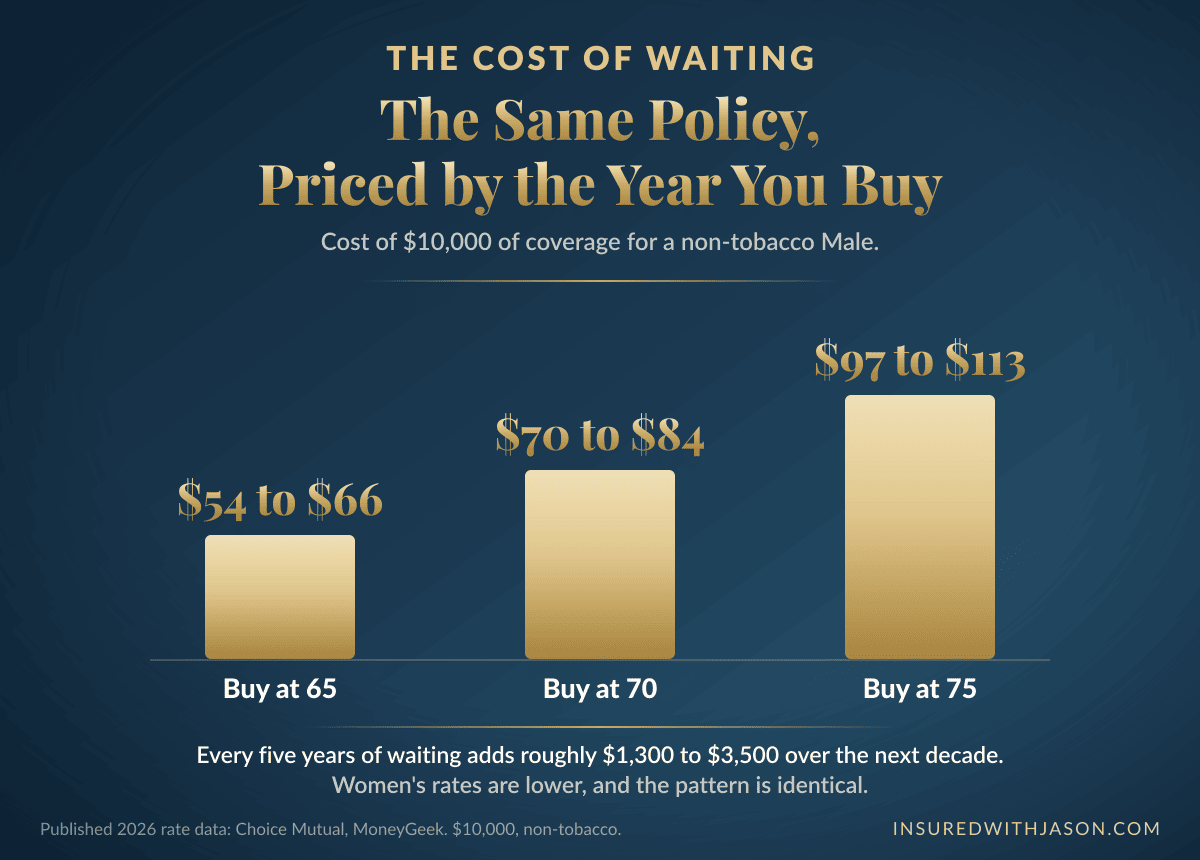
The same policy, priced by the year you buy it.
Social Security’s lump-sum death benefit, unchanged since 1954. Against a median $8,300 funeral, it covers about 3 percent. The other 97 percent is what a final expense policy exists to handle.
Source: Social Security Administration
Should I just stretch for the biggest policy I can manage?
Say someone works through these tables, finds a number they can just barely reach, and asks me to write it. Here is how I think that through, and it runs against my own interest to say it. The most common mistake in this category is not overpaying by a few dollars a month, it is buying more coverage than a budget can carry for a lifetime. The best policy for anyone is the one they can comfortably pay through thick and thin, because if it is not still there at the very end of their life, everything paid into it was for nothing.
What would change my answer: whether the premium survives a bad year, not a normal one. Room in a good month is easy to find. If a slow year, a car repair, or a jump in medication cost would put the payment at risk, the honest move is a smaller face amount that never gets dropped.
Today’s age is the best price you’ll ever see.
Lock it in · No exam · No obligation
Why TV and Mail Life Insurance Offers Look So Cheap
Those TV and mail offers look cheap because the advertised price buys far less coverage than most people assume. Remember the $9.95 from the top of this page? That price typically buys one unit of coverage, which is around $1,000 of death benefit, and it’s quoted at the youngest, healthiest end of the eligible ages. The price per unit climbs as you get older, so you can’t just multiply your way to $10,000 at the advertised rate. And the plan behind the offer is usually guaranteed acceptance, which means the two-year waiting period rides along with it.
I understand why that price anchor is hard to let go of. Everybody gets these mailers, everybody sees the ads, and everybody hopes the goal can really be accomplished for ten dollars a month. Most people sense it’s too good to be true, but the number sticks anyway. Here’s the release valve: if you can answer no to a short list of health questions, you can very likely buy real coverage, with no waiting period, at a better cost per thousand dollars than any advertised unit plan. The honest math favors you, not the commercial.
Every advertised price is a starting point for someone younger and healthier than the ad’s actual audience.
If a rate sounds impossible for your age, it isn’t your rate. Judge what coverage costs from a quote built on your real age and health profile, never from a mailer.
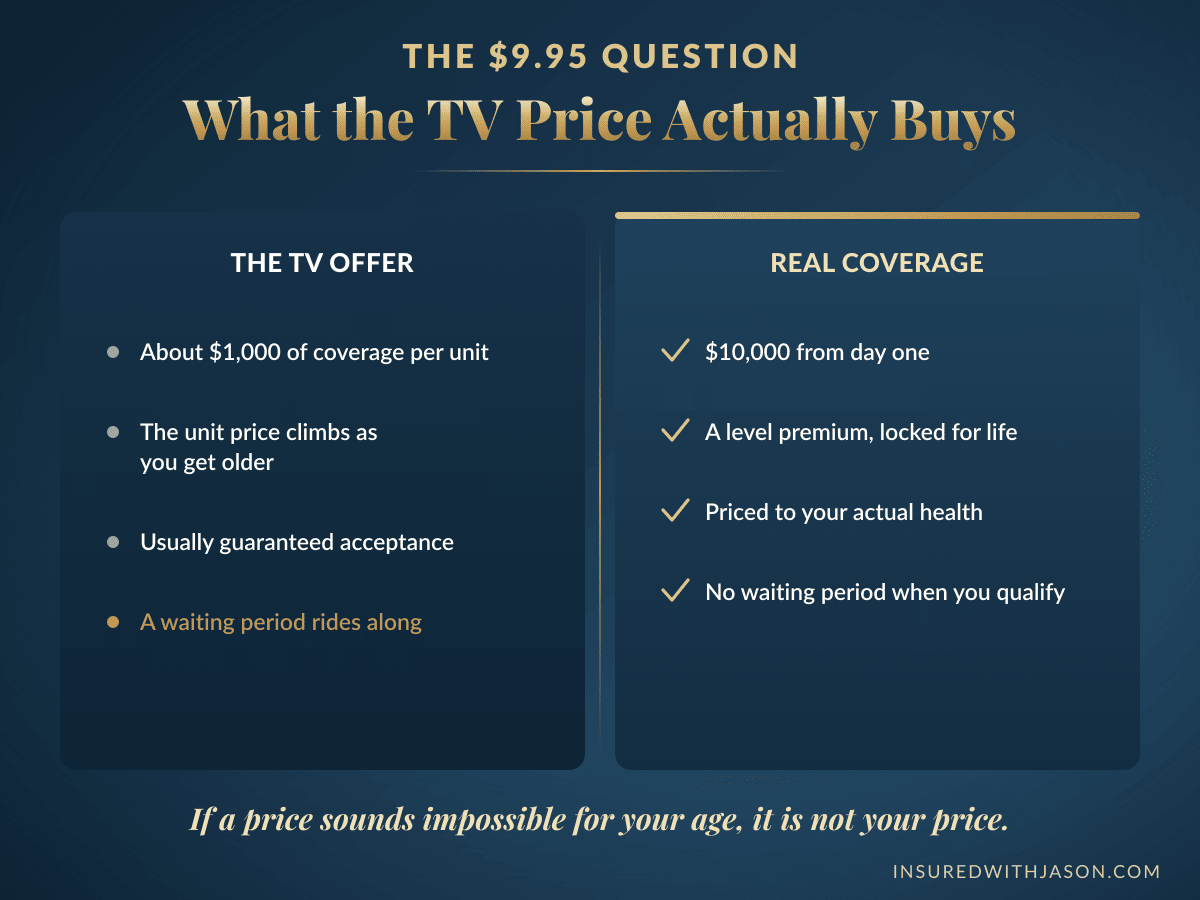
What the $9.95 TV price actually buys, next to real coverage.
How to Get a Final Expense Insurance Quote
Getting a final expense insurance quote takes a few minutes, requires no medical exam, and commits you to nothing. The published tables on this page tell you the neighborhood. Your actual number depends on your age, health, tobacco status, and state, and finding the low end of the spread is the whole game. Three steps get you there.
How to find your real price
The tables show the neighborhood. These three steps find your number.
- 1Know Your Health ProfileHave your medications and diagnoses handy
The health questions are short, and accurate answers route you to the best policy type you qualify for.
- 2Compare the Whole MarketWork through an independent broker
I represent many insurance companies rather than any one of them, and my job is to find which carrier prices your exact situation best. The comparison costs you nothing.
- 3Lock It InChoose a level whole life policy you can comfortably keep
The right premium is one you’ll never have to drop, because the policy only protects your family if it’s in force on the day it’s needed.
You’ve seen what final expense insurance costs per month, what moves the price, and what waiting does to it. The one number this page can’t show you is yours. Get your quote below, and let’s find the low end of your table together.
Final expense insurance cost: frequently asked questions
The questions people ask me most, answered plainly.
Is burial insurance the same as final expense insurance?+
Yes. Burial insurance, final expense insurance, and funeral insurance are three names for the same product: a small whole life insurance policy designed to cover funeral expenses and other end-of-life expenses. Companies and agents use the terms interchangeably.
How much is final expense insurance per month for a 70-year-old?+
Based on current published rate data, a 70-year-old woman pays roughly $53 to $64 per month for $10,000 of coverage at non-tobacco rates, and a 70-year-old man pays roughly $70 to $84. Your exact rate depends on your health, tobacco status, and state.
Does the cost of final expense insurance go up as you age?+
Not after you buy. Final expense policies are whole life insurance, so your premium locks at issue and never increases. Age only raises the price while you’re still shopping, which is why the same policy costs more every year you wait to apply.
Are there different types of final expense insurance policies?+
Yes, two main types. Simplified issue asks a short list of health questions and offers lower rates with full day-one coverage. Guaranteed issue asks no health questions, costs 30 to 50 percent more, and carries a two to three year waiting period. If your health lets you answer no to the questions, simplified issue is almost always the better deal.
Do I need a medical exam to get final expense insurance?+
No. Final expense insurance never requires a medical exam. Depending on the policy, you’ll either answer a short health questionnaire or no health questions at all.
What’s the cheapest way to buy final expense insurance?+
Qualify for a policy with health questions if your health allows, buy at your current age instead of waiting, and compare rates across many insurance companies before you apply. An independent broker runs that comparison for you at no cost.
Find your real monthly price
You’ve seen what final expense insurance costs per month, what sets your price, and what waiting does to it. The one number this page can’t show you is yours. A few quick questions, real rates from many companies, and zero obligation. If you want the wider picture first, start with the overview of burial insurance. Remember, the rate is set by your age right now, so the cheapest day to start is the one you’re standing in.
This article is for educational purposes only and is not legal, tax, or financial advice. Sample rates shown are drawn from published third-party data as of the dates noted, are not a quote or an offer of coverage, and vary by person, company, and state. Please speak with a licensed professional about your specific situation before making a decision.
Independent broker · No spam calls, ever