
How to Get Burial Insurance With Pre-Existing Conditions (Day One Coverage Is Still Possible)
Also called final expense insurance. How the health questions work, what the three issue types mean, and why coverage with no waiting period is still within reach.

- Yes, you can get burial insurance with pre-existing conditions. This whole life coverage was designed for ages 50 to 85, when health conditions are the norm, not the exception.
- No medical exam. Most burial insurance policies use a short health questionnaire instead, usually around ten to fifteen questions.
- Day one coverage with no waiting period is real for many people with health conditions, when the right carrier is matched to your health profile.
- Policies come in three issue types: no waiting period (level), graded, and guaranteed issue. Guaranteed issue life insurance accepts everyone in the age range, no health questions asked.
- A waiting period only limits natural-cause payouts. All three types pay the full death benefit for accidental death from the first day.
- No single condition decides your outcome. Approval depends on the combination of your conditions, how recent they are, and which company’s rules are measuring you.
- Every insurance company uses different health questions and look-back windows. The same person can be declined at one company and get day one coverage at another.
- A broker who shops many carriers is the approval strategy. One short conversation, and you can know which companies are most likely to take you and what it will cost.
- Health issues? Most qualify
- Declined? Jason has next steps
- New policies up to age 85
- Fits a Social Security budget
- Free quotes, no commitment
- Just Jason, never a stranger
Your information goes to Jason. Not a call center. Not a lead list.
Burial insurance with pre-existing conditions isn’t the long shot people think it is; it’s the whole point of the product. Carriers know that by 65, more than 90% of us are carrying at least one chronic condition, so they built this coverage for real-world health: no medical exam, a short list of questions, and full day one coverage still on the table for many people. The question worth your next five minutes isn’t whether you can get covered. It’s which company wants you most, and I’ll show you exactly how we find that out.





Can you get burial insurance with pre-existing conditions?
Yes, you can get burial insurance with pre-existing conditions, and in many cases you can get it with full coverage from your very first day. That answer surprises people, because most of us assume life insurance works like a job interview: show up healthy or don’t show up at all. Burial insurance runs on a different premise entirely.
Here’s the premise. This is a small whole life insurance policy, built to cover final expenses like the cost of a funeral, cremation, a headstone, and any last bills. The people who need it most are between 50 and 85. And at those ages, a clean health record is the rare thing, not the standard one. The carriers know it, they price for it, and they wrote their applications expecting your conditions to walk in the door with you.
So the honest question was never “can I qualify for burial insurance.” It’s “which type of policy, from which company, at what price.” The rest of this page answers exactly that.
More than nine in ten adults 65 and older live with at least one chronic condition. Among adults 85 and older, it’s 92.6%. If you’re shopping with a health history, you are the typical buyer, not the exception.
Source: CDC / National Center for Health Statistics
Why final expense insurance was designed for people with health conditions
Final expense insurance was designed from the ground up for people whose health isn’t perfect, and every piece of the product shows it. There’s no medical exam. No blood work, no nurse visit, no waiting weeks for lab results. In place of all that sits a short health questionnaire, and for some policies, no questions at all.
Why can carriers afford to be this welcoming? The coverage amounts are modest on purpose. A final expense life insurance policy usually pays a death benefit between $5,000 and $25,000, enough to cover a funeral with viewing and burial, which runs about $8,300 according to the National Funeral Directors Association, before the cemetery adds its share. Because the insurance company’s risk on each life policy is small, it can say yes to health histories that a traditional life insurance company, underwriting a half-million-dollar term life policy, would turn away.
And this isn’t a side product. In 2024, over a million of these policies were sold in the United States, and 85% of them were simplified issue, the kind approved with health questions instead of an exam, according to LIMRA. The entire market is organized around one assumption: the buyer has a health history. That assumption is why your pre-existing condition is a factor here, not a wall.
According to the CDC, 69.5% of adults 55 to 64 already have at least one chronic condition, and it climbs from there. The carriers read the same data. They built the product to match it.
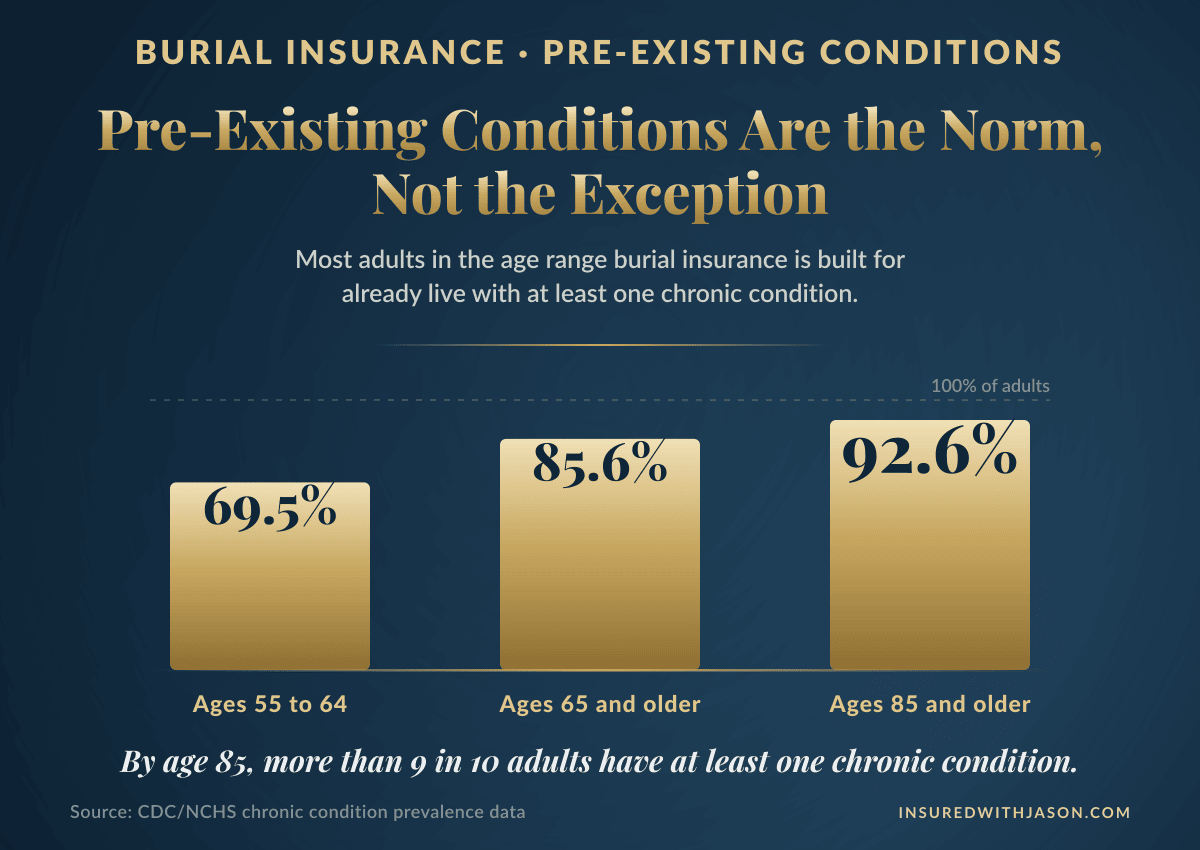
By 85, over nine in ten of us carry at least one chronic condition. This product was built knowing that.
Worried a health condition will hold you back?
No medical exam · A real answer, fast
What do the health questions ask about your pre-existing conditions?
The health questions on a burial insurance application ask about specific conditions inside specific time windows, not about your health in general. A typical application runs around ten to fifteen yes-or-no questions. Have you been hospitalized recently? Do you use oxygen? Have you been treated for a heart attack, stroke, or cancer within the last so-many months? That last part matters more than people realize.
Those time windows are called look-back periods, and they’re where the game is won. One insurance company asks about heart trouble in the past 36 months. Another asks about the past 24. A condition from three years ago exists inside one company’s window and has quietly aged out of another’s. Same you, two different answers, and we’ll come back to why that’s the best news on this page.
How insurance companies verify your answers
Carriers don’t rely on your memory alone, and honestly, that works in your favor. Behind the questionnaire, two quick checks run: a prescription history search, which confirms your medications line up with your answers, and a check with MIB, a nonprofit consumer reporting agency that holds coded summaries of what you’ve told other insurers on past applications. Not your medical records, just codes. You’re legally entitled to a free copy of your MIB file every year, and you can dispute anything that’s wrong.
So accuracy is the whole strategy. When your answers, your prescriptions, and your history all tell the same story, approvals move fast. And when you work with a broker who already knows each company’s questions and windows, your application goes to a carrier built to say yes to your health profile in the first place. That’s the difference between applying and applying smart.
The three ways a policy can be issued: day one, graded, guaranteed issue
Every burial insurance policy is issued one of three ways, and the way yours is issued decides when the full benefit becomes payable and what you’ll pay each month. Think of them as three doors into the same room. All three end at the same place: a permanent whole life policy with a locked premium and a death benefit for the people you love. They just differ in how you enter.
Door one is level coverage, the one I chase for every client: full death benefit from day one, no waiting period, and the lowest price of the three. Door two is graded: a partial benefit for natural causes in the first two years, commonly around 30% in year one and 70% in year two, then the full amount, at a price between the other two. Door three is guaranteed issue life insurance: no health questions at all, everyone in the age range accepted, a two-year waiting period, and the highest price. Here’s the full lineup of the types of burial insurance, side by side.
| No Waiting Period (Level) | Graded | Guaranteed Issue | |
|---|---|---|---|
| Health screening | Health questions, no medical exam | Health questions, no medical exam | No health questions at all |
| Natural causes, years 1–2 | Full death benefit from day one | Partial benefit (often ~30% year one, ~70% year two; varies by company) | Premiums returned plus interest, often around 10% (varies by company) |
| Natural causes, after year 2 | Full death benefit | Full death benefit | Full death benefit |
| Accidental death, any time | Full death benefit | Full death benefit | Full death benefit |
| Relative cost | Lowest | Middle | Highest |
Payout percentages, interest rates, and waiting periods vary by insurance company and state. Guaranteed issue commonly costs 40% to 100%+ more than level coverage for the same benefit amount.
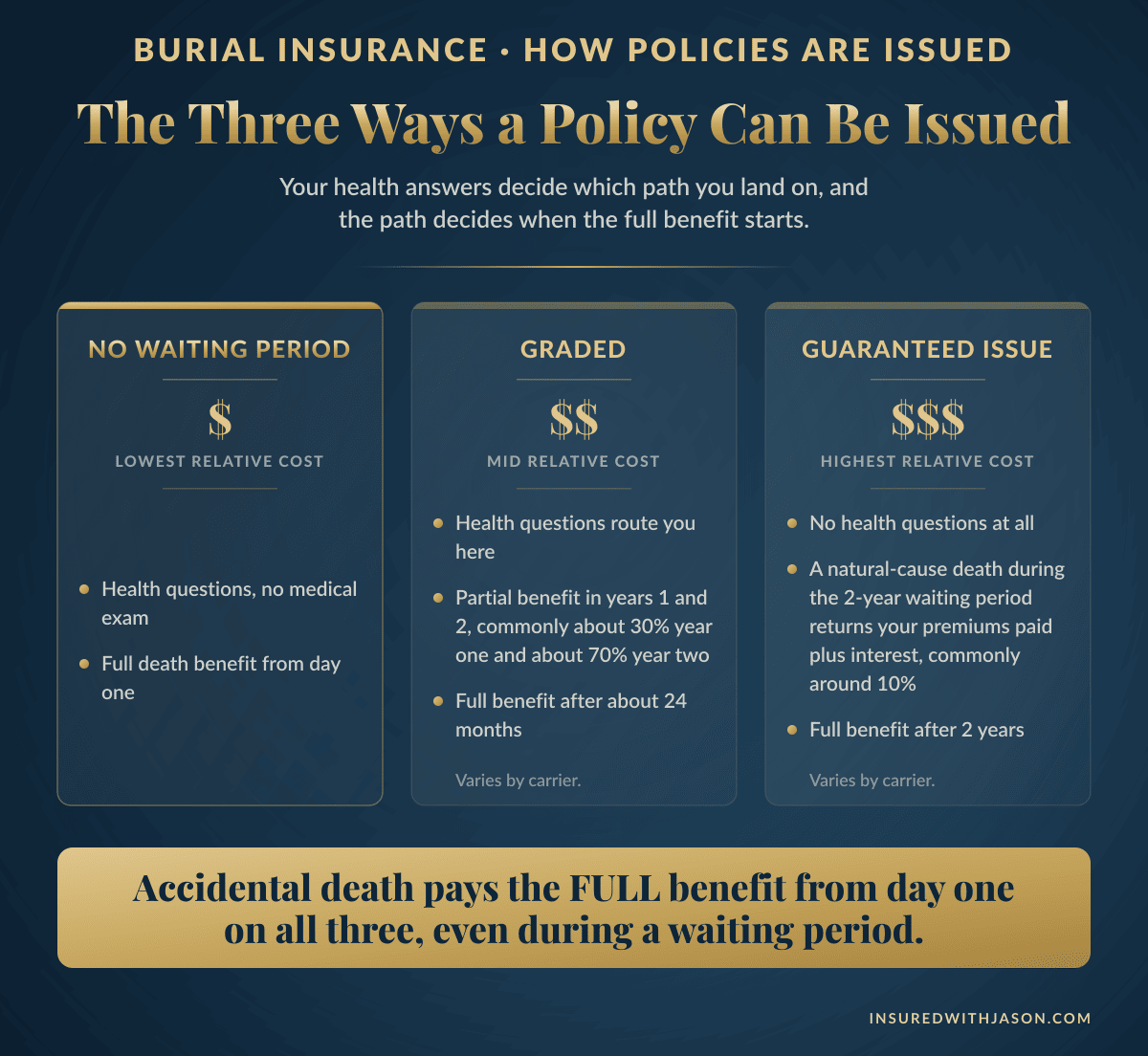
Three doors into the same room. The healthier the profile a company sees, the lower the door number and the lower the price.
How does the waiting period actually work?
A waiting period on burial insurance limits the payout for natural-cause death during the first two years of the policy; it does not mean you’re walking around uninsured. This is the most misunderstood two years in the whole product, so let’s take it apart.
On a graded policy, a natural-cause death in the first two years pays a percentage of the benefit, and after the waiting period ends, the full amount is payable forever. On guaranteed issue burial insurance, a natural-cause death during the two-year waiting period returns every premium you paid plus interest, often around 10%, and then the full death benefit takes over. Your money is never gone. Your family is never left with nothing.
And here’s the part almost nobody tells you: accidental death is covered in full from the first day on all three policy types, waiting period or not. The waiting period only ever applies to natural causes.
Every burial insurance policy pays the full benefit for accidental death from day one.
Level, graded, or guaranteed issue, it makes no difference. A waiting period only limits payouts for natural causes. From the moment your first payment clears, accidental death is covered at the full amount on all three.
So which door will you walk through?
Can you still get coverage with no waiting period if you have pre-existing conditions?
Yes, many people with pre-existing conditions still qualify for burial insurance with no waiting period, and the deciding factor is almost never the single condition you’re worried about. It’s the whole picture: which conditions, in what combination, how recent, and how well managed.
Picture two applicants. One has diabetes that’s been perfectly controlled for fifteen years, but had a heart attack last month. The other had a heart attack ten years ago, fully recovered, but their blood pressure recently spiked out of control. Neither one is defined by the diagnosis on paper. Each is defined by the totality, measured against a specific company’s rule book. Diabetes, COPD, heart problems, a past stroke: people get approved for coverage with no waiting period carrying every one of these, and other people with the same words in their chart land in a graded policy instead. It genuinely depends.
Which is why nobody can promise you day one coverage from a webpage, including this one. What I can promise is this: the answer exists, it’s specific to you, and finding it takes one short conversation, not weeks of guessing.
My conditions are all managed. Will I get day-one coverage?
Say someone calls me with three conditions, all well-managed for a decade, asking whether they’ll get day-one coverage. The mentality I’d hand them is to assume a graded offer: then there’s no disappointment waiting, and if the shopping turns up day-one coverage, the surprise runs in the right direction. That’s not pessimism. It’s the only honest posture before underwriting speaks.
What would change my answer: the actual underwriting answers, nothing else. And that is exactly why we shop before anyone assumes anything.
See if you qualify for day-one coverage.
Full coverage from the first day · No waiting
What if your health conditions are more serious?
If your health conditions are serious enough that no company offers you coverage with no waiting period, you still have two strong paths: a graded policy or guaranteed issue. And I want to talk about these honestly, because this is where too many people walk away with nothing.
My attitude as a broker is to go for the gold. I want day one coverage for everybody, and I’ll turn over every stone to find it. But some people genuinely can’t get it, and for them, the all-or-nothing mindset is the real danger. I’ve sat with people so set on full coverage or bust that they chose bust, and bust protects no one.
Look at what the waiting period actually is: two years. Not forever, two years. Take out a graded policy today, and two years from now it isn’t graded anymore. It’s 100% of the benefit, locked in for life, at a premium that never rises. Same with guaranteed issue. Yes, it tends to cost more, but after two years there’s nothing left to wait for. You’re in. The people who took out these policies two years ago are already there. The only question is whether you’ll be there two years from now, or still standing at the starting line waiting for perfect.
Two years from now, a graded policy isn’t graded anymore. It’s full coverage, locked for life. The waiting period ends. Doing nothing never does.
How does a broker improve your odds of approval?
An independent broker improves your odds of approval by matching your exact health profile against many companies’ rule books before you ever apply, instead of letting one company’s rules decide your fate. Remember those look-back windows from earlier? This is where they pay you.
Every insurance company writes its own health questions, its own time windows, and its own list of conditions it handles well. An agent who represents one company can only bring you that one company’s answer, however it lands. A broker holds a stack of rule books, and somewhere in that stack is usually a company that treats your combination of conditions as its favorite kind of customer. Landing with the right one doesn’t just get you approved. It can mean no waiting period instead of two years, and a meaningfully lower premium for the exact same protection.
And the process is faster than most people expect. You don’t even have to talk on the phone if you’d rather not; I can send the health questions by email or text and send everything back the same way. But if you call, here’s the whole thing:
How the qualification call works
One short conversation, and you can know which companies are most likely to take you and what it will cost.
- 1The Health QuestionsAnswer around ten to fifteen yes-or-no questions
The same questions the insurance companies ask. Takes about a minute and a half.
- 2The BasicsShare your state, ZIP code, height, and weight
Another two minutes. This pins down which carriers and rates are available where you live.
- 3The MatchSee which companies are most likely to accept you
Your answers, measured against many rule books at once, with real insurance quotes attached.
- 4The PlanDecide who and what the money protects
Who are you covering, who stands to lose what, and what is this for: cremation, funeral and burial, a headstone, final bills.
- 5The ApplicationApply with the company that fits you best
Many applications come back with an answer immediately, or within minutes.
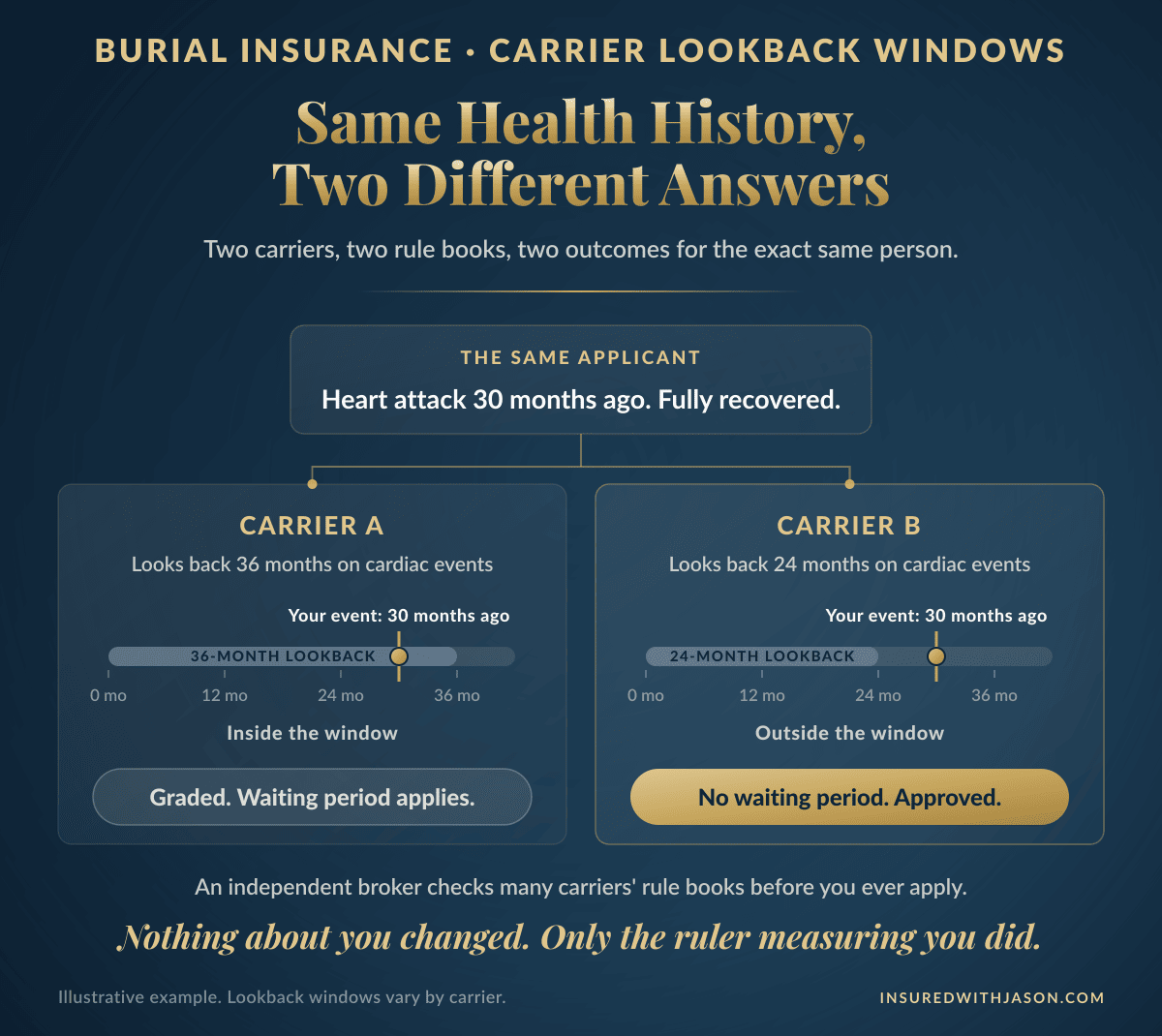
Nothing about the applicant changed. Only the ruler measuring him did. That’s why shopping many carriers is the approval strategy.
One more reason to shop first instead of settling: the price of landing in the wrong policy type compounds quietly. Pay $35 a month more than your health actually requires, and over 15 years that’s $6,300 out of your pocket for the exact same death benefit. The best burial insurance for you isn’t a brand name. It’s whichever company’s rule book likes your health profile best, and a licensed independent insurance broker finds that company before you apply, not after a decline.
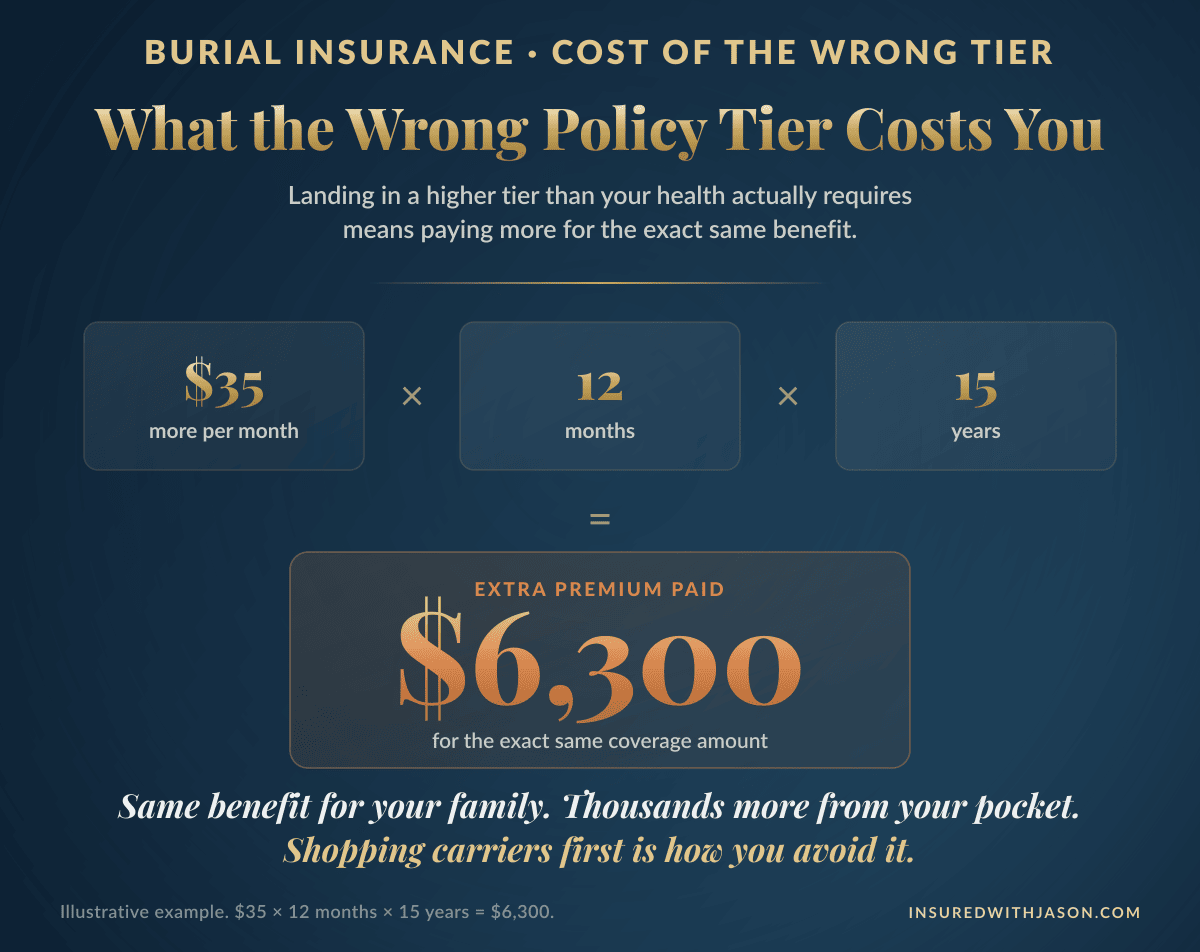
Same coverage for your family, thousands more from your pocket. Shopping the market first is how you avoid it.
Too many people disqualify themselves before they ever make the phone call.
That’s what bothers me. Somewhere right now there’s a person in good health for their age who’s convinced that because they’re not 22 anymore, they can’t get anything. And there’s someone else who got one decline and decided that was the market’s final word. Neither one knows there are people like me all over the country who will scour every carrier available in their state, turning over every stone to get them day one coverage.
Life insurance isn’t all or nothing, and treating it that way is how families end up with nothing. Once you actually ask, you know what’s attainable, and from there you can make a solid decision, whether that’s full coverage from day one, a graded policy, or guaranteed issue. I wrote this so you’d make the call you were talking yourself out of.
Burial insurance with pre-existing conditions: frequently asked questions
The questions people ask me most, answered plainly.
Can you be denied burial insurance because of pre-existing conditions? +
An individual insurance company can decline your application, but a decline from one company is not a decline from the market. Every company uses its own health questions and look-back windows, so the same conditions that get a no at one company can get a yes at another. And guaranteed issue burial insurance accepts everyone in the eligible age range with no health questions at all, so almost nobody is shut out of coverage entirely.
Does burial insurance pay if I die from my pre-existing condition? +
Yes. Once your policy is in force and any waiting period has passed, the death benefit pays for death from any cause, including the condition you disclosed on the application. With a no waiting period policy, that protection starts on day one. With a graded or guaranteed issue policy, the full natural-cause benefit becomes payable once the waiting period ends, and accidental death is covered in full from the first day on every policy type.
What if I was already denied life insurance by another company? +
You can still apply elsewhere, and many people denied life insurance at one company qualify at another, sometimes with no waiting period. Applications often ask whether you have been declined before, so answer honestly; the new company evaluates the reason behind the prior decline against its own rules. A broker can usually tell you which companies are most likely to accept your health profile before you submit anything.
Do I need a medical exam to get burial insurance? +
No. Burial insurance does not require a medical exam. Most policies use a short health questionnaire, usually around ten to fifteen yes-or-no questions, along with a prescription history check. Guaranteed issue policies skip the health questions entirely.
Is there an age limit for burial insurance? +
Most companies issue burial insurance between ages 50 and 85, and some offer it a bit younger or older. Your premium is set by your age on the day the policy starts and locks there for life, which is why starting sooner costs less for the same coverage.
Let’s find the company that wants you most
You came here wondering if your health would keep you from protecting your family, and now you know it doesn’t have to. The next step takes about five minutes: answer the health questions, by phone, email, or text, and find out which companies are most likely to accept you and exactly what your coverage would cost. Your rate is set by your age the day you start, so the least expensive day to ask is today.
This article is for educational purposes only and is not legal, tax, or financial advice. Coverage, costs, and rules for life insurance plans vary by person, company, and state. Please speak with a licensed professional about your specific situation before making a decision.
Day-one coverage checked first