
The 4 Types of Final Expense Insurance (and the One to Aim For)
Level, graded, modified, and guaranteed issue: what each one really pays your family, who each one fits, and how to aim for coverage that starts on day one.

- There are four types of final expense insurance: level, graded, modified, and guaranteed issue. They’re the same small whole life policy underneath. What changes is when your family gets the full benefit.
- Level is the one to aim for. It pays 100% of the benefit from day one, with no waiting period, usually at the lowest price.
- Graded pays a rising share of the benefit during the first two years. Modified and guaranteed issue return your premiums plus interest during that time, then pay in full after.
- The names describe the paperwork, not the value. Guaranteed issue sounds best but usually costs the most and always carries a two-year wait.
- You don’t need perfect health for day-one coverage. Everyday conditions often still qualify for level, and every insurance company draws its own lines.
- Because those lines differ, an independent broker who shops many carriers does two jobs: finds the best tier you qualify for, and the lowest price among the carriers in your state likely to approve you. That second part is true at every tier, even guaranteed issue.
- If day-one coverage truly isn’t possible, a graded or guaranteed issue plan is still worth having. Some people have health that rules out level everywhere, and for them, certain coverage in two years beats no coverage at all.
- Accidental death is typically paid in full at any time, on all four types, even during a waiting period.
- Health issues? Most qualify
- Declined? Jason has next steps
- New policies up to age 85
- Fits a Social Security budget
- Free quotes, no commitment
- Just Jason, never a stranger
Your information goes to Jason. Not a call center. Not a lead list.
There are four types of final expense insurance, and they all carry names that do a poor job of telling you what each one actually does. Guaranteed issue sounds like the safest pick, yet it usually costs the most and makes your family wait two years for the full benefit. A level policy sounds plain, but it pays in full from the very first day. Once you know what separates the four, you can look at any offer and see exactly what you are getting, and whether better coverage is within reach.





What the types of final expense insurance have in common
All four types of final expense insurance are the same product underneath: a small whole life insurance policy designed to cover a funeral and the other end-of-life expenses that come with it. Because it’s whole life, the premium is locked the day the policy is issued and never goes up, the coverage never expires, and the death benefit goes to the beneficiary you name. No type requires a medical exam. Nobody is drawing blood or scheduling a physical.
So if the product is the same, what separates the four types? Just two things: whether you answer health questions, and what the insurance company does with your answers. Behind the scenes, the insurer checks your application against your prescription history, so honest answers matter either way. Where your health lands you decides one thing above all: when your family can receive the full death benefit. The graphic below shows how that path works.
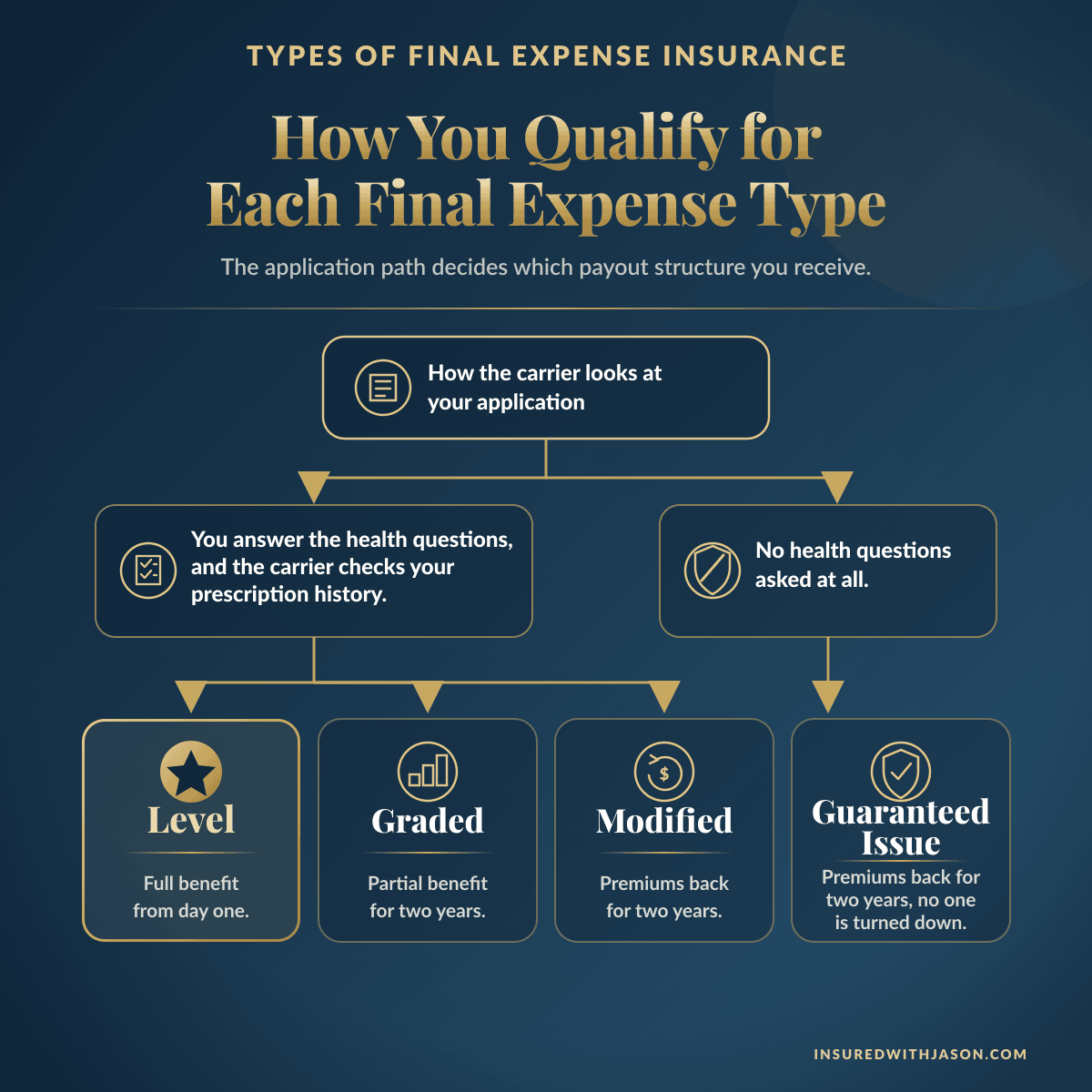
Two things decide which type you get: whether you answer health questions, and what your answers show.
The four types of final expense insurance, explained
Level benefit burial insurance: full coverage from day one
A level benefit policy pays 100% of the death benefit from the day it’s issued, no matter when or how you pass away. If the worst happened a week after your first premium, your family would receive every dollar of the coverage. There is no waiting period of any kind.
Level is the type to aim for, and it’s the one I try to find for every client first. It usually carries the lowest premium of the four, and it’s the only one that protects your family in full from day one. You qualify by answering no to the health questions and passing the prescription check. And here’s the part most people don’t expect: you don’t need perfect health. Plenty of people managing everyday conditions still qualify, because every insurance company draws its own lines.
A well-managed condition is not the same as a disqualifying one.
Many people who assume their health rules out day-one coverage qualify for a level policy once their profile is shopped to the right insurer. The same history can land in graded at one company and level at another. That difference is worth a lot of money over the life of the policy.
Graded benefit final expense insurance: a partial payout for two years
A graded benefit policy pays a percentage of the death benefit during the first two years, then the full amount after that. A common schedule pays roughly 30 to 40 percent of the coverage in the first year and 70 to 80 percent in the second, though every insurance company sets its own numbers. From year three on, it pays in full, for life.
Notice what graded is not. It is not a policy that pays nothing early on. If you passed away in those first two years, your family would still receive a real share of the benefit, not just your premiums back. That single detail separates graded from the two types below it, and it’s the detail most buyers were never shown. Graded exists for people whose health rules out level at a given carrier but isn’t in the most serious tier. If that’s the offer in front of you, it’s real protection, but it’s worth checking whether another insurer would offer you level first.
Modified benefit burial insurance: your premiums back during the wait
A modified benefit policy returns the premiums you’ve paid, plus a small amount of interest, if you pass away from natural causes during the first two years. After two years, it pays the full death benefit for life. Accidental death is typically paid in full at any time, just like graded.
This is where the labels start doing real damage, because graded and modified sound like the same thing, and they are not. Graded pays your family a real share of the coverage from the start. Modified pays back what you put in. On a two-year-old policy, that difference can be enormous. And a detail that surprises people: a modified policy still has health questions, and an application can still be declined. It accepts more health history than level or graded, but it is not automatic approval. Only one type is.
Guaranteed issue final expense insurance: no health questions, a two-year wait
A guaranteed issue policy asks no health questions at all. No medical exam, no prescription check, no application to fail. If you’re inside the eligible age range, you’re approved, no matter your health. That’s what the name promises, and it delivers.
Here’s what the name doesn’t say. Guaranteed issue is usually the most expensive type for the same coverage, and it carries a two-year waiting period that works like modified: if you pass from natural causes during those two years, your beneficiary receives the premiums back plus interest, not the death benefit. Accidental death is typically covered in full from day one. You’ve seen this type advertised, by the way. Those famous television commercials selling life insurance to seniors with no health questions asked are guaranteed issue, nearly every one.
So who is it for? People who genuinely can’t qualify for anything else. And for them it isn’t a consolation prize; it’s the policy doing exactly the job it was built for. Every premium is protected, an accident is covered in full immediately, and after two years the full benefit is locked in for life. If your health has closed the other doors, this is not you failing to get coverage. This is you getting the coverage that was built for exactly your situation, and knowing that two years from now your family is protected for good. That certainty is worth a great deal. And here’s something most people don’t realize: even guaranteed issue plans don’t all cost the same. The price for the same coverage varies from one insurance company to the next, so there’s still a lowest rate to find, and finding it is part of the job.
One thing from experience: I’ve met people who qualified only for guaranteed issue and put it off for years because the waiting period bothered them. Had they started when they first looked, the wait would already be behind them. If guaranteed issue is truly what you qualify for, the two years only start when you do, so the sooner you begin, the sooner your family is fully covered.
Simplified issue vs guaranteed issue: how fast you get approved
Simplified issue is not a fifth type of policy; it’s the way the first three get approved. The term just means the insurance company underwrites you with a short health questionnaire and a prescription check instead of a medical exam. Level, graded, and modified are all simplified issue policies, and an offer usually comes back within days, sometimes the same day.
Guaranteed issue is the other approval path: no questions, no check, no chance of being declined. So when you see the two side by side, you’re not comparing two policies. You’re comparing two ways of qualifying. Simplified issue opens the door to level coverage. Guaranteed issue opens a door that’s never locked, at a higher price and with a wait.
Can’t I just take guaranteed issue and skip the health questions?
Say someone calls me who could pass the health questions but wants guaranteed issue anyway, just to be done with it. I understand it, because nobody enjoys an interview. But that interview runs about ten minutes, I stay on the line with you for all of it, and the same monthly payment usually buys quite a bit more coverage on a level plan, payable in full from day one instead of after two years. Ten minutes has never been worth giving a family half the coverage.
What would change my answer: health that genuinely requires guaranteed issue. Then it isn’t a shortcut, it’s the right policy for the situation, and that’s a different and honest conversation.
The types of final expense insurance side by side
Here are all four types of final expense insurance in one view, so the differences stop hiding behind the names.
| Level | Graded | Modified | Guaranteed Issue | |
|---|---|---|---|---|
| Health questions? | Yes | Yes | Yes | None |
| Can you be declined? | Yes | Yes | Yes | No |
| Year 1 payout (natural causes) | 100% | About 30 to 40% | Premiums back plus interest | Premiums back plus interest |
| Year 2 payout (natural causes) | 100% | About 70 to 80% | Premiums back plus interest | Premiums back plus interest |
| Year 3 and beyond | 100% | 100% | 100% | 100% |
| Accidental death, any time | 100% | Typically 100% | Typically 100% | Typically 100% |
| Cost for the same coverage | Lowest | Moderate | Higher | Highest |
Payout schedules and interest rates vary by insurance company. Confirm the exact schedule in any policy before you buy.
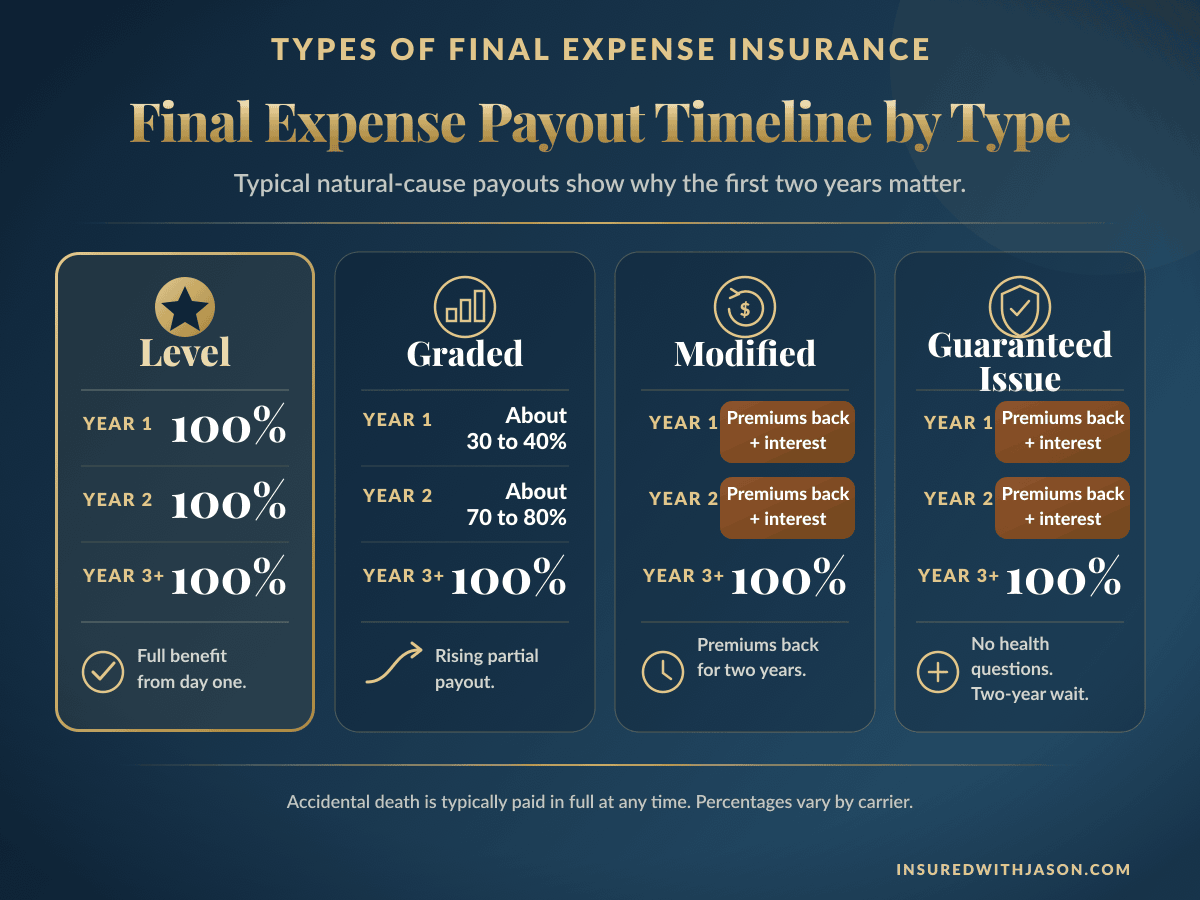
What each type pays your family in the first two years is the real difference between them.
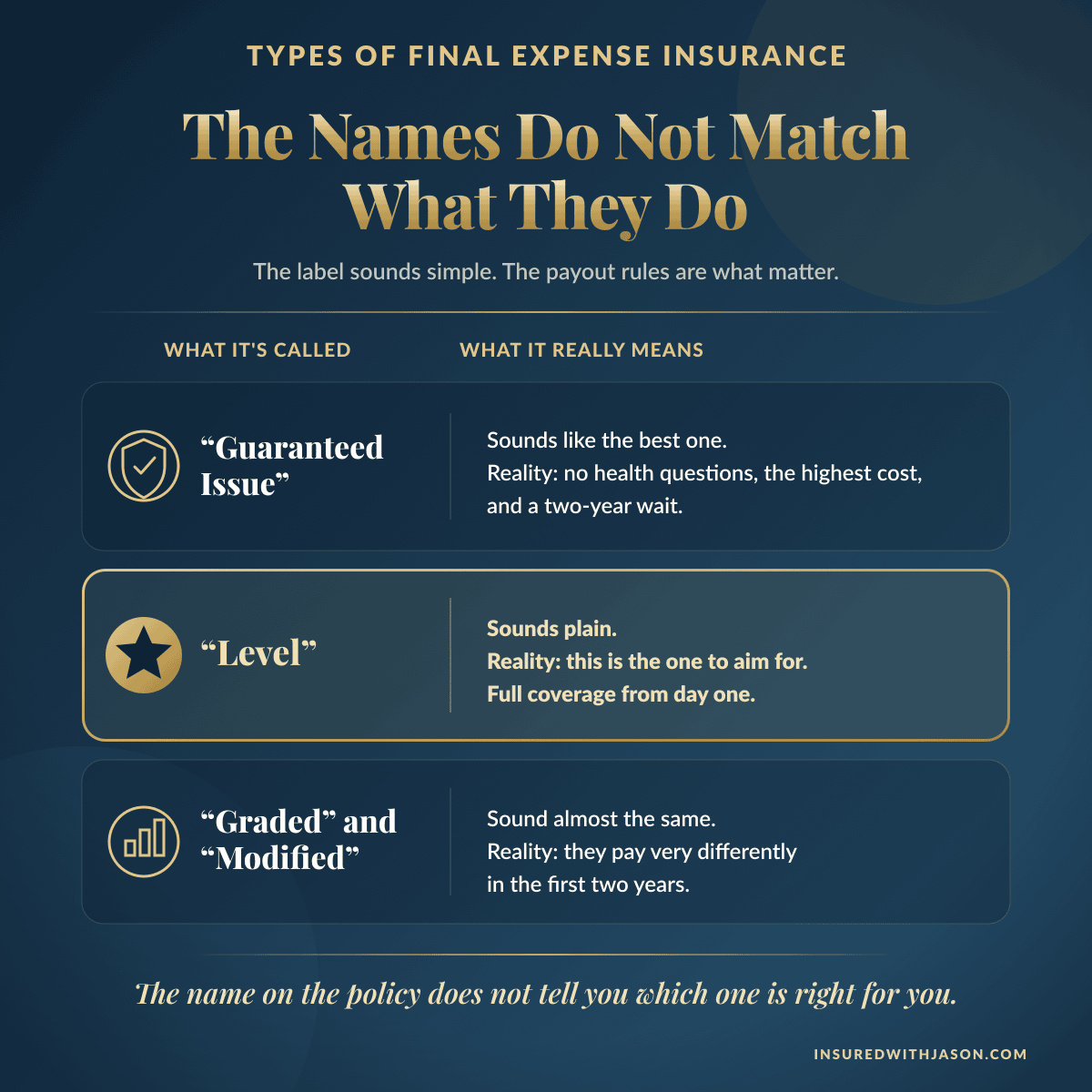
The names on these policies describe the underwriting, not the value. Level is the quiet winner.
Which type of burial insurance is right for you
The right type of burial insurance is the best one your health will let you buy, and the order to try them in never changes. Aim for level first, and drop to the next type only when the one above it is truly out of reach. Here’s the order, top to bottom.
Aim high, then work down
Say yes to a lower step only after the step above it has actually said no.
- 1Aim Here FirstLevel: full coverage from day one
The most protection for your dollar and the fastest full benefit. If any insurer offers you level, that’s your policy.
- 2Next BestGraded: a real partial payout during the wait
If level is truly out of reach, graded still pays your family a meaningful share in the early years instead of a refund.
- 3If Graded Isn’t OfferedModified: premiums back during the wait
Often still a better value than guaranteed issue, because the payout is comparable and the premium is usually lower.
- 4Certain Coverage For Those Who Need ItGuaranteed issue: nobody is left with nothing
When health closes the other three doors, this one opens every time. For those who truly can’t qualify otherwise, it’s a real answer: certain, permanent coverage two years out, and worth starting today.
See if you qualify for day-one coverage.
Full coverage from the first day · No waiting
How to get day-one final expense coverage with health conditions
Day-one coverage with health conditions comes down to one fact: every insurance company underwrites differently, and the same health history can get a different answer at each one. There is no universal rulebook. A history that lands in graded territory at one insurer can qualify for level at another, because each company writes its own health questions and draws its own lines.
That’s why the single most useful move you can make is having an independent broker shop your health profile across many carriers before you accept anything. A broker who represents one company can only offer what that company sells. An independent broker does two things at once: finds the best tier you qualify for, and then, among the carriers likely to approve you at that tier, finds the lowest price in your state. Getting approved is only half the job. Getting approved at the lowest rate is the other half, and it’s where an independent broker earns their keep. The best tier is level coverage more often than people expect. Two things help the search: answer every health question honestly, since the prescription check verifies your answers anyway, and apply while it’s on your mind, because your age sets your premium and it isn’t going down.
And if the search comes back and day-one truly isn’t available to you, that’s an answer too, and a useful one. It means you’ve stopped guessing and can move forward with confidence. A graded or guaranteed issue plan still puts real, permanent protection in place. The point was never day-one or nothing. The point is knowing your family is covered, and getting that started.
What to watch out for before you buy funeral insurance
Funeral insurance, burial insurance, and final expense insurance all describe the same small whole life policy, and the shopping traps are the same too. Before you sign anything, run down this short list, and ask one plain question that tells you everything.
What to confirm, and what to walk away from
A real final expense policy is whole life, with a fixed premium and full natural-death coverage. Use this to tell a solid offer from a trap.
- The premium is fixed for life, in writing, and never rises.
- It’s whole life, so it never expires while it’s paid.
- It covers natural death, not just accidents.
- You know which of the four types you’re being offered.
- A premium that rises every few years and becomes unaffordable with age.
- A term policy dressed up as final expense, one that ends at a set age.
- An accident-only policy that pays nothing for natural death.
- An agent who can’t or won’t tell you the payout if you passed tomorrow.
If I passed away tomorrow from natural causes, exactly what would my family receive?
Now that you know the difference between a graded payout and a returned premium, that single question tells you everything about the policy in front of you. If the answer isn’t clear, that’s your answer.
Final expense insurance types: frequently asked questions
The questions people ask me most about the four types, answered plainly.
What’s the difference between graded and modified final expense insurance? +
Both carry a two-year waiting period, but they pay very differently during it. A graded policy pays your family a percentage of the death benefit, commonly 30 to 40 percent in year one and 70 to 80 percent in year two. A modified policy returns the premiums you’ve paid plus a small amount of interest. After the waiting period, both pay in full.
Does all final expense insurance have a waiting period? +
No. A level benefit policy pays the full death benefit from the day it’s issued, with no waiting period at all. Only graded, modified, and guaranteed issue policies carry one, and it typically applies to natural causes of death, not accidents.
Is guaranteed issue life insurance a bad choice? +
Not for the person it was built for. If your health can’t qualify for any other type, guaranteed issue means your family is never left with nothing: premiums are protected during the waiting period, accidents are typically covered in full immediately, and the full benefit locks in after two years. It’s only a poor choice when someone who could qualify for a better policy buys it without checking.
What happens if I die during the waiting period? +
It depends on your policy type and the cause of death. On a graded policy, your beneficiary receives a percentage of the death benefit. On a modified or guaranteed issue policy, they receive the premiums paid plus interest. On any of the four, accidental death is typically paid in full at any time. And on a level policy the question never comes up, because there is no waiting period.
Is burial insurance different from final expense insurance? +
No. Burial insurance, final expense insurance, and funeral insurance are three names for the same product: a small whole life policy designed to cover end-of-life costs. Whatever name is on the brochure, the four types work exactly as described above.
Can I be turned down for guaranteed issue? +
Not because of your health. Within the eligible age range, a guaranteed issue policy accepts every applicant, with no health questions and no medical exam. Age limits vary by insurance company.
I’ll turn over every stone before I ever tell someone day-one coverage is off the table, because most people who were told it’s impossible were told wrong. But some people truly can’t qualify, and I never want them to feel this page wasn’t for them. It is. If day-one isn’t possible for you, a graded or guaranteed issue plan is still real protection worth having, and certain coverage two years from now beats leaving your family with nothing. Whatever tier you land in, my job doesn’t end at getting you approved. It ends when I’ve found you the lowest price among the carriers that will take you. What I don’t want is anyone shopping in circles, calling office after office to hear the same answer. Once you know which type fits you, the move is the same either way: get it started at the best rate you can. That’s the whole reason for this page.
Find out which type you qualify for
You now know the four types better than most people ever will. The one thing an article can’t tell you is which one your health qualifies you for, and that’s the work I do. I’m an independent broker, and I’ll shop your health profile across the market to find the best coverage you qualify for, at the lowest price among the carriers in your state likely to approve you. We aim for day-one first, and if that isn’t possible, we find the plan that gives your family real, permanent protection, still at the best rate available to you. Either way you walk away covered, not guessing. Your rate is set by your age today, so the sooner we look, the better the answer.
This article is for educational purposes only and is not legal, tax, or financial advice. Coverage, costs, and rules for life insurance plans vary by person, company, and state. Please speak with a licensed professional about your specific situation before making a decision.
Independent broker · No spam calls, ever