
Burial Insurance for Seniors: How to Get Approved Today, Whatever Your Health
What approval really takes with health conditions, what coverage honestly costs each month, and how to get it done today with an independent broker who works for you.

- Nearly every senior qualifies for some form of coverage. The real question is which of three approval types your health lands you in, because that decides your price and when the full benefit is payable.
- Many seniors get coverage with no waiting period, even with diabetes, high blood pressure, or a heart history, as long as the conditions are managed.
- Decisions are usually instant, and coverage can begin the same day.
- A $10,000 policy runs roughly $40 to $78 a month in your early 60s and climbs with every year you wait. Ranges are estimates; a real quote is the only number you can take to the bank.
- There is no government burial insurance program. Social Security pays a one-time $255, capped in 1954 and frozen flat since 1981, which covers about 3% of a median funeral.
- The “best company” depends on your health, not a ranking. The winner is whichever company approves you at the lowest price, ideally with no waiting period, and finding that company is exactly what an independent broker does.
- Your premium locks the day your policy starts and never rises. Age only moves the starting price in one direction.
- Health issues? Most qualify
- Declined? Jason has next steps
- New policies up to age 85
- Fits a Social Security budget
- Free quotes, no commitment
- Just Jason, never a stranger
Your information goes to Jason. Not a call center. Not a lead list.
Burial insurance for seniors was built for exactly the age you are right now, which means you are not late to the party. Most seniors think they waited too long to get burial insurance, but the truth is most people in their 60s, 70s, and even their 80s will still get approved, many with no waiting period, and decisions are usually instant. These policies were designed for this exact time in your life, and getting approved is more straightforward than most people expect.





What is final expense burial insurance for seniors?
Final expense burial insurance is a small whole life insurance policy, usually between $5,000 and $50,000, built to pay for your funeral and other final bills. The premium locks in on day one and never goes up. The coverage never expires. And there is no medical exam, just a short set of health questions, and sometimes none at all.
You will see it sold under three names: burial insurance, final expense insurance, and funeral insurance. All three are the same product, a type of whole life insurance sized for the end-of-life bills a family actually faces. When the time comes, the money goes straight to the person you name, tax-free and in cash, to use however your family needs it most.
That is the whole product in one paragraph, and if you want the deeper mechanics, my complete burial insurance guide walks through every gear. This page is for something more specific: you, at your age, getting approved and covered now.
Can seniors get approved with diabetes, heart problems, COPD, or high blood pressure?
Yes. Most seniors with common health conditions still get approved, and many still qualify for coverage with no waiting period. I started helping families over twenty years ago, and the single biggest surprise I get to deliver is this one: the conditions people assume will sink them, like managed high blood pressure, controlled type 2 diabetes, asthma, arthritis, or a heart history that has settled down, usually do not.
Here is the part most articles skip. The question was never “will I be approved?” It is “which of three doors does my health put me through?” Every application lands behind one of them, and the door decides your price and when the full benefit becomes payable.
Full coverage from the very first day, at the lowest price. The industry calls this level benefit, or day-one coverage. This is the door we fight to get you through.
- Managed high blood pressure, controlled type 2 diabetes, asthma, arthritis, or past surgeries that healed well.
- No major hospitalizations or new diagnoses in the last couple of years.
You are approved, but the full benefit is usually delayed for about two years. A middle door for moderate health situations, and one worth trying to shop your way out of.
- Insulin use is a common trigger, along with some COPD and heart condition answers.
- One company’s graded offer often isn’t every company’s answer, which is why we keep shopping.
No health questions at all. Everyone in the age range is accepted. The trade-off is a waiting period of about two years and a higher price, because the company is accepting everyone.
- Recent cancer treatment, congestive heart failure, kidney disease, a recent stroke or heart attack, or dementia.
- Being declined elsewhere. Nobody in the age range is truly out.
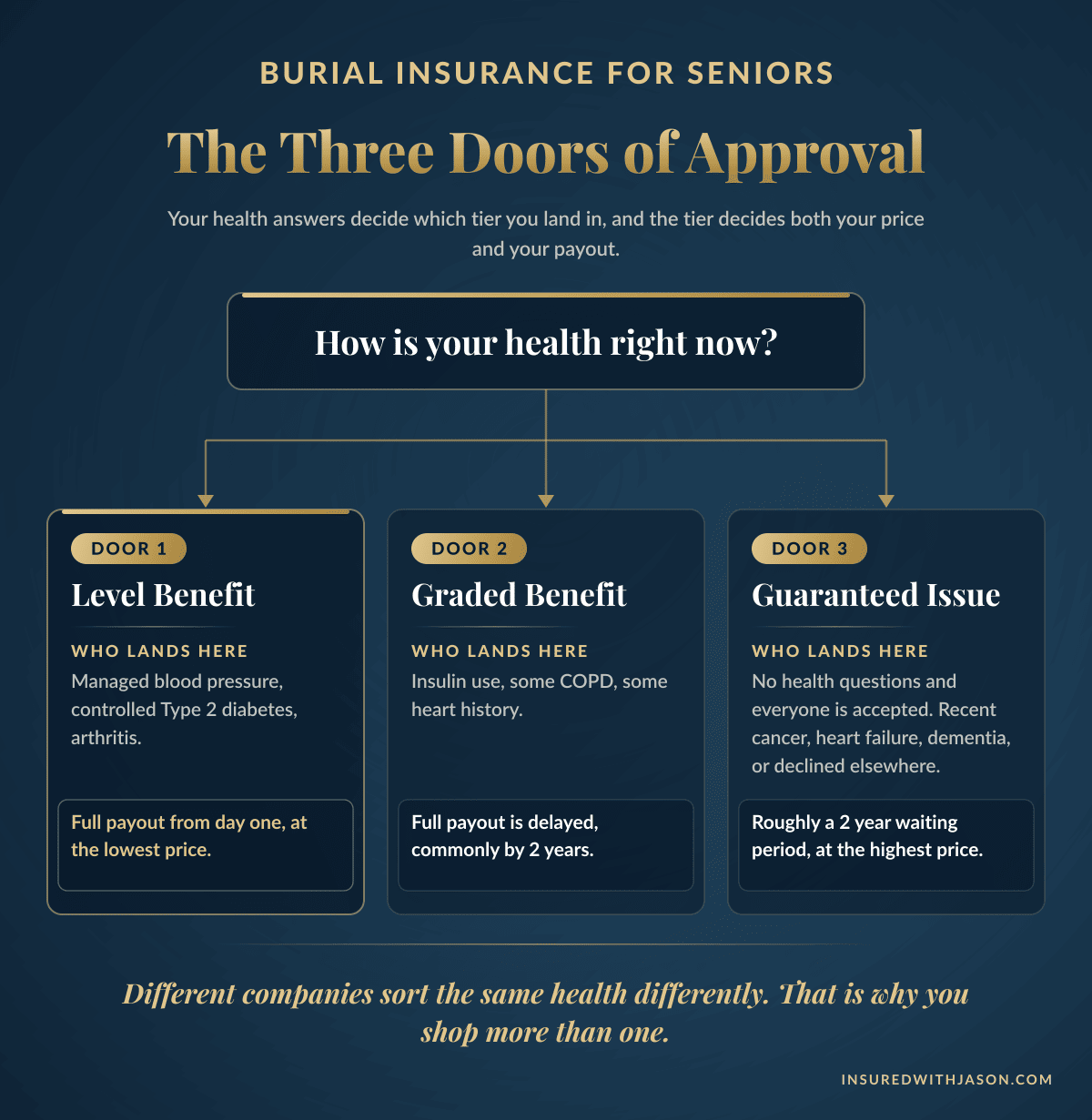
One question decides everything: which approval door your health opens, and different companies answer it differently.
Here is why those doors matter so much: the same health answers do not open the same door at every insurance company. One company reads insulin use as an automatic graded offer. Another reads the exact same application and offers coverage with no waiting period. Neither company is wrong. They just measure risk differently, and how each company handles burial insurance with pre-existing conditions is exactly where a good broker earns their keep.
I was declined two years ago. Doesn’t that mean I’m uninsurable?
No, and here’s how I think it through. A decline is one company’s answer at one moment, not a status. So say someone brings me a two-year-old no: we go through the health questions fresh and see who might approve them today, because two years is plenty of time for things to change, especially if the decline came right after a health event that has since settled down. And with a single company, you never even know whether you should have applied somewhere else in the first place.
What would change my answer: what actually caused the decline, and how long ago it happened. The only way to know is to look, and looking is free.
Worried your health will hold you back? Find out in about a minute.
See If You Qualify →Do senior burial policies have a waiting period?
Some do and some don’t, and the difference comes down to which approval door you walked through. A policy with no waiting period pays the full benefit from the very first day it’s in force. A graded or guaranteed acceptance policy makes your family wait, usually about two years, before the full benefit is payable for natural causes. If you pass away during that window, most companies return the premiums you paid plus a little interest instead of the full amount.
Here’s the part that bothers me enough to put it in writing. Guaranteed acceptance is marketed as the easy option, no questions, no hassle, everyone approved. What the ads leave out is that the no-questions policy is also the one most likely to pay your family little if the worst happens early. And the people most likely to buy it, seniors with serious health issues, are exactly the people for whom those first two years matter most. That’s not a reason to avoid it. It’s a reason to understand it, and to make a good broker check every other door first.
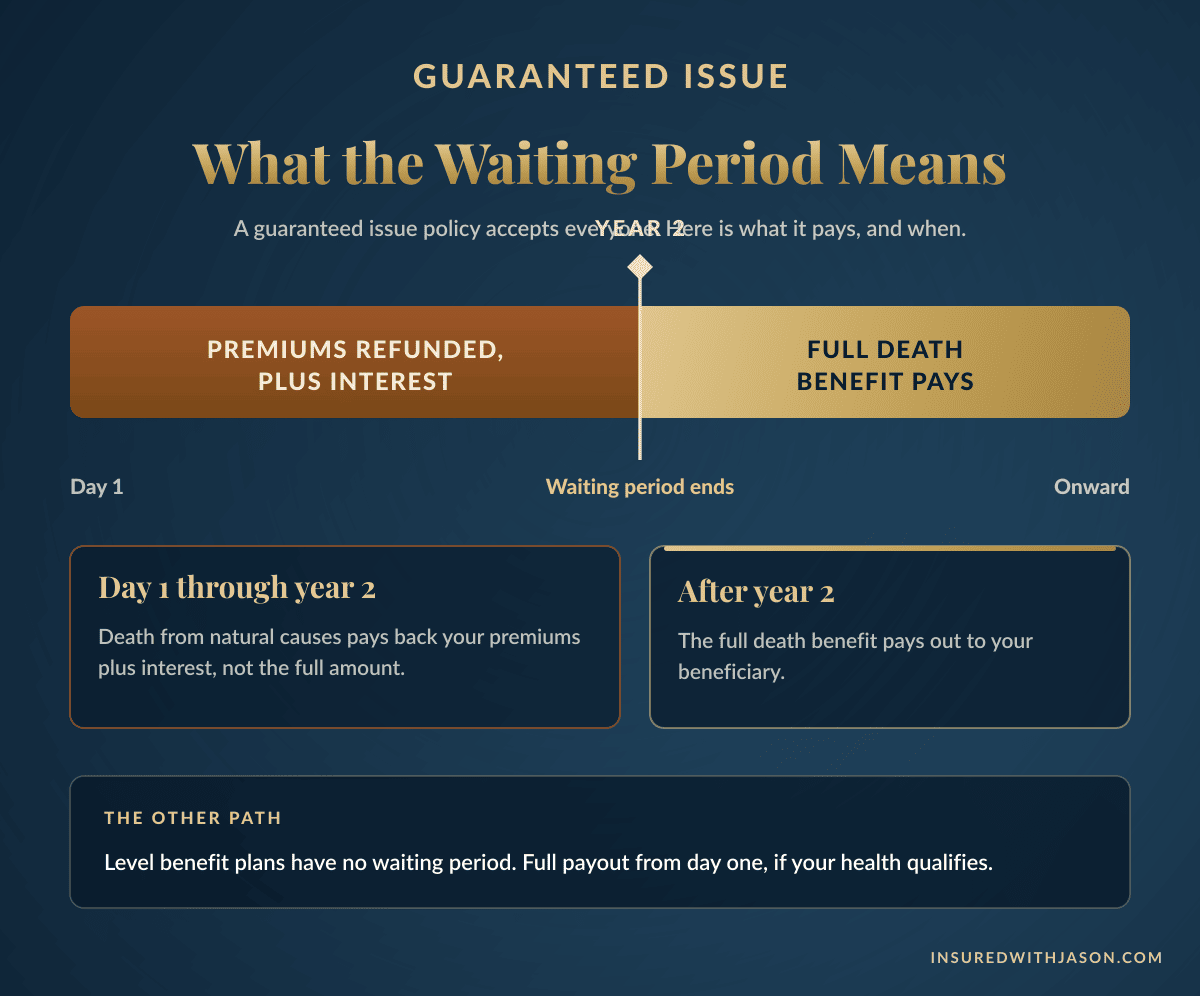
The guaranteed acceptance timeline: about two years of limited protection, then the full benefit, while no-waiting-period plans pay in full from day one.
One more thing worth knowing: even a waiting period has a bright side, and it’s time. The two-year clock starts the day the policy does, and it runs whether you’re thinking about it or not. Two years from now, a guaranteed acceptance policy bought today has no waiting period left at all. We’ll come back to why that matters so much in the section on age.
How much does burial insurance for seniors cost?
For a $10,000 policy with no waiting period, most non-smoking seniors pay somewhere between $40 and $130 a month, depending on their age. The ranges below show how that moves through the decades. Your gender, your health, and tobacco use all shift the price too, and women generally pay less than men at every age.
What a $10,000 no-waiting-period policy tends to cost a non-smoker, by age.
| Your Age | $10,000 of Coverage |
|---|---|
| 50–55 | $25–$45 / month |
| 56–65 | $40–$78 / month |
| 66–75 | $65–$130 / month |
| 76–85 | $92–$200+ / month |
These are market-consistent estimates as of July 2026, and prices change constantly. The only number you can take to the bank is a real quote from a real licensed insurance broker, and we can get you that quote in minutes.
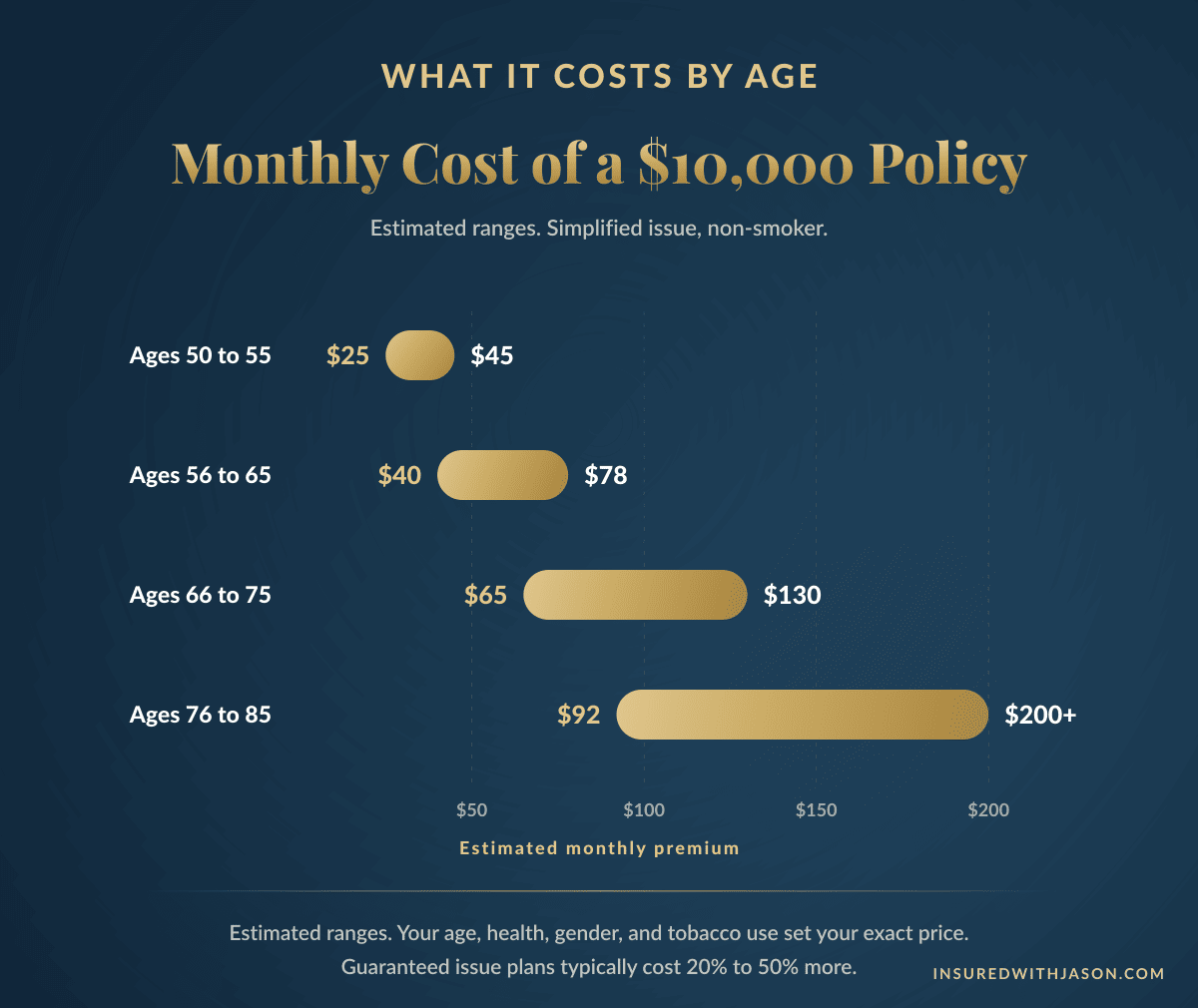
The pattern every senior should see once: the price climbs with every age band, and it only ever climbs.
Two facts do most of the work in that table. First, your premium is set by your age on the day the policy starts, and once it’s set, it is locked for life. It will not rise on your birthday, and it will not rise if your health changes. Second, the price of waiting runs in only one direction. Guaranteed acceptance coverage costs more than these ranges for the same amount, because the company is accepting everyone without a single health question, and that risk gets priced in.
So when someone at 75 looks at the price and wishes they’d bought at 60, I understand it completely. Everybody wishes they’d done something sooner, me included. But that’s not how you judge where you stand with this. The comparison that matters is between the price at your age now and the price at your next one.
See what no-waiting-period coverage costs at your exact age.
Get My Price →How much burial insurance coverage does a senior actually need?
Enough to cover the send-off you actually want, plus a cushion, and the honest starting point is what funerals really cost. The National Funeral Directors Association’s 2023 study puts the national median at $8,300 for a funeral with viewing and burial, and $6,280 for a funeral with cremation. Both numbers leave out the cemetery side, and the plot, marker, and flowers can add another $2,000 to $5,000 on top.
That’s why $10,000 to $15,000 handles a cremation or a modest funeral with a little room to spare, $15,000 to $25,000 covers a traditional burial plus some final bills, and $25,000 to $50,000 covers everything and still leaves a small gift behind. Build your amount up from the real bill, never down from whatever an ad happens to be selling.
Cremation is now the majority choice in America, projected at about 63% of cases in 2025 and climbing toward 82% by 2045.
That shift changes the math for a lot of families. If cremation is your plan, a smaller policy sized to the real $6,280 median, plus your other final bills, can protect your family completely without paying for coverage you never intended to use.

Three coverage tiers, sized to real median funeral costs, so you can pick your number instead of guessing at one.
Doesn’t the government help pay for funerals?
Is there a government burial insurance program for seniors?
No. There is no federal burial insurance program, no government final expense plan, and no free burial insurance for seniors. The only federal payment tied to a death is Social Security’s one-time lump-sum death payment of $255, and it goes only to a qualifying surviving spouse or, in limited cases, a child, who must claim it within two years. You can read the rule straight from the Social Security Administration.
Now here’s the part almost nobody says out loud. That $255 was capped back in 1954, and a 1981 law froze it flat and restricted who can receive it to a surviving spouse or child. Adjusted for inflation, it would be worth more than $3,000 today. Against the $8,300 median funeral, it covers about 3%. Congress noticed: a 2024 bill called the Social Security Survivor Benefits Equity Act proposed raising it to $2,900 and tying it to inflation going forward. It was never enacted. The payment is still $255, and it still covers about 3% of the bill.
The one-time lump-sum death payment, capped in 1954 and frozen flat since 1981. It covers about 3% of today’s median funeral, and the 2024 bill to raise it was never enacted.
Source: Social Security Administration
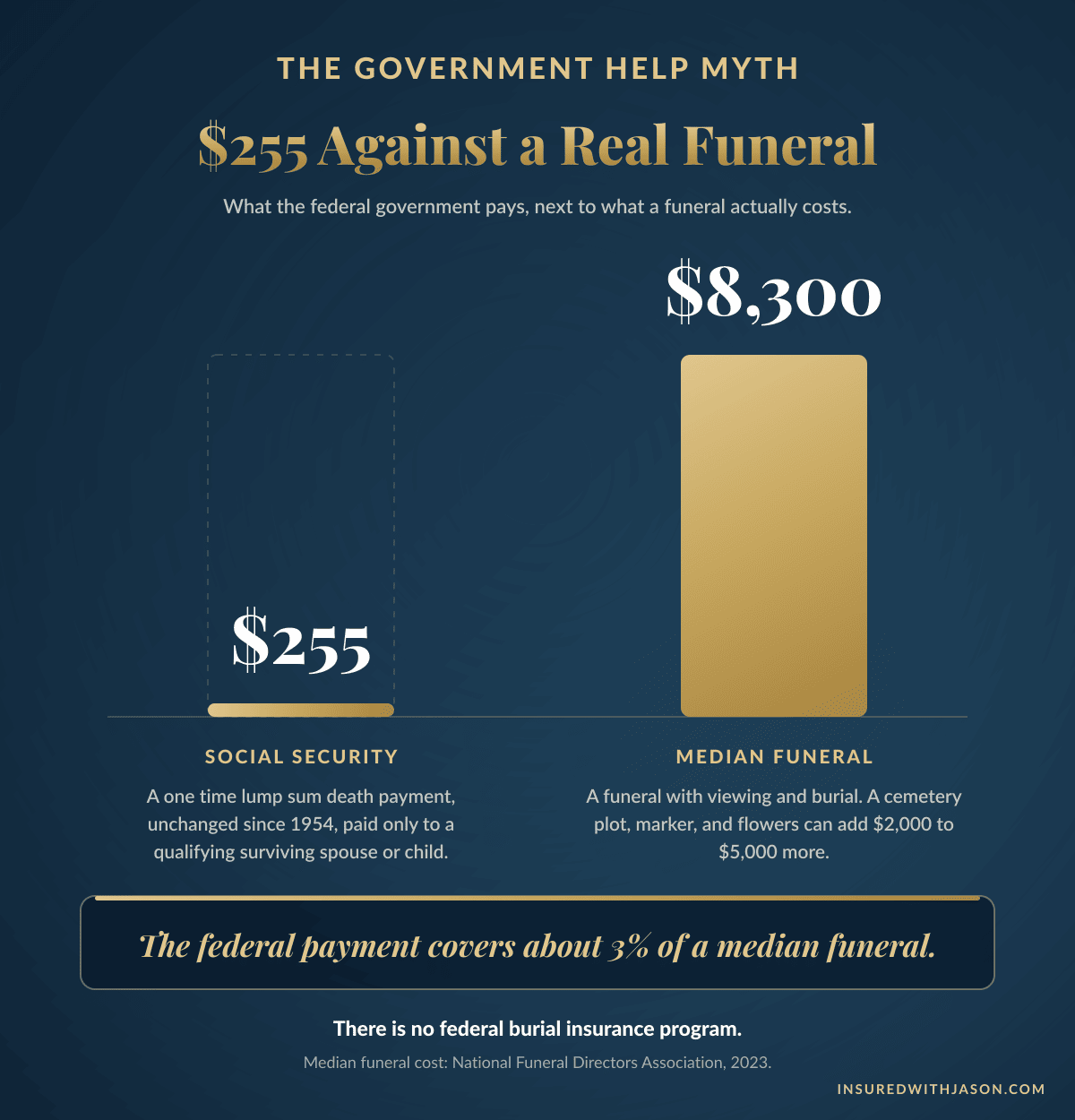
The whole government-help myth in one picture: $255 next to an $8,300 median funeral.
So when a mailer or a search result dangles “government burial programs for seniors,” you now know exactly what’s behind the curtain: $255 for a qualifying spouse, and nothing else. The gap between that payment and a real funeral is the exact gap a burial insurance policy exists to close, with money that goes to your family, not to a program with rules about who qualifies.
What age is too old for burial insurance?
Most insurance companies stop taking new applicants at 85, and a small number will issue a new policy up to age 90. Coverage caps also shrink as you get older, so an 82-year-old can usually buy less total coverage than a 70-year-old. And honestly, that’s less of a problem than it sounds. By 85, the mortgage is almost always gone, the kids are grown, and often seniors themselves. What you need at that point is truly a funeral policy, or a cremation policy, and the smaller caps fit that smaller need just fine.
The age that deserves real attention is the one right before the door narrows. Let me walk you through the decision I sit with people on all the time, because it may be yours or belong to someone you love.
Picture someone who is 84. We shop the whole market for no-waiting-period coverage first, always, even after a decline, because if your health is good, your age alone means very little. But suppose it’s confirmed: no company will offer day-one coverage. Now there’s one decision left. Take the guaranteed acceptance policy at 84, with its roughly two-year waiting period, or do nothing.
Here’s what doing nothing actually costs. The next chance to decide comes at 85, at a higher price, and after 85 most companies are no longer available at all. Meanwhile the two-year clock never needed your permission to run. Take the policy at 84, and by 86 the waiting period is behind you and your family is fully protected. Do nothing, and at 86 you have fewer companies, higher prices, and not one day of that clock used up. Not qualifying for no-waiting-period coverage stings, I know. But the sting is not a reason to leave your family unprotected. Taking the policy that’s available to you isn’t settling. It’s doing something real to protect the people you love, and that is the whole point.
Lock your rate before your next birthday.
Get My Quote →Which company has the best final expense insurance for seniors?
The best company is whichever one approves you at the lowest price, ideally with no waiting period, and you can’t know which one that is until companies actually look at your health. That’s the honest answer, and it’s the one the “top ten” lists can’t give you. You’ve heard the big names. They’re largely the same insurance companies I represent. But a company that’s the cheapest for your neighbor’s arthritis may not be the cheapest for your diabetes, because each one treats each condition differently.
This is the whole reason independent brokers exist. I don’t work for any one insurance company; I work for you, and I shop more than 25 of them to find which will approve you and which offers you the lowest price. A good broker turns over every stone and moves mountains to get you no-waiting-period coverage before ever settling for less. That’s the job, and it costs you nothing, because brokers are paid by whichever company you choose, at the same price you’d pay going to that company directly.
The best company isn’t a name on a list. It’s whichever one approves you at the lowest price, ideally with no waiting period.
Mailers and TV ads promising huge coverage amounts for a few dollars a month are not describing this product.
Real burial insurance policies run $5,000 to $50,000, priced by your age and health. An unsolicited offer of $100,000 for pocket change, or a form that floods your phone with calls the moment you submit it, is a lead machine, not a policy. A legitimate quote names a licensed broker or agent you can look up. Mine is NPN 8616286, and you’re welcome to check it.
How fast can a senior get approved and covered?
Decisions are usually instant, and coverage can begin the same day. The application takes about 15 minutes, most times less, with no medical exam, just the health questions. Most of the time we know whether you’re approved within minutes of applying, usually while we’re still on the phone together. Once in a while an application needs a closer look and gets kicked to underwriting for a day or so, but that’s the exception, not the rule.
And when your family eventually needs the policy to do its job, it moves fast there too. A standard claim on an in-force policy, with complete paperwork, typically pays within about 3 to 14 business days, in cash, directly to the person you named. One clarification worth having: every life insurance policy also has a contestability period, generally the first two years, when the company can review the application’s answers if a death occurs early. That’s a separate mechanism from the guaranteed acceptance waiting period, and for anyone who answered their health questions honestly, it’s nothing to fear.
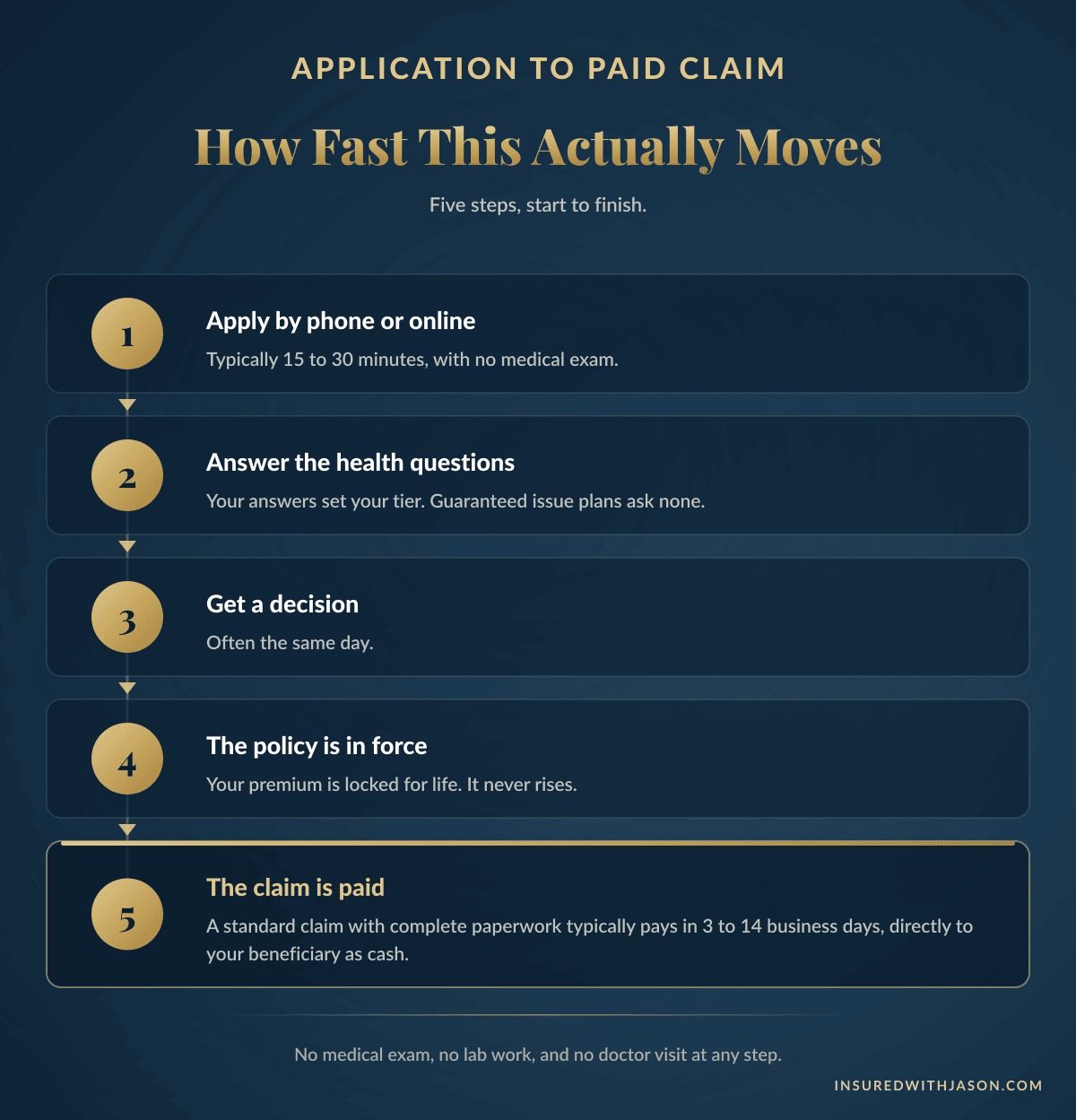
Start to finish: a short application, a decision that’s usually instant, and a claim paid directly to your family in days.
What does your burial insurance policy cover?
Whatever your family needs it to cover. The benefit pays in cash to the person you name, not to a funeral home, and there are no restrictions on how it’s used. The funeral, the cremation, the cemetery, final medical bills, a credit card balance, or simply a cushion while the family catches its breath: your beneficiary decides, because it’s their money the moment it pays.
That flexibility is also what separates this coverage from a preneed plan sold at a funeral home. A preneed contract locks your money to that one funeral home and its price list. A burial insurance policy travels with your family wherever they are and whatever they choose. Both have their place, but only one keeps every option open.
One small piece of housekeeping does a lot of work here: name a real person as your beneficiary, and check the name every few years. If no beneficiary is on file, the money pays to your estate instead, and an estate can mean probate, which means waiting, which is the one thing this policy exists to prevent. Naming a person keeps the payout fast and simple, exactly the way you intended it.
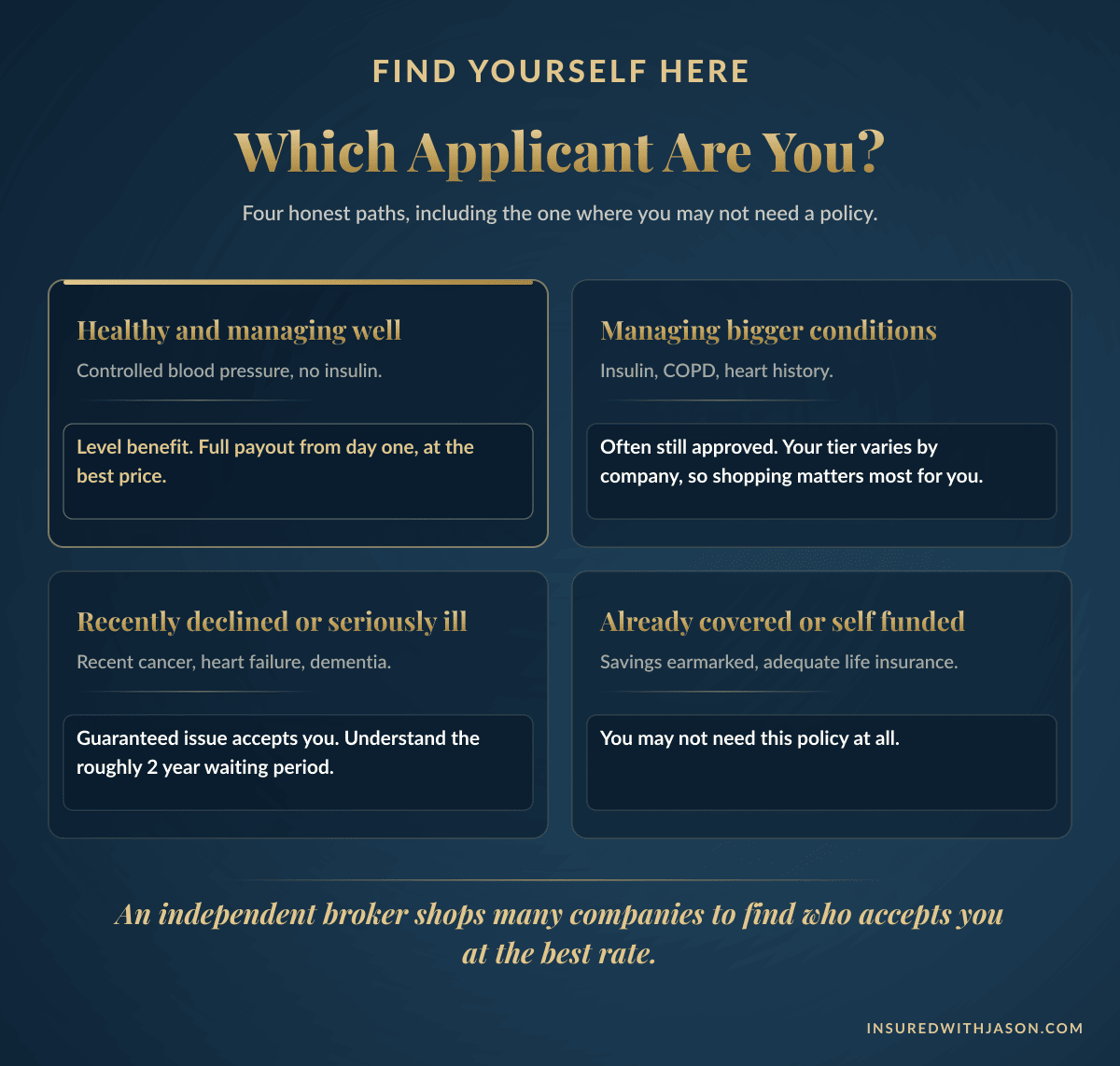
Find yourself on the map: four kinds of applicants, the path that usually fits each one, and the honest note that some people don’t need this policy at all.
Burial insurance for seniors: frequently asked questions
The questions people ask me most, answered plainly.
Can I get burial insurance with COPD? +
Often, yes. Approval usually depends on the severity, whether you use oxygen, and whether you’ve had a recent hospitalization. Some companies will offer coverage with no waiting period, while others may offer a graded policy for the same answers, which is exactly why we shop your situation across multiple companies before accepting any single answer.
Is there burial insurance for seniors with no waiting period? +
Yes. If your health qualifies you for a level benefit policy, the full coverage amount is payable from the very first day, with no waiting period at all. Only graded and guaranteed acceptance policies carry a waiting period, and a good broker always tries every no-waiting-period option first.
What is the oldest age you can buy burial insurance? +
Most companies stop taking new applicants at 85, and a small number will issue a new policy up to age 90. Coverage amounts also shrink at the oldest ages, so the sooner you apply, the more companies and more coverage you have to choose from.
Does Social Security pay for a funeral? +
No. Social Security pays a one-time lump-sum death payment of $255 to a qualifying surviving spouse or, in limited cases, a child. It was capped in 1954, frozen flat since 1981, and covers about 3% of the median cost of a funeral. There is no federal burial insurance program.
How fast does burial insurance pay out? +
A standard claim on an in-force policy with complete paperwork typically pays within about 3 to 14 business days, in cash, directly to the beneficiary. Claims can take longer if paperwork is missing or if the death falls within a waiting period or the policy’s first two years. And your family won’t handle it alone: part of my service is being there on the worst day, walking them through the claim and making sure no paperwork is missing, so the payout arrives as fast as it possibly can.
Do burial insurance premiums go up as I get older? +
No. Your premium is set by your age and health on the day the policy starts, and it is locked for life. It will never rise with your next birthday or with a change in your health. Waiting to apply is the only thing that raises the price.
You shouldn’t have to chase an 800 number to protect your family.
I wrote this because so many seniors quietly assume the answer is already no, when most of the people who ask me get approved. Everybody wishes they’d done something sooner. Everybody, including me. But that’s not how you judge where you stand. You’re still here, you still have your wits about you, and you still love your family, and that makes this a good time to put a policy in place.
I also wrote it because you shouldn’t have to call an 800 number or chase a TV offer that sounds too good to be true. You can still handle this the old-fashioned way, with one licensed broker who works for you, and with the speed of today’s technology working right beside you.
If you’re a senior without coverage or savings set aside for your final expenses, burial insurance is often the simplest way to make sure your family never has to find that money in their hardest week. Most people reading this will get approved, many with no waiting period, and your price is set by your age on the day you start.
Let’s find out what you qualify for today
You came here with three questions: can I get approved, what will it cost, and how do I get it now. You have the honest answers, and the last step takes about a minute. Tell me a little about yourself in the form above, and I’ll shop more than 25 insurance companies to find who will approve you at the lowest price, ideally with no waiting period. Decisions are usually instant, and coverage can begin the same day.
This article is for educational purposes only and is not legal, tax, or financial advice. Coverage, costs, approval outcomes, and rules for life insurance plans vary by person, company, and state, and the cost ranges shown are estimates, not quotes. Please speak with a licensed professional about your specific situation before making a decision.
Most age 50–85 qualify