
Burial Insurance Policy Maintenance: Keeping Your Policy Up to Date
The five-minute yearly habit that makes sure your policy pays the right people on the day it matters.

- Two updates can’t wait: tell your carrier the same week you change banks or move. A bounced draft starts the grace-period clock.
- Your will does not control the payout. The beneficiary form does, so review it yearly and always name a backup beneficiary.
- A third-party notification designee is free. One form, and a person you trust gets a copy of any lapse warning before coverage ends.
- Somebody needs to know the policy exists. Billions in benefits have gone unclaimed because nobody knew where to look.
- Keep the policy you have. Letting it lapse or replacing it can restart the two-year contestability window.
- Health issues? Most qualify
- Declined? Jason has next steps
- New policies up to age 85
- Fits a Social Security budget
- Free quotes, no commitment
- Just Jason, never a stranger
Your information goes to Jason. Not a call center. Not a lead list.
Burial insurance policy maintenance comes down to one idea: your policy has one job on one day, and that day may be twenty or thirty years from now. Between now and then, life keeps moving, through new banks, new addresses, new grandchildren, and goodbyes you didn’t see coming, and the policy can’t follow any of it on its own.
The good news is that keeping a policy healthy takes about five minutes a year. If you don’t own coverage yet, start with the full guide to burial insurance and come back here after you buy.





Table of contents
- You Changed Banks or Moved: The Two Updates That Can’t Wait
- What Should You Check on Your Policy Every Year?
- What Is a Third-Party Notification Designee?
- Who Should Know Your Policy Exists?
- What Happens When Nobody Knows About a Policy?
- The Five-Minute Burial Insurance Policy Maintenance Routine
- Who Do You Call to Update Your Policy?
- What You Don’t Need to Do
- Frequently Asked Questions
You Changed Banks or Moved: The Two Updates That Can’t Wait
Almost every carrier collects premiums by automatic monthly draft from a checking account, and that setup exists to protect you. It keeps the policy alive without you having to think about it, because a lapse is the one problem nobody wants. Nobody sets out to lose coverage they’ve been paying for. The draft is what stands between a busy life and a lapsed policy.
That’s exactly why a new bank account is the single most urgent update you’ll ever make. When the draft hits a closed account, it bounces, and a bounced draft starts a clock most people never know is running: the grace period, typically 30 to 60 days depending on your state and policy. Pay inside that window and nothing is lost. Miss it, and the coverage ends. Call your carrier or your broker the same week you switch banks, not next month.
Your address matters for the same reason. The carrier’s mail is how every warning reaches you: premium notices, lapse letters, policy communications. A stale address means the safety-net letters go to a stranger’s mailbox while the clock runs.
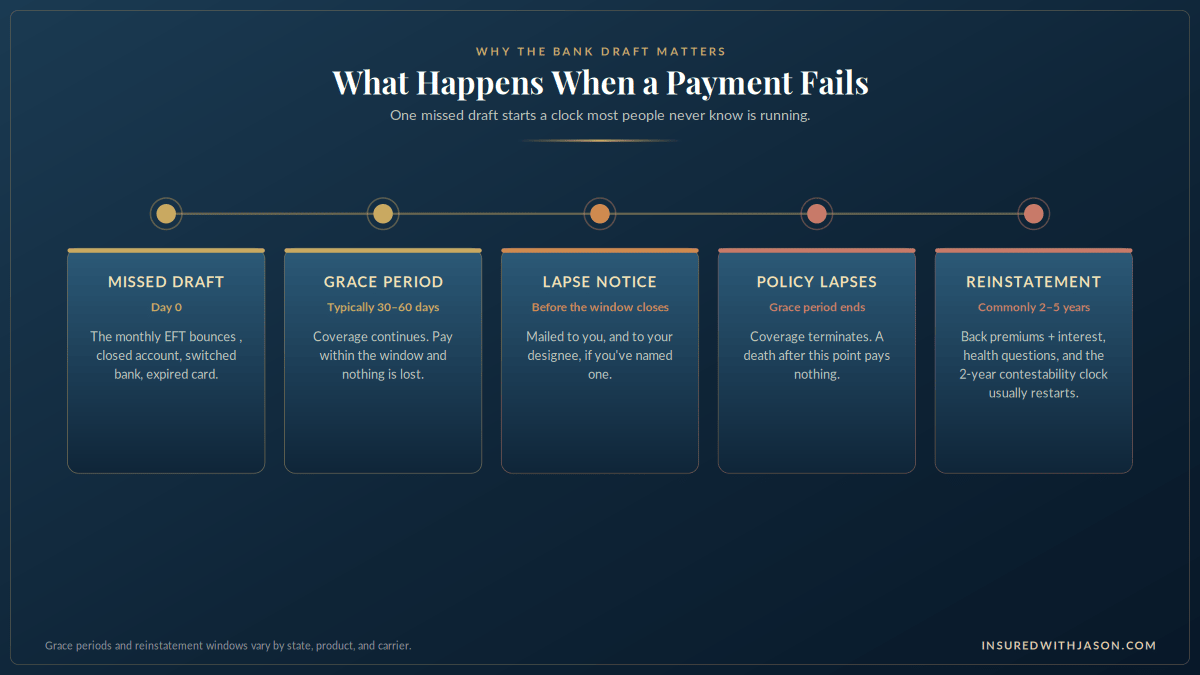
One missed draft starts the grace-period clock. Windows vary by state, product, and carrier.
Getting a lapsed policy back usually restarts the two-year contestability period, even on a policy you’ve owned for a decade.
Reinstatement means an application, back premiums plus interest, health questions, and a fresh window where the carrier can re-examine everything. A lapse is never just an inconvenience. Keeping the draft healthy is worth far more than fixing what a bounced payment breaks.
What Should You Check on Your Policy Every Year?
The yearly review starts with your beneficiaries, because the beneficiary form is the whole ballgame. Your will does not control who receives the money. The insurance contract does, and it pays exactly who the form names, no matter what any other document says. A marriage, a divorce, a birth, a falling out, or a beneficiary who passes away before you: any of these is a reason to look at the form and make sure it still matches your wishes.
Name a backup while you’re there. Many people name a primary beneficiary and stop, and that gap has real consequences. If your only beneficiary passes before you and nobody updates the form, the money defaults to your estate. That means probate, months of delay, public records, and in most states the loss of the creditor protection a named living beneficiary would have had.
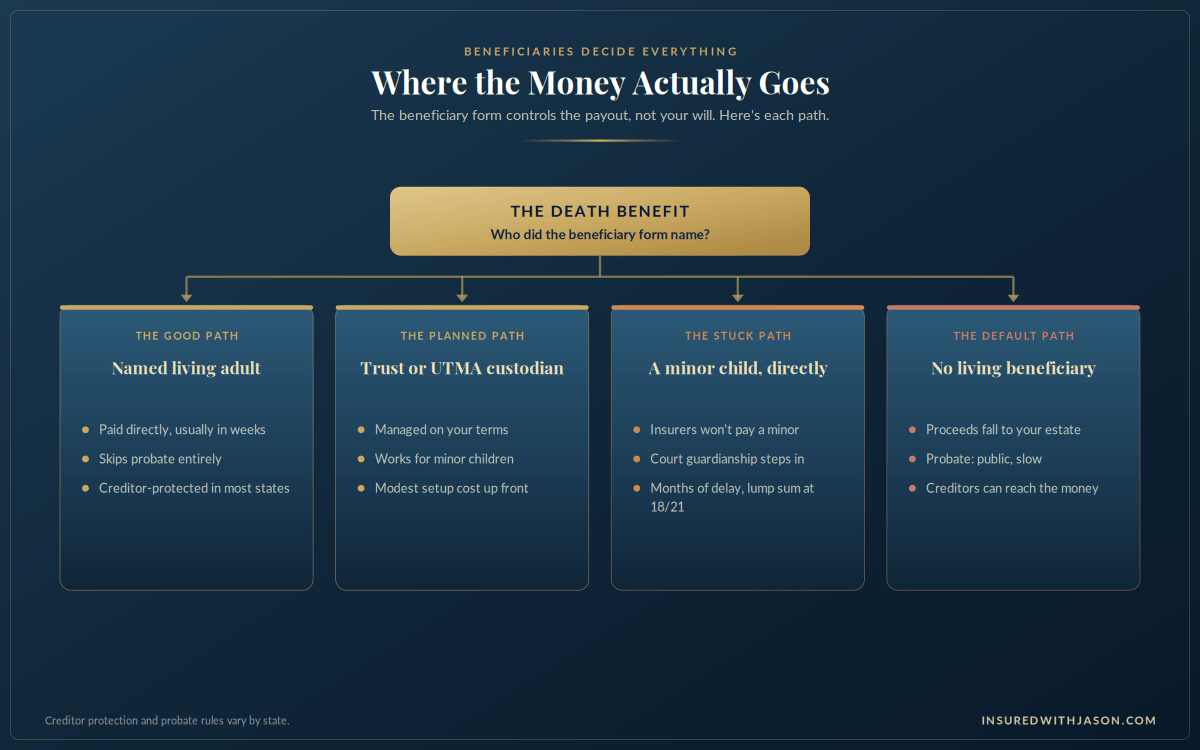
The beneficiary form decides which path the money takes. Creditor and probate rules vary by state.
A few more items belong on the yearly pass. If you want a grandchild or any minor child to receive the money, don’t name them directly, because insurers won’t pay a death benefit to a minor and a court ends up holding the money instead. The free fix goes right on the carrier’s own beneficiary form: name a trusted adult as custodian for the child under your state’s Uniform Transfers to Minors Act. You pick the custodian, it costs nothing, and your wishes get honored without a courtroom.
Divorce deserves its own alarm bell. Updating your will changes nothing on the policy, and for coverage through an employer, the plan generally pays whoever is on the form even after a divorce. Courts have backed that outcome again and again. If your wishes changed, change the form. And if they didn’t change, that’s a decision too. Say someone tells me their ex is still the beneficiary and that’s exactly how they want it, because they’re on good terms and that person will handle the services. There’s nothing for me to push. The policy is theirs, the wishes are clear, and everything stays as it is. The maintenance point is making sure the form matches your wishes on purpose, never by accident.
Finish with the small stuff: name changes from marriage or divorce, on you or any beneficiary, and a current phone number and email, since carriers increasingly use both to reach you before a problem becomes a lapse.
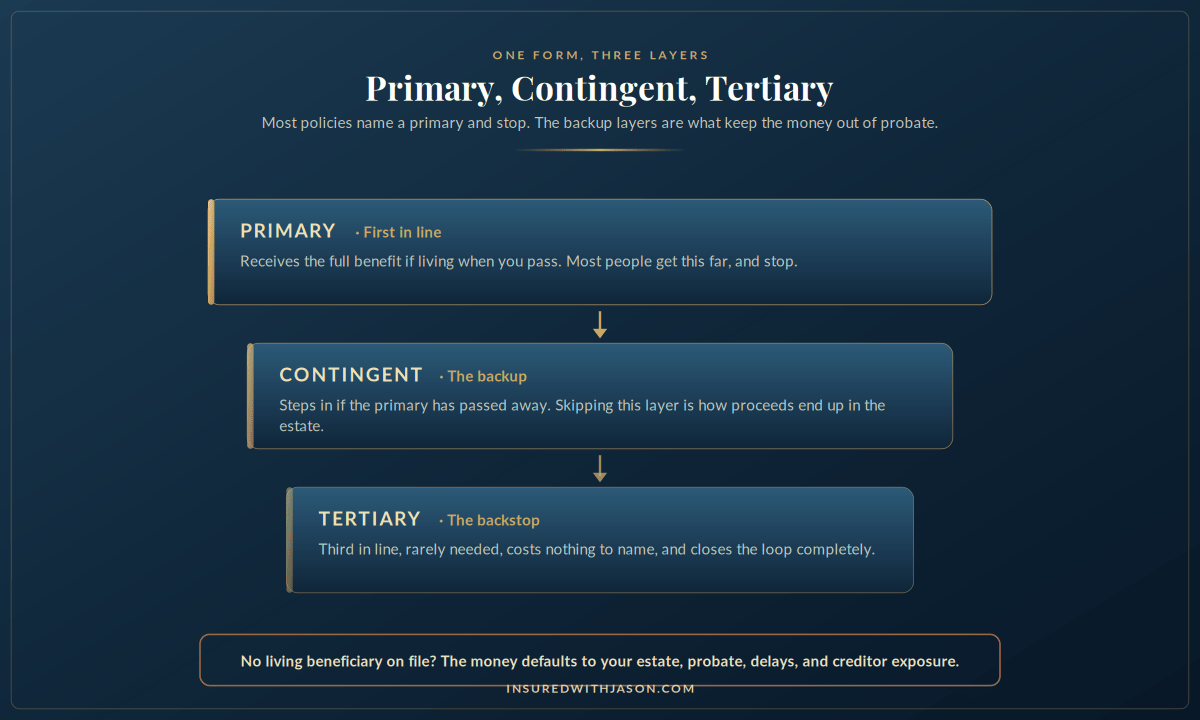
Most people name a primary and stop. The backup tiers are what keep the money out of probate.
Most people qualify for coverage that never expires, and finding out takes about a minute.
See My Price →What Is a Third-Party Notification Designee?
A third-party notification designee is a person you name, at no cost, who receives a copy of any warning that your policy is about to lapse for nonpayment. That’s the entire arrangement. Your designee has no bills to pay, no duties, and no liability of any kind. They get the same letter you get, before coverage ends, so someone you trust can pick up the phone if a payment slips past you.
Think about when a payment actually slips: during a hospital stay, a move where the mail didn’t forward, or a season where memory isn’t what it was. Those are exactly the stretches of life when nobody is watching the mail, and the designee exists so that one missed statement never quietly becomes a lost policy. Some states require carriers to offer this on every individual policy, and many more require it for seniors, so ask for the form. It takes a minute to fill out and it can save the whole policy.

Free to add, notification only, and no liability for the person you name.
Researchers have found that missed bill payments can appear as early as six years before a memory-loss diagnosis.
That research is a big part of why designee laws exist. Missing a payment is often the first sign anyone sees, years before a doctor is involved, which is why a second set of eyes on the mail protects people long before they consider themselves old.
Who Should Know Your Policy Exists?
Somebody in your life needs to know three things: that the policy exists, which company holds it, and roughly where the paperwork lives. That’s your point person, and it is a different job than the designee. The designee gets the carrier’s mail. The point person carries the knowledge, so the policy gets found and claimed when the time comes.
Whether that person is your kids is entirely up to you. Some parents loop their children in from day one. Some keep it private, do the protecting quietly, and let the kids do the receiving. Both are normal, and neither is wrong. My own father never told me about his policy, and it did everything it was supposed to do. What matters is that someone knows: a sibling, a friend, an attorney, anyone you trust. And when that someone moves away, passes on, or drifts out of your life, replacing them is a yearly checkup item just like a beneficiary.
What if there’s truly nobody to name?
Say someone calls me with no family and no close friends left, and they still want their funeral handled. Here’s how I think it through: a policy needs a beneficiary with a real interest, so the answer is to make arrangements with a funeral home and designate the policy to it. The maintenance then becomes two checks a year: the funeral home is still in business, and it’s still where you live. If either changes, you pick a new one and update the policy the same week.
Even with nobody to tell, a policy can still be pointed at the exact job you bought it for.
And what happens if nobody ever finds it?
What Happens When Nobody Knows About a Policy?
When nobody knows a policy exists, the money just sits with the carrier, waiting on a claim no one knows to file. Regulators built a free tool for exactly this problem, the NAIC Life Insurance Policy Locator, and it has reconnected families with more than $13 billion in benefits they didn’t know existed. Separate multistate settlements returned nearly $10 billion more, money that went missing largely because addresses, contacts, and paperwork went stale while policies quietly kept their promises.
The locator is the backstop, not the plan. It’s free, it’s encrypted, and a family searching for a lost policy can wait up to 90 business days for an answer. Your point person and your yearly checkup exist so your family never needs it. And when the day comes and the policy is found, the payout itself is the easy part, which is covered in full in how burial insurance claims work.
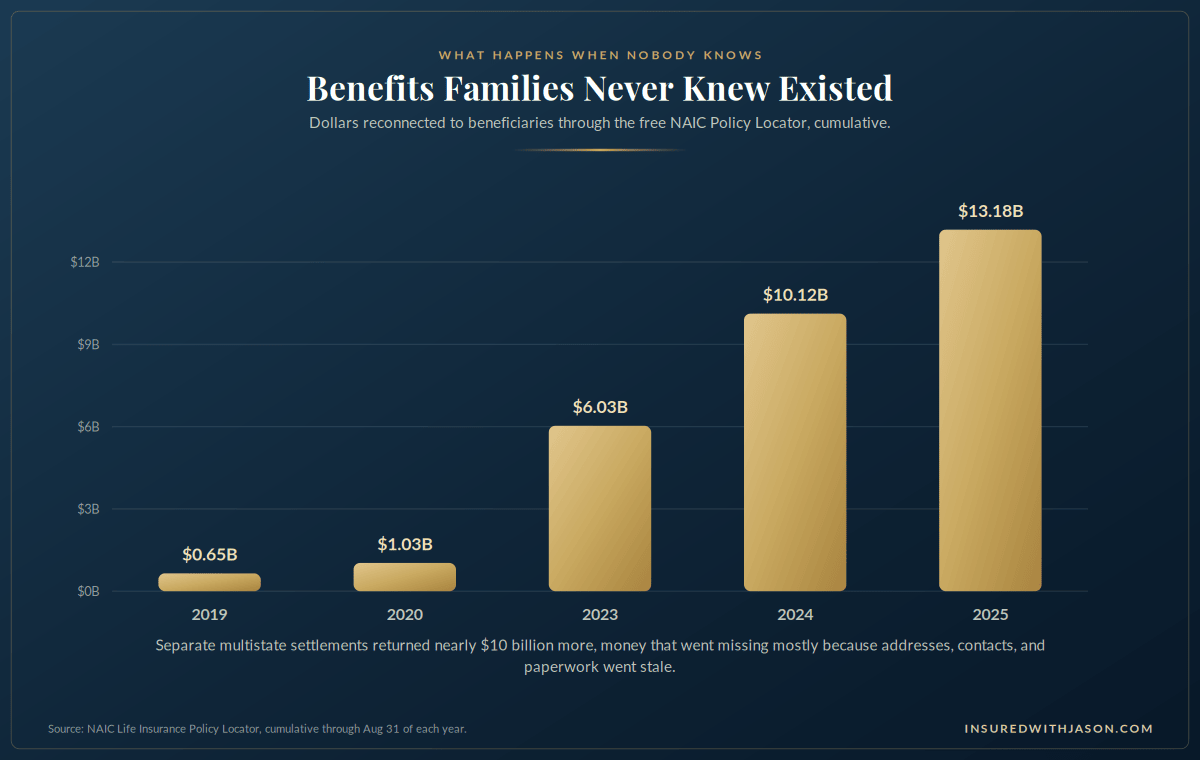
Cumulative benefits matched to families through the free NAIC Policy Locator, through August 31 of each year.
Curious what coverage that never expires would cost at your age? The answer is one minute away.
Check My Rate →The Five-Minute Burial Insurance Policy Maintenance Routine
Here’s the trick that makes burial insurance policy maintenance actually happen: set one recurring reminder in your phone. Your birthday, the policy anniversary, whatever sticks. When it goes off, grab the policy, run down the list below, and you’re done. Most years it takes closer to ten seconds than five minutes, because most years nothing changed. The reminder exists for the years when something did.
Six checks, once a year, in any order.
- 1PaymentThe bank draft is live and clearing
Account open, no switched banks, no bounced drafts.
- 2ContactAddress, phone, and email are current
The carrier’s mail is how every warning reaches you.
- 3BeneficiariesPrimary and backup both named and current
Spelled right, still living, still matching your wishes.
- 4NamesNo mismatches from marriage or divorce
On you or any beneficiary. A mismatch at claim time is paperwork your family doesn’t need.
- 5Backup ContactYour designee is named and reachable
Add one if you haven’t. It’s free.
- 6FindabilityPolicy number and carrier phone are findable
A folder, a fireproof box, a note with your will. Your point person knows where.
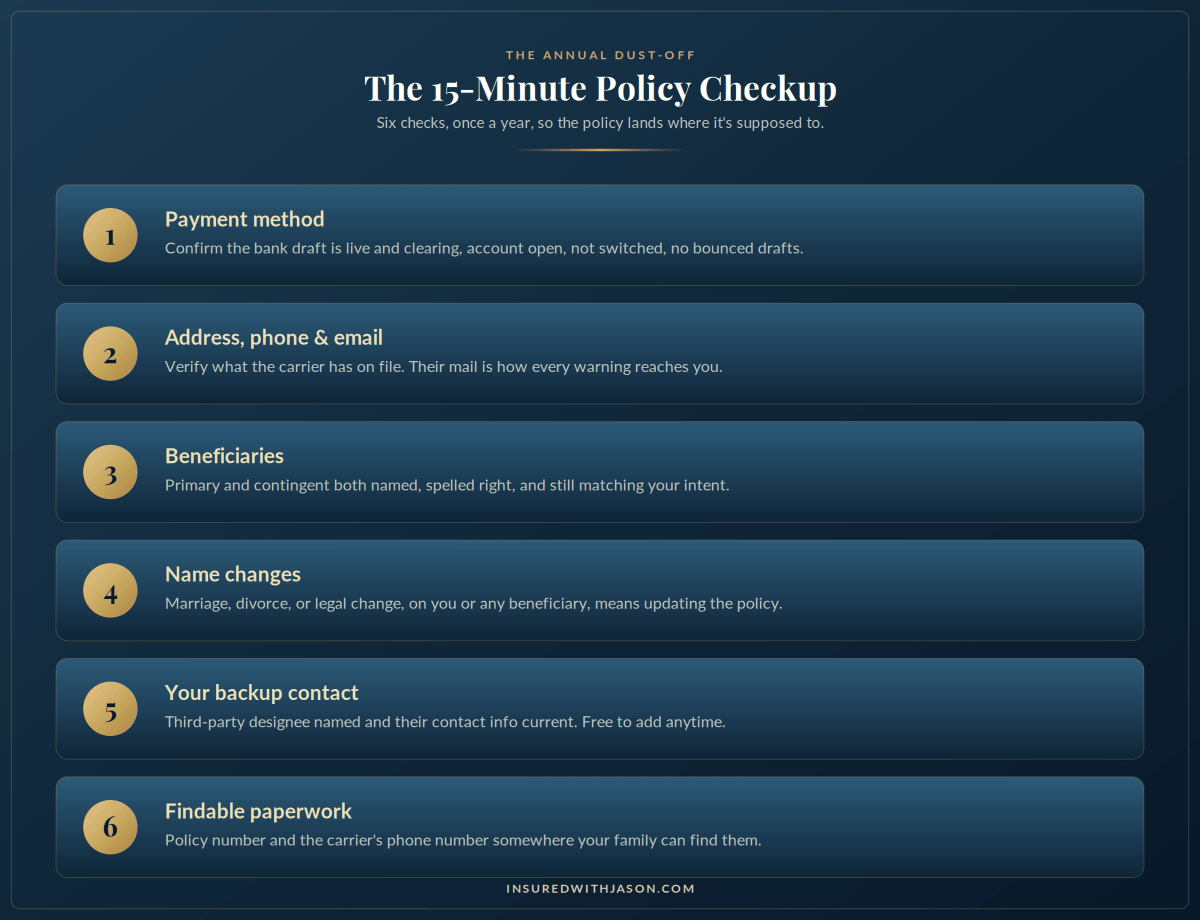
Save this checklist, or send it to the parent or friend whose policy you help look after.
Who Do You Call to Update Your Policy?
If you bought through a broker, call your broker. Every update on this page is a quick service call, and if you’re my client, this is exactly the kind of call I want to get. It comes with the policy.
If your original agent has retired, moved on, or disappeared, take a breath, because nothing about your coverage changed. The policy is a contract with the carrier, and the carrier’s policyholder services line exists precisely for this. Have your policy number handy and they can update your bank, your address, your beneficiaries, and your designee directly. That servicing is what the carrier was paid to provide, so use it without hesitation. And if your situation has changed and you want a fresh set of eyes on whether your coverage still fits, that conversation is a different thing entirely, and any independent broker, me included, is glad to have it. This is also worth knowing if you’re helping a parent manage their coverage; there’s a full guide to burial insurance for your parents that covers those conversations.
What You Don’t Need to Do
You don’t need to react to mail telling you your coverage is outdated. State regulators have warned repeatedly about misleading solicitations dressed up as official notices, and the facts favor the policy you already own: a brand-new policy means a brand-new two-year contestability period at your current age’s rates, while the policy in your drawer may have already served that window in full.
The same math applies after a lapse. Say someone calls me three years after a policy lapsed, asking whether to bring it back. Here’s how I’d walk it through with them: reinstatement means three years of back premiums plus interest, all at once, so the first question is whether that check even makes sense to write. Then you weigh whatever cash value the old policy built, and you look at the whole market with your health as it is today, because the answer changes if a carrier out there would take your new diagnosis with coverage from day one. You compare everything before you commit to anything. What would change my answer is the size of that back-premium check and what doors your health still opens. That’s a real conversation with real numbers, never a guess.
One more caution while we’re here: the FTC warned just this month about fake unclaimed life insurance letters from pretend law firms fishing for Social Security numbers and bank details. Never send personal information to one. When anything about your policy looks off, call your carrier or your broker directly and check.
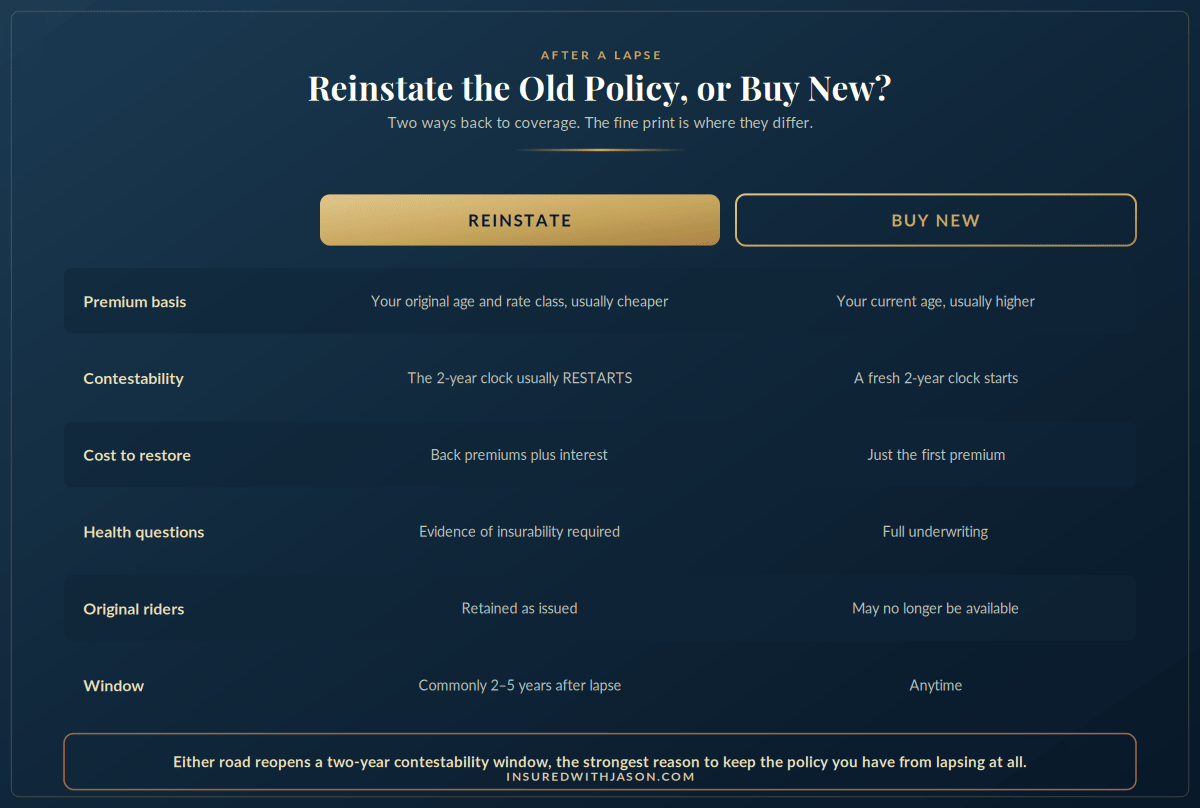
Either road back reopens a two-year contestability window, which is the strongest reason to keep the policy you have from lapsing at all.
Find out which doors your age and health open, with real numbers instead of guesses.
Get My Quote →Burial insurance policy maintenance: frequently asked questions
The questions people ask me most about keeping a policy up to date, answered plainly.
How often should you review a burial insurance policy?
Once a year on a recurring reminder, plus immediately after two events that can’t wait: changing bank accounts and moving. The yearly pass covers beneficiaries, name changes, contact information, your designee, and where the paperwork lives.
Does your will override your life insurance beneficiary?
No. The beneficiary form on the policy controls the payout, no matter what the will says. Updating one without the other changes nothing, so when your wishes change, change the form.
What is a third-party notification designee on a life insurance policy?
A person you name, for free, who receives a copy of any notice that your policy is about to lapse for nonpayment. The designee has no duty to pay and no liability of any kind. They just get the warning, so someone you trust can step in before coverage ends.
What happens if you miss a payment on burial insurance?
A grace period starts, typically 30 to 60 days depending on your state and policy. Pay inside that window and coverage continues with nothing lost. If the grace period runs out, the policy lapses and coverage ends.
Can you get a lapsed burial insurance policy back?
Often yes, commonly within two to five years of the lapse. Reinstatement requires an application, back premiums plus interest, and health questions, and it usually restarts the two-year contestability period. Compare that against a new policy and your current health before deciding anything.
How do you find a lost life insurance policy?
Use the free NAIC Life Insurance Policy Locator, which searches carriers nationwide. A response can take up to 90 business days, and a match requires a certified death certificate and the insurer’s claim form. State unclaimed-property programs are the second place to check.
Life’s biggest moments are exactly when a policy gets forgotten.
Major life events are distracting, and the good ones are just as distracting as the hard ones. When you’re caught up in a move, a marriage, a new grandchild, or a loss, the last thing on your mind is a policy that’s been quietly doing its job for years. So you have to give yourself a mental time-out, a few minutes on purpose, with a few alarm bells installed for the moments that matter: a new bank, a new address, a beneficiary who passes before you, a family relationship that changes. A checkup like that can’t solve every problem a lifetime throws at a policy. But it eliminates a huge chunk of them, across millions of insured lifetimes, and that makes it a best practice worth knowing. That’s why I wrote this one.
Let’s make sure your coverage is set up right
Maybe your policy needs a five-minute tune-up. Maybe your agent is long gone and you want a fresh look at whether the coverage still fits. Or maybe you’re still shopping and want to start with a policy set up right from day one. Whichever it is, the first step is the same: answer six quick questions and see where you stand.
See My Price →This article is for educational purposes only and is not legal, tax, or financial advice. Policy features, grace periods, reinstatement rules, and beneficiary laws vary by state, carrier, and product. Figures cited are drawn from the sources named and were current at the time of writing. Review your own policy documents and speak with a licensed professional about your specific situation.
Six questions. About a minute.