
The Average Cost of a Funeral: Where Does the Money Go?
The $8,300 average cost of a funeral covers only the funeral home’s bill. Here is what a funeral really costs, itemized.

- The average cost of a funeral with a viewing and burial is $8,300, and that median counts only the funeral home’s own charges.
- Cemetery costs are billed separately. The plot, the fee to open and close the grave, the vault, and the marker commonly add $3,000 to $10,000 or more.
- A funeral with cremation runs a median of $6,280, and a direct cremation often costs $1,500 to $3,500 all in.
- The FTC Funeral Rule guarantees you an itemized price list, and the basic services fee is the only charge you can’t decline.
- Social Security pays a one-time death benefit of $255, an amount that hasn’t changed since 1954.
- A small burial insurance policy is the most flexible way to have these costs handled before your family ever sees the bill.
- Health issues? Most qualify
- Declined? Jason has next steps
- New policies up to age 85
- Fits a Social Security budget
- Free quotes, no commitment
- Just Jason, never a stranger
Your information goes to Jason. Not a call center. Not a lead list.
The average cost of a funeral in the United States is $8,300, and that number doesn’t include as much as most people think. It comes from the funeral homes themselves, so it covers the casket, the service, and the hearse, but it stops at the funeral home’s front door. The cemetery sends its own bill for the plot, the vault, and the headstone, and that second bill can push a traditional burial past $15,000. Before you can decide what any of this means for your family, you need to see both bills side by side.





What Is the Average Cost of a Funeral in 2026?
The average cost of a funeral with a viewing and burial is $8,300, according to the National Funeral Directors Association, and it climbs to $9,995 once a vault is added. A funeral with cremation instead of burial runs a median of $6,280. Those are the most recent national figures, from the association’s 2023 study, and real-world prices in 2026 have kept climbing since.
Now here’s the part almost nobody explains. That famous average is built from the funeral home’s charges only: the director’s services, moving and preparing your loved one, the casket, the viewing, the ceremony, and the hearse. It does not include the cemetery plot, the fee to open and close the grave, the headstone, the flowers, the obituary, or the clergy. The published average cost of a funeral stops at the funeral home’s own door, and the cemetery hasn’t even sent its bill yet.
Add the cemetery and the extras back in, and a traditional funeral and burial commonly lands between $11,000 and $17,000, with higher totals in big metro areas. Those figures are estimates, and they move with your zip code and your choices. But the lesson holds everywhere: treat the average as a floor, not a ceiling. And because $8,300 is a median, the true midpoint, half of all funerals cost more than the sticker figure.
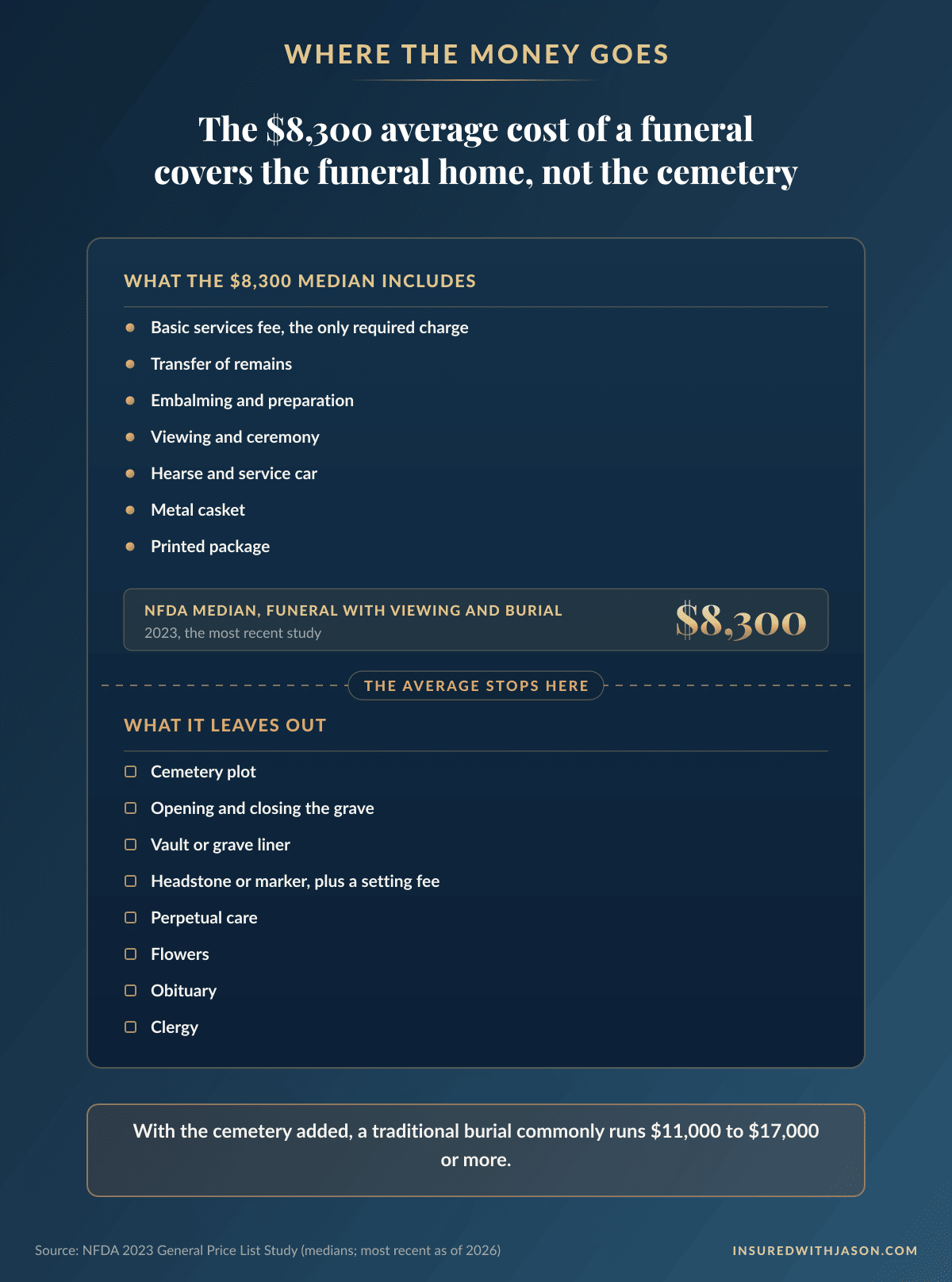
The average cost of a funeral covers the funeral home’s charges only. The cemetery is a second, separate bill.
What Do Funeral Homes Actually Charge For?
A funeral home’s bill is a list of individual charges, and federal law says you’re entitled to see every line before you agree to anything. Every funeral provider must hand you an itemized General Price List when you ask, so you can see exactly what the funeral director charges for each service. Here are the national medians for the most common line items, so you know what normal looks like before you sit down.
National median charges for a traditional funeral, from the NFDA’s 2023 study. Your local funeral prices will differ.
| Charge | 2023 Median |
|---|---|
| Basic services fee (can’t be declined) | $2,459–$2,495 |
| Transfer of your loved one to the funeral home | $395 |
| Embalming | $845 |
| Other preparation (dressing, cosmetology) | $295 |
| Facilities and staff for the viewing | $475 |
| Facilities and staff for the ceremony | $550 |
| Hearse | $375 |
| Service car or van | $175 |
| Printed memorial package | $195 |
| Metal casket | $2,500 |
| Vault (outer burial container) | $1,695 |
Source: NFDA 2023 General Price List Study. Medians, not quotes. Local prices vary by provider and region.
The basic services fee deserves a closer look, because it’s the one charge every family pays no matter what. That fee covers the funeral director’s time, the planning, the permits, and the overhead, and it’s the only non-declinable item on the list. Everything else is a choice. Skip the viewing, and that charge comes off. Choose a simpler casket, and the total drops by hundreds or thousands, because caskets run from about $1,000 for a basic model to $2,500 for a mid-range metal one, and well past $10,000 for premium wood and bronze.
Because the basic services fee is a large, fixed slice of the funeral home’s bill, comparing it across two or three funeral homes is where real savings start. The same service can carry very different funeral prices a few miles apart, and calling several funeral homes for their price lists costs you nothing but a little time.
No state in the country legally requires embalming.
Most states require embalming or refrigeration only when the burial or cremation is delayed, usually beyond about 24 hours. For a direct cremation, a direct burial, or a closed-casket service, families can often skip the embalming charge entirely, and the funeral home is required to tell you so.
How Much Does a Funeral Plot Cost?
A funeral plot typically costs between $1,000 and $5,000, and the plot is only the beginning of the cemetery’s bill. Public and municipal cemeteries sit at the low end of that range. Private and religious cemeteries often run $5,000 to $15,000, and a plot in a scarce urban cemetery can pass $20,000, because a grave is real estate and it follows real estate prices.
Here’s what stacks on top of the plot itself, and remember, none of this is inside the $8,300 average cost of a funeral. The fee to open and close the grave runs $1,000 to $3,000 for a full burial, and far less for cremated remains. Most cemeteries require a burial vault or a grave liner to keep the ground from settling, another $1,000 to $5,000, even though no state law requires one. A headstone or marker adds $1,000 to $8,000 or more depending on material and size, plus a separate fee to set it. And many cemeteries charge perpetual care, commonly 10 to 20 percent of the plot price, to fund the grounds forever. All of those figures are estimates, and every one of them belongs in your total cost before you sign anything.
Some families buy the plot years ahead of time to lock in the land price, and in a fast-rising market that can be a smart, sure thing. Just remember what it does and doesn’t solve: the plot handles the ground, and the funeral home’s entire bill is still waiting. A paid-for plot is a great start on funeral planning, not the finish line.
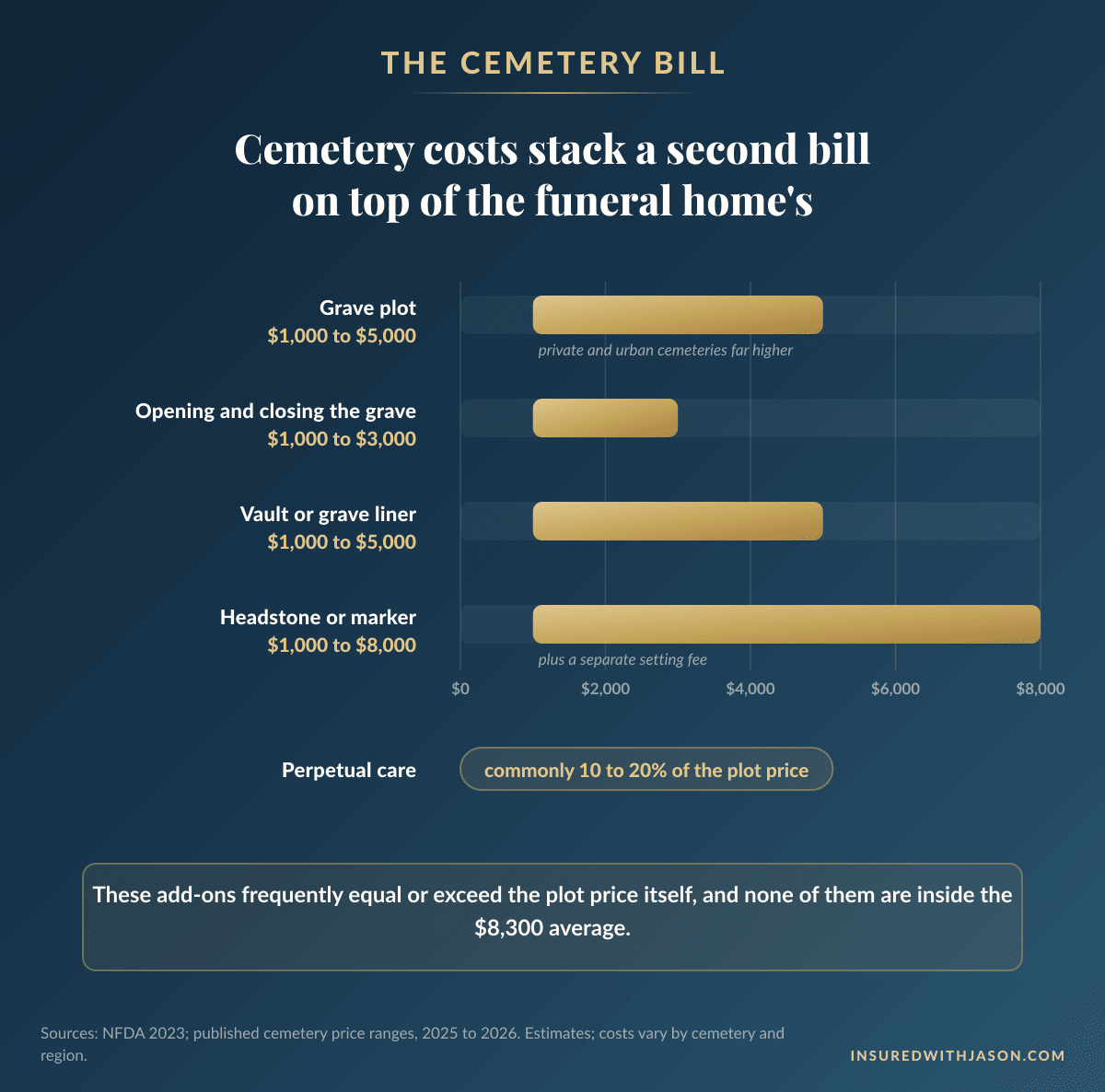
The cemetery’s add-ons frequently equal or exceed the price of the plot itself.
Families budget to the funeral home’s bill and forget the cemetery bills separately.
That’s how a family covers the service and comes up short on the burial. Ask the cemetery for an all-in written quote covering the plot, the opening and closing, the vault requirement, the marker, and the setting fee. Count both bills from the start.
See what it costs to have both bills covered.
Real numbers · No pressure · Takes a minute
Is cremation the cheaper way to go?
How Much Does a Cremation Funeral Cost?
A cremation funeral with a viewing and ceremony costs a median of $6,280, more than $2,000 below the average cost of a funeral with a burial. The savings come from what cremation removes: no burial casket, no vault, and often no embalming. And this isn’t a niche choice anymore. The NFDA projects that 63.4 percent of American families will choose cremation in 2025, which makes it the way most funerals in this country now happen.
Direct cremation is the simplest and most affordable option of all. There’s no viewing and no service at the funeral home; your loved one is cremated and the remains are returned to the family, who can hold a memorial service anytime, anywhere, on their own terms. A direct cremation generally runs $1,500 to $3,500 all in, and in some areas less. The main cremation costs behind that price are the cremation fee itself, a simple cremation container, and an urn if you choose one. One more protection worth knowing: a funeral home cannot require you to buy a casket for a direct cremation, ever.
A few families ask me about the newer alternatives, so here they are with honest numbers, all estimates. Green burial, with a biodegradable casket or shroud and no vault, typically runs $2,000 to $5,000 all in. Water cremation, legal in roughly half the states, runs about $5,000 to $7,000. Human composting, legal in 14 states so far, runs about $4,000 to $7,000. Each deserves its own full article, and those are coming. For now, know that they exist, they’re legitimate, and their costs sit between direct cremation and a traditional funeral.
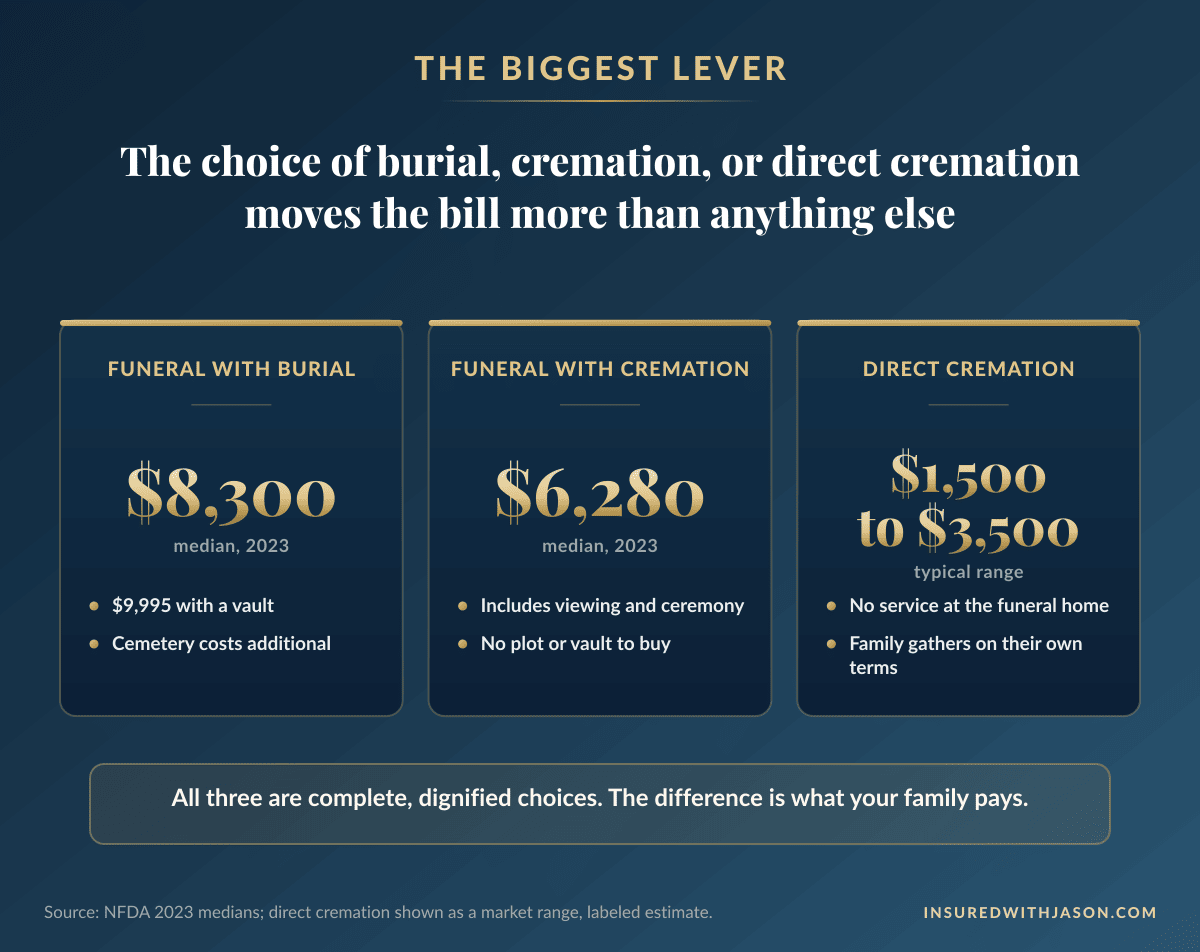
The choice between burial, cremation, and direct cremation moves the total more than any other decision.
I’m just getting cremated. Do I even need coverage?
Maybe not, and I’ll say so. Say someone calls me in that spot: if the $1,500 to $3,500 is genuinely set aside where your kids can reach it, you may not need a policy, and that’s a personal decision I’d respect. Here’s what I’d walk through with them first, though. Is the cremation truly the only expense, or will there be a gathering, flowers, travel, and missed work for the people grieving you? And some folks who know their kids could easily cover it buy a small policy anyway, because they see the funeral as their own bill to pay, not their children’s. Both views are legitimate. Only one of them buys a policy.
What would change my answer: whether the money truly exists in reachable form, and whether the cremation is truly the only cost your family will carry. That’s a short conversation worth having before you decide.
Why Do Funeral Costs Vary So Much by State?
The average cost of a funeral varies by thousands of dollars from state to state, and land is the biggest reason. A cemetery plot is real estate, so a funeral in California or New York carries the land and labor prices of California and New York, while states like Mississippi and Arkansas sit far below the national median. The same service can cost thousands more at a Los Angeles funeral home than at one in a small Southern town, purely on cost of living and competition.
State rules move the bill too. Most states require embalming or refrigeration when the funeral is delayed, and a few add mandatory waiting periods before a cremation, which can add holding charges. States where cremation dominates, like Nevada and Oregon, tend to see lower average costs overall, simply because most families there are choosing the less expensive path. Wherever you live, your zip code sets the starting line, and comparing several funeral homes is how you find the fair price inside your own market. We’ll be publishing state-by-state funeral cost pages with local numbers, starting soon.
Federal law protects you inside the funeral home, but it mostly stops at the cemetery gate.
What Are Your Rights When Paying for a Funeral?
The FTC Funeral Rule is a federal law that gives every family real, enforceable rights inside the funeral home, and it costs you nothing to use them. Nobody hands grieving families a rights card at the door, so let me be the one who does. Under the Funeral Rule, a funeral home must give you an itemized price list to keep as soon as you start discussing arrangements, and it must quote you accurate prices over the phone if you ask. It must show you the casket price list before showing you caskets. You can buy a casket or urn anywhere you like, even online, and the funeral home cannot charge a handling fee or refuse to use it. You pay only for the goods and services you actually choose, and before you pay anything, you must receive a written, itemized statement of everything you selected.
The Rule also protects you from being told something is required when it isn’t. Embalming is not required by law in most situations, and a funeral provider has to disclose that. These rights are actively enforced, so use them without a moment of guilt: ask for the list, take it home, and compare. A good funeral director will respect you for it.
Now the honest boundary, and it’s the biggest surprise on this whole page. The Funeral Rule largely does not cover cemeteries. A cemetery that sells only plots, markers, and interment is generally outside the Rule, so cemetery pricing is governed by state law, if it’s governed at all. That’s exactly why the second bill is where families get surprised, and why a written, all-in cemetery quote matters so much.
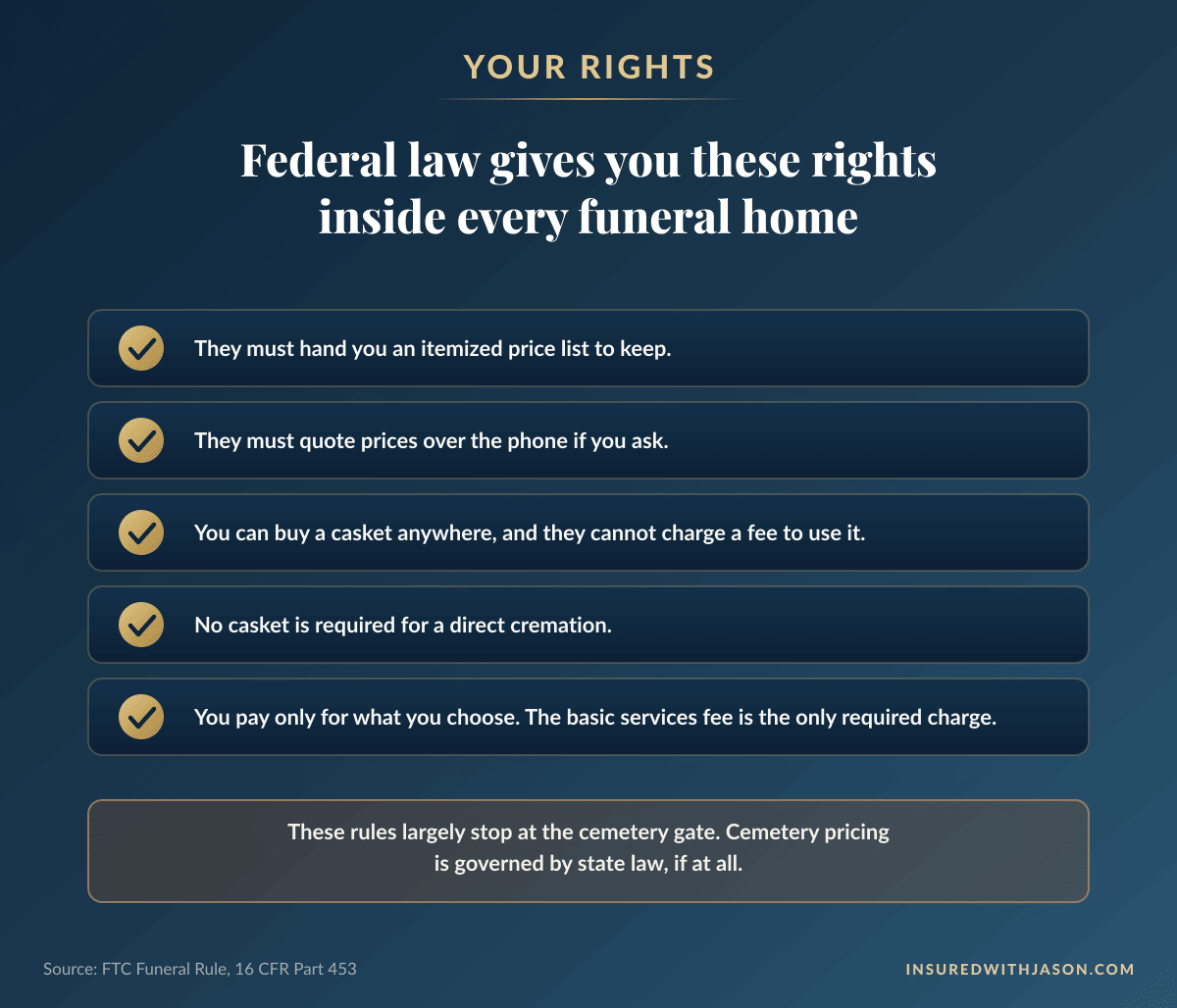
Five federal rights every family carries into the arrangement room, and the one place they stop.
Who Can Help If You Can’t Afford Funeral Costs?
Real help exists for funeral expenses, and it’s smaller than most families hope. Start with what you may already be owed. Social Security pays a one-time lump-sum death payment of $255 to an eligible surviving spouse or child. Veterans and their families can receive considerably more: the VA burial allowance pays up to $2,000 for a service-connected death, and up to $1,002 plus a $1,002 plot allowance otherwise, along with free burial in a national cemetery for eligible veterans. One caution: if you see an ad promising a $25,000 VA burial benefit, know that the VA’s real maximums are the ones listed on VA.gov, and applying through the VA or an accredited service officer is always free.
Beyond those, most counties run an indigent burial or cremation program for families with no resources, though eligibility and amounts vary widely. Some employers, unions, and fraternal organizations pay a death benefit many families never think to check. Charities and crowdfunding help some families close a gap, though most campaigns raise only a fraction of their goal. And FEMA’s COVID-19 funeral assistance program, which once paid up to $9,000, closed to new applications on September 30, 2025, so don’t count on it. For a full walkthrough of what the government actually pays toward a funeral, I’ve written a separate guide.
Whole-body donation to medical science deserves a brief, respectful mention, because it’s a genuine no-cost path: accredited programs typically cover transport and cremation and return the remains to the family. It has to be arranged by the person in advance, acceptance is never guaranteed, and it isn’t the right fit for every family’s comfort. It belongs on the table as a fact, and the decision belongs entirely to you.
One more thing families are relieved to learn: a funeral bill is generally a debt of the estate, not of the adult children personally, unless a child signed the contract. And a practical tip from someone who’s been the one handling everything: order enough certified death certificates the first time. Most families need somewhere between 8 and 15, each costs roughly $5 to $34 depending on the state, and nearly every institution keeps the copy you send.
The one-time Social Security death benefit has not changed since 1954. Against today’s median funeral, it covers about three percent of the bill.
Source: Social Security Administration
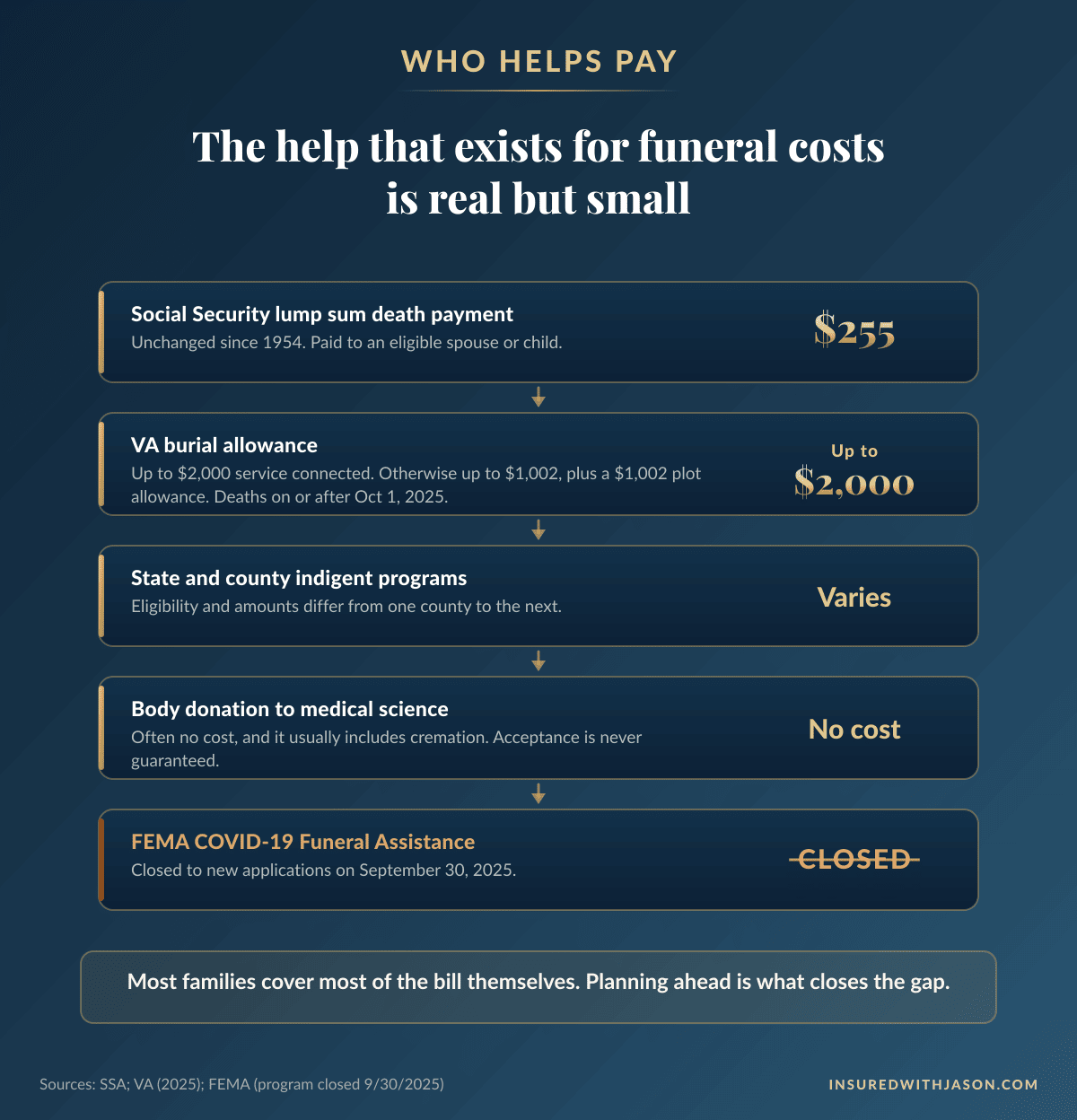
The financial assistance for funeral costs is real, and most families still cover most of the bill themselves.
How Do Families Cover Funeral Costs Ahead of Time?
Families cover funeral costs ahead of time in two main ways: by prepaying a funeral home directly, or with a small burial insurance policy that pays a person they name. I’ve compared those two paths in detail in my guide to how burial insurance compares to the other ways to pay for a funeral, so here I’ll keep it to what matters most on this page: a policy pays cash to your beneficiary, and that person can spend it on any of the costs you’ve just read about. The funeral home, the cemetery, the flowers, the death certificates, the missed work. A purpose for every dollar.
And there’s a reason planning ahead beats deciding in the moment, one that has nothing to do with math. When you’ve just lost someone you love, you are not in a headspace to make careful financial decisions. Grieving families skip the comparison shopping, forget to ask questions, and say yes to things they would normally think over, and it’s completely understandable. In the real world, that can push the bill 10, 20, even 30 percent past what the price lists say. The prices on this page are what things cost in a perfect world. The people who lock in a plan while they’re thinking clearly are the ones who never have to find out what the fog costs.
What about the person who looks at the all-in number and knows they can’t cover all of it? Here’s how I think that through, because I hear it often. The true cost of a funeral was never meant to price anyone out; it’s just light on the real bill. Say someone can only afford a $5,000 whole life policy against a $13,000 funeral. That policy still carries their family most of the way, and here’s the part people miss: a family that’s $3,000 short pulls together, because someone steps up to close a gap that small. A family staring at the whole bill from zero freezes. You do what you can, and you do it proudly, because the best policy is the one you can comfortably afford for your entire life without ever breaking a sweat. If that means smaller, that’s fine. Plenty of people add a second small policy fifteen or twenty years later when inflation has nibbled at the first one, and their plan stays intact the whole way. What would change my answer is affordability itself: a premium that strains the budget is the wrong policy at any size, and that’s a conversation worth having with a real person before you decide.
How to turn the average cost of a funeral into the amount of coverage you need
Build the amount up from the real bill, not down from whatever an ad is selling.
- 1Start HereDecide: burial or cremation?
That single choice swings the cost of your funeral more than anything else.
- 2Get The Real NumberAsk two or three funeral homes for their price lists
The Funeral Rule guarantees you an itemized list, in person or by phone.
- 3Don’t Forget ThisPrice the cemetery separately
Plot, opening and closing, vault, headstone, and the setting fee, in writing.
- 4Build In RoomAdd a cushion
Final bills, death certificates, missed work for the family, and a little room for inflation.
- 5SubtractTake out what’s already set aside
Savings your family can actually reach, or an existing policy earmarked for this.
- 6Your AnswerWhat’s left is your target coverage amount
That’s the number to shop with, and to protect the people you love.
Have your number? See what coverage costs at your age.
One independent broker · The whole market compared for you
Funeral costs: frequently asked questions
The questions families ask me most about the average cost of a funeral, answered plainly.
Does the average cost of a funeral include the cemetery? +
No. The widely quoted $8,300 median from the NFDA covers only the funeral home’s charges. The cemetery plot, the fee to open and close the grave, the vault, the headstone, flowers, and the obituary are all billed separately and can add thousands of dollars to the total cost of the funeral.
Is embalming required by law? +
No state requires embalming outright. Most states require embalming or refrigeration only when the burial or cremation is delayed, usually beyond about 24 hours. For direct cremation, direct burial, or a closed-casket service, families can often skip it, and the funeral home must tell you when it isn’t required.
Who pays for a funeral if there’s no money? +
A funeral bill is generally a debt of the deceased person’s estate, paid through probate, and adult children are not personally responsible unless they signed the funeral contract. When the estate has nothing, most counties offer an indigent burial or cremation program, and family members sometimes pool resources to cover the rest.
Does Social Security pay for a funeral? +
Social Security pays a one-time lump-sum death benefit of $255 to an eligible surviving spouse or child. The amount has not changed since 1954, and it covers only a small fraction of today’s funeral expenses.
Does Medicare cover funeral costs? +
No. Medicare does not pay for funerals, burials, or cremation. Covering those costs falls to the family, the estate, savings, or a life insurance policy such as burial insurance.
Are funeral costs tax deductible? +
Funeral costs are not deductible on an individual’s personal tax return. An estate that files an estate tax return may be able to deduct funeral expenses, which applies to relatively few families. A tax professional can confirm what fits your situation.
How many death certificates do I need? +
Most families need between 8 and 15 certified death certificates, because banks, insurers, and government agencies each keep the copy they receive. They cost roughly $5 to $34 each depending on the state, and ordering extras up front is faster and cheaper than reordering later.
Everybody has a guess at what a funeral costs. Almost nobody has priced the whole thing.
I wrote this because a death in the family touches far more than the funeral home’s bill, and very few people ever see the full picture laid out. There’s the cemetery, the death certificates, the time away from work, and the plain truth that grief is a terrible headspace for financial decisions. People overpay in those first days, not because anyone set out to hurt them, but because they say yes to things they’d normally think over. I want you to have the real numbers now, while you can think clearly, so nothing about this ever catches your family off guard. Whether coverage is right for you after that is your call to make. In my experience, people who are open to receiving all the facts make really good decisions for the people they love. That’s the whole reason this page exists.
Know the costs. Then make sure they’re covered.
You now know what sits behind the average cost of a funeral, both bills included, and that puts you ahead of almost everyone who walks into an arrangement room. The next step is simple: see what it costs to have it all handled, so the people you love inherit a plan instead of a bill. As an independent broker, I shop burial insurance across the whole market to find who will cover you at the best rate, and your rate is set by your age right now. The cheapest day to start is the one you’re standing in.
This article is for educational purposes only and is not legal, tax, or financial advice. Funeral, cemetery, and cremation prices are estimates that vary by provider, region, and the choices you make, and coverage, costs, and rules for life insurance plans vary by person, company, and state. Please speak with a licensed professional about your specific situation before making a decision.
See what covering it costs you.