
Burial Insurance for Veterans: Your Guide to Covering the VA Gap
Your VA benefits are real. So is the gap they leave. Here is exactly how veterans cover it.

- Yes, veterans can get burial insurance. A VA disability rating will not keep you out of private coverage, and many veterans qualify for protection that starts the same day.
- VA burial benefits are real but partial. The VA pays up to $2,000 for a service-connected death, or about $2,004 combined otherwise, against a national median funeral of $8,300.
- New for 2026: if you still carry an older VA policy called S-DVI, applying for VALife now ends that policy the day you’re approved. The full explanation is below.
- VALife is guaranteed acceptance for veterans with a service-connected rating, capped at $40,000, with a two-year wait before the full benefit is payable.
- A veteran can often beat VALife’s price with private day-one coverage, even with health complications. These policies were built for people with a few bumps and bruises. A veteran who truly can only get guaranteed issue should absolutely price VALife.
- Surviving spouses get an automatic VA payment and can share a national cemetery gravesite, but their own funeral costs still need a plan.
- Health issues? Most qualify
- Declined? Jason has next steps
- New policies up to age 85
- Fits a Social Security budget
- Free quotes, no commitment
- Just Jason, never a stranger
Your information goes to Jason. Not a call center. Not a lead list.
Burial insurance for veterans surprises people, because most veterans believe their funeral is already handled. The truth is that it’s partly handled: the VA pays real money, about $2,004 toward most veterans’ funerals and up to $2,000 when the death is service-connected, against a bill that now averages $8,300. You earned every one of those benefits, and this guide shows you what they cover, what they don’t, and how to close the difference for good.





If you still carry an older VA policy called S-DVI, applying for VALife now cancels it the day your application is approved.
That leaves you with no full coverage at all during VALife’s two-year waiting period. The window that let veterans keep both closed on December 31, 2025. We break down exactly how this trap works, and who it affects, further down this page.
Can Veterans Get Burial Insurance?
Yes, veterans can get burial insurance, and you have more doors open to you than most people realize. Every veteran can shop the private final expense market exactly like any other buyer. The companies look at your age, your health, and your prescriptions. They do not ask whether you served, and they do not ask about your disability rating.
On top of the private market, the Department of Veterans Affairs runs its own life insurance option for one specific group. It’s called VALife, it’s guaranteed acceptance, and it’s only open to veterans who hold a service-connected disability rating. An older VA program called S-DVI closed to new applicants at the end of 2022, though many veterans still carry those policies today.
So the honest map looks like this. Every veteran has the private market. Veterans with a service-connected rating also have VALife. And the smartest move, which we’ll walk through step by step, is comparing both before you commit a single dollar.
Is There Special Burial Insurance Just for Veterans?
There is exactly one life insurance product built specifically for veterans, and the government runs it. That’s VALife, from the VA itself. No private insurance company in the country sells a burial policy with special underwriting or special pricing just because you served. Some veterans’ organizations put their name on standard guaranteed-issue policies from regular carriers, but the product underneath is the same one everyone else can buy.
I’d rather tell you that plainly than dress it up. The pages that promise “exclusive veteran burial insurance” are selling the same final expense insurance I can shop for you across more than 25 companies. The real veteran-specific value lives inside the VA system, and the rest of this page shows you how to use both worlds together.
What Burial Benefits Do Veterans Get From the VA?
Veterans earn a real package of burial benefits, and every eligible veteran should claim all of them. If you were discharged under conditions other than dishonorable, here is what your service entitles you to.
Burial in a VA national cemetery, at no cost. That includes the gravesite, the opening and closing of the grave, a government headstone or marker, and perpetual care of the site. Many state veterans cemeteries and tribal cemeteries offer free or low-cost burial too. Space depends on the cemetery, and burial in a national cemetery is one of the most meaningful benefits the VA provides.
A burial flag and a Presidential Memorial Certificate. The flag drapes the casket or sits with the urn, then goes to your next of kin. The certificate honors your service with the President’s signature, and your family can request more than one copy.
Military funeral honors. The Department of Defense, not the VA, provides the honors ceremony when the family requests it: the folding and presentation of the flag, and the playing of Taps. Your funeral director arranges it with a copy of your DD-214.
Cash allowances toward burial and funeral costs when the veteran is buried in a private cemetery, plus reimbursement for transporting the veteran’s remains in certain cases, such as when the veteran was hospitalized by VA at the time of death. We’ll put exact dollar figures on those in the next section, because the amounts are where the surprises live.
And your spouse is part of this package. A surviving spouse and dependent children can be buried with you in a national cemetery. When you pass, the VA also automatically sends your surviving spouse a set payment toward plot, interment, or transportation costs, with no claim to file, as long as they’re listed as your spouse in VA records. What the package does not include is money for your spouse’s own funeral service. Their costs need their own plan, and most families only discover that at the worst possible time.
A surviving spouse doesn’t have to file anything to receive the VA’s automatic payment. The VA sends it once it learns of the veteran’s death.
That automatic payment is separate from the full burial allowance, which usually requires an application. Families who don’t know the difference sometimes collect one and miss the other.
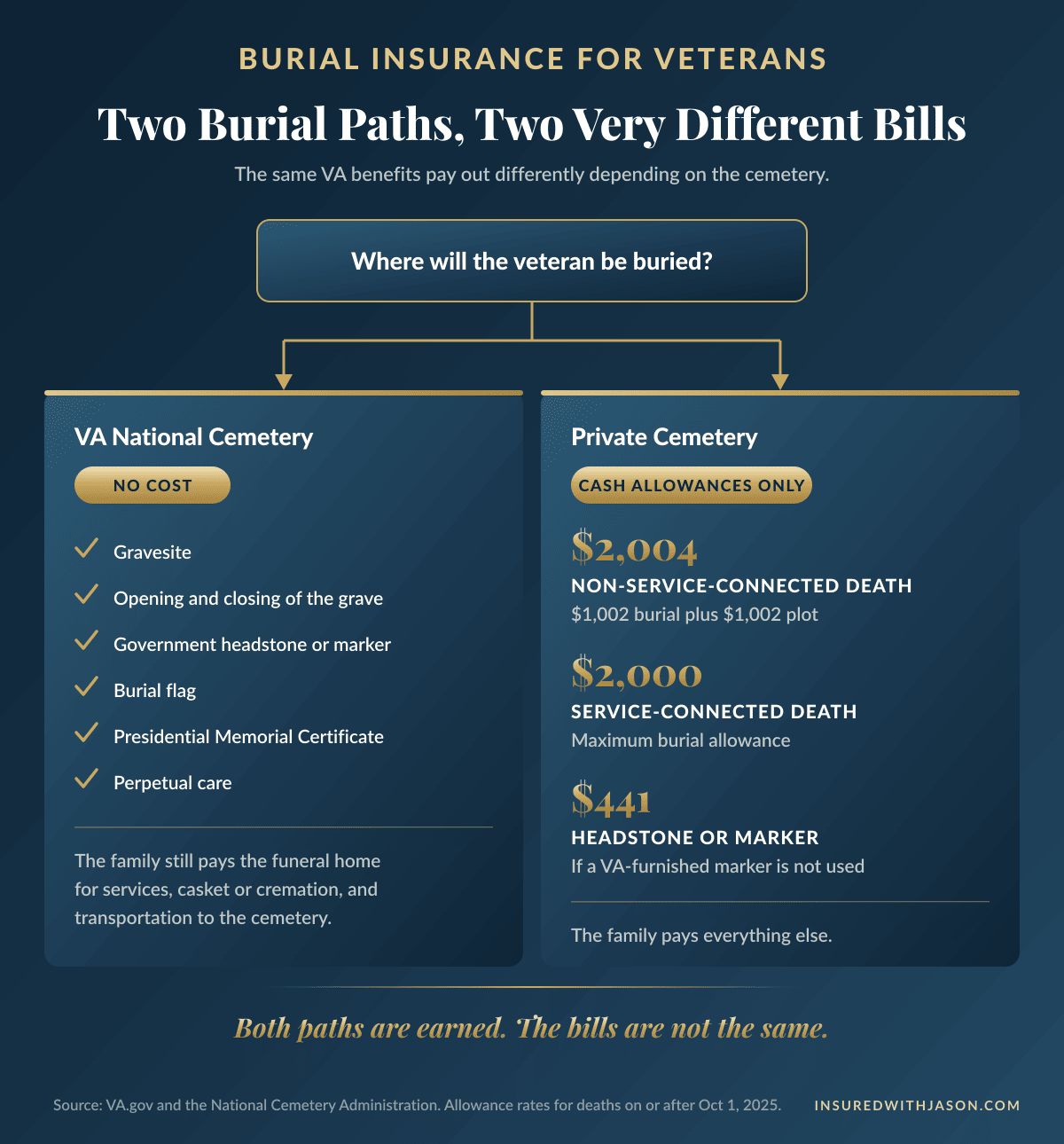
Where the veteran is buried decides which benefits apply: a national cemetery is largely free, while a private cemetery brings cash allowances instead.
So how much of the funeral bill does the VA actually pay?
How Much Does the VA Actually Pay Toward a Veteran’s Funeral?
The VA pays up to $2,000 toward burial and funeral expenses for a service-connected death, and about $2,004 combined for most other deaths. Those are the real numbers, straight from the VA’s burial allowance page, for veterans who died on or after October 1, 2025. Here’s how the veterans burial allowance breaks down.
For a non-service-connected death, the VA pays a $1,002 burial allowance plus a separate $1,002 plot or interment allowance when the veteran is buried outside a national cemetery. For a service-connected death, the allowance rises to $2,000, with no time limit to file. There’s also a headstone or marker allowance of up to $441 when a VA-furnished marker isn’t used. These amounts reset every October 1 with the federal fiscal year. And if the four-dollar difference between the two routes looks like a typo, it isn’t: the two $1,002 allowances rise a little each October with inflation, while the $2,000 service-connected figure is a flat amount set by law.
Eligibility has its own rules. The allowance generally applies when the veteran died while receiving VA care, died while traveling under proper authorization and at VA expense for treatment, had an original or reopened claim for compensation or pension pending at the time of death, or was receiving VA pension or compensation, including veterans who chose military retirement or disability pay instead. And these are reimbursements, not prepayments. Your family pays the funeral home first, then files an application for burial benefits, VA Form 21P-530EZ, and waits for the payment to arrive. For a non-service-connected death, the burial allowance claim must be filed within two years of the burial, though there’s no deadline on the plot or transportation portions.
Now put those numbers next to the bill. The National Funeral Directors Association’s most recent study puts the median funeral with viewing and burial at $8,300, and that figure doesn’t include the cemetery plot, the vault, or the fee to open and close the grave. Against that bill, the VA’s roughly $2,004 leaves a gap of about $6,300, and often more once the cemetery is counted.
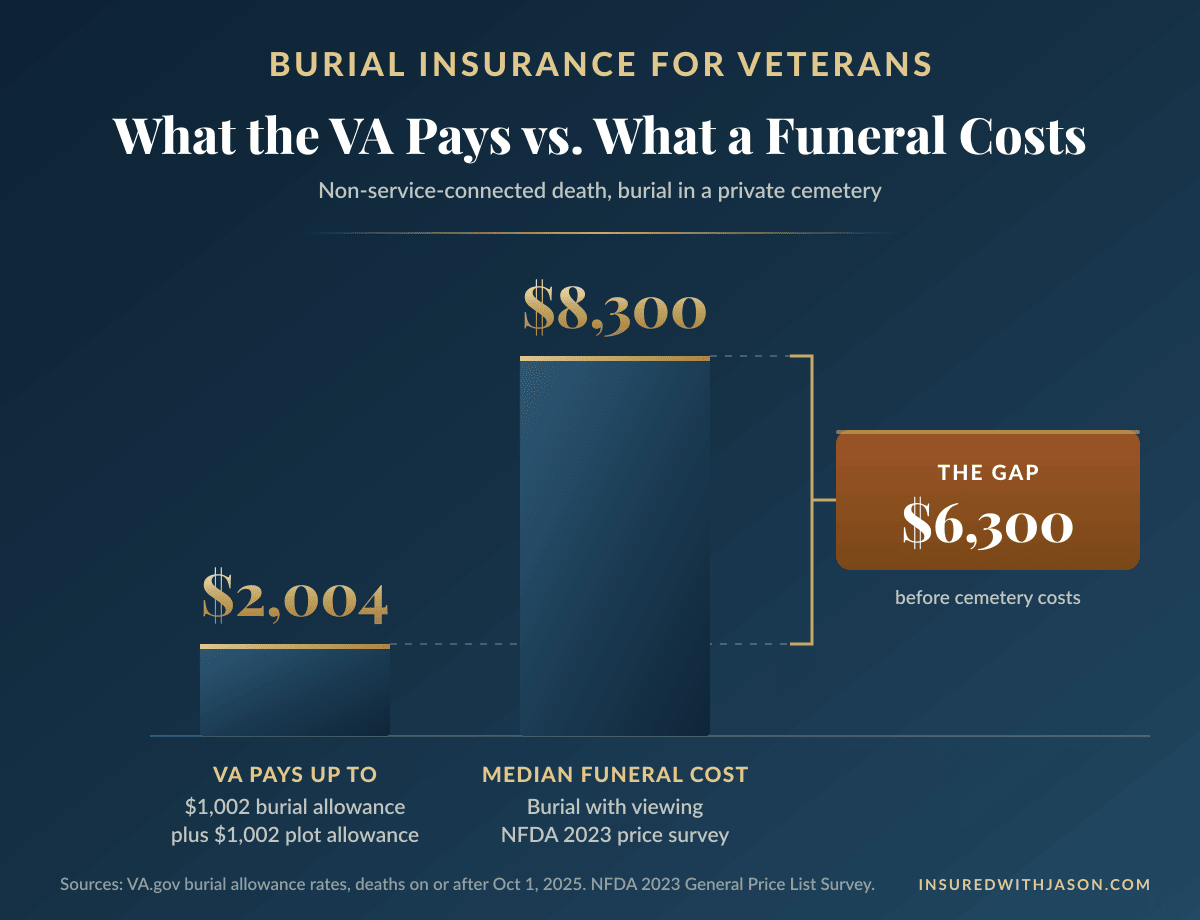
The VA’s maximum cash benefit for most deaths covers about a quarter of the median funeral, before cemetery costs are even counted.
Fairness demands the other side of that math too. A veteran buried in a national cemetery with a VA-furnished headstone skips the plot, the interment fee, and the marker entirely. The family still pays the funeral home for services, the casket or cremation, and getting the veteran there, so the gap shrinks, but it doesn’t disappear. It usually lands in the low thousands instead of the mid thousands.
If the national cemetery covers my burial, do I even need a policy?
That’s a fair question, and sometimes the honest answer is no: if the burial itself is genuinely the whole ask, and the VA is covering it, then the burial is handled. Say a veteran in that spot calls me anyway, though, and the conversation usually turns up things the headstone doesn’t touch. The benefit can be spent on anything, so it might be a gift to the family, or a cushion on the monthly bills so the kids can get the house ready for a proper sale instead of a rushed one.
What would change my answer: whether anything beyond the burial itself needs funding. That’s a needs analysis, not a sales pitch, and it’s a short conversation to run.
One more thing you deserve to know, because it’s circulating in ads and unsolicited calls right now. There is no $25,000 VA burial benefit. That figure is a marketing invention used to capture leads, and the VA does not pay it. The VA also never charges a fee to schedule a burial in a national cemetery, so anyone asking for money to do that is waving a red flag at you.
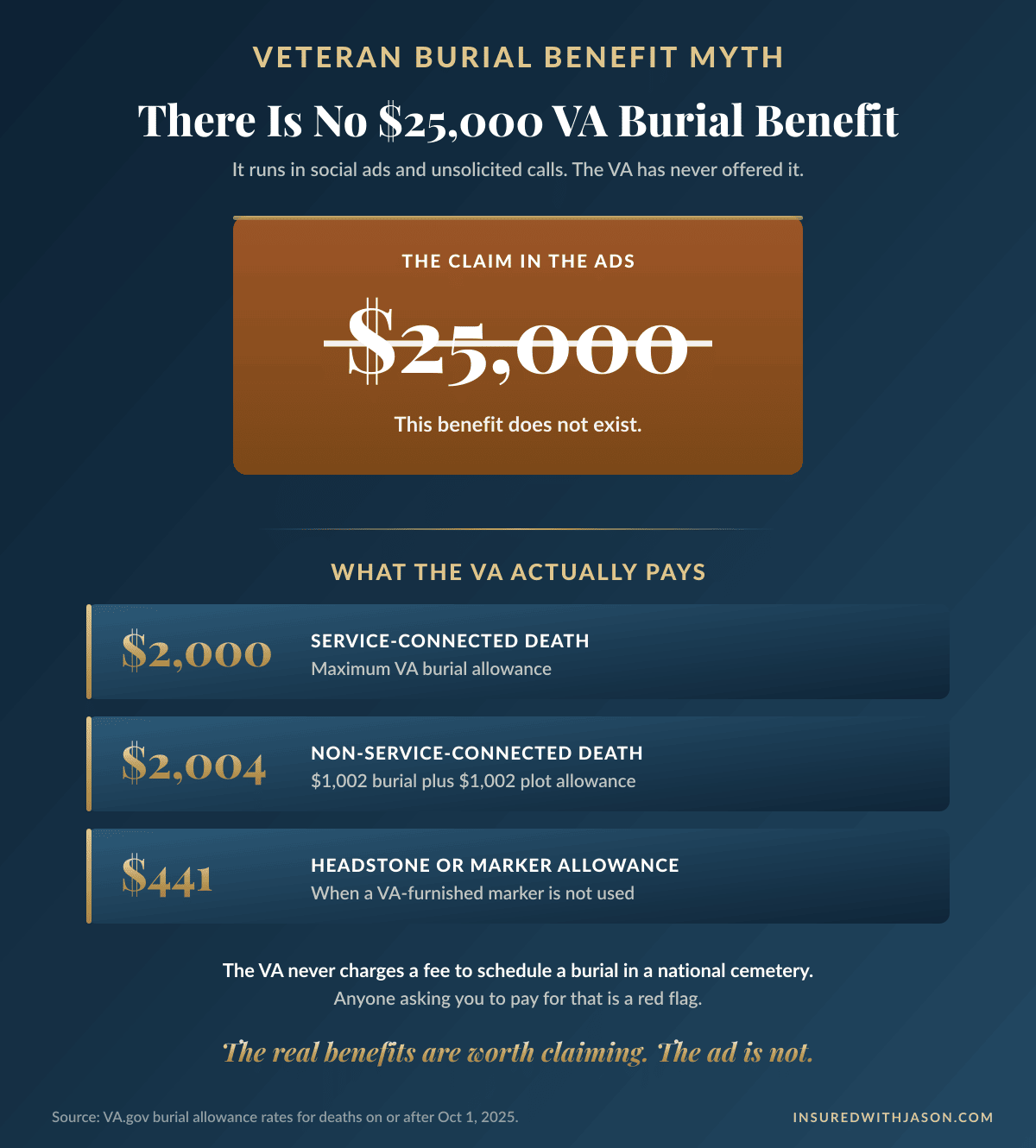
The $25,000 figure in social media ads is not a VA benefit. These are the real numbers, worth claiming from the real source.
See what it costs to close your family’s gap.
Get my price →What Is VALife and Who Qualifies for It?
VALife is guaranteed acceptance whole life insurance run directly by the VA, offering up to $40,000 in coverage for veterans with a service-connected disability rating. If you have any rating at all, even 0%, and you’re 80 or younger, the VA approves you automatically. No health questions, no exam, no time limit to apply. You can read every rule and see every premium on the VA’s official VALife page.
Coverage comes in $10,000 steps up to $40,000. Your premium is set by your age when you enroll and never rises, and it’s the same rate regardless of gender or health. After the first two years, the policy starts building cash value, though it doesn’t offer loans, and VALife has no premium waiver of any kind.
The rule that matters most is the waiting period. Your full coverage starts two years after you apply, and you pay premiums the whole time. If you pass away during those two years, your beneficiaries receive the premiums you paid plus interest, at 4.23% for deaths in 2026, not the face amount. Veterans 81 and older can only get in through a narrow exception: they applied for the disability rating before turning 81, received it after, and apply for VALife within two years of the rating notice.
And if you have no service-connected rating, VALife isn’t available to you at any age or any price. Your route is the private market, which, as you’ll see, is often the better deal anyway.
The private market also stays open longer. Past 80, VALife’s door is closed except for that narrow rating exception, but private guaranteed issue policies commonly accept new applicants through age 85, and some companies go as late as 89 or 90. Aging past VALife’s window doesn’t mean aging out of coverage.
What about VGLI?
Many veterans also carry Veterans’ Group Life Insurance, or VGLI, the coverage service members can convert their SGLI into after separation. VGLI is a different animal from everything else on this page: it’s group term-style coverage whose premiums step up as you move through five-year age bands, rather than a rate that locks for life the way a final expense policy or VALife does. If you hold VGLI, the question worth asking as those premiums climb is how its cost at your next age band compares with a small locked-premium policy, and that’s a comparison worth running with real numbers rather than assumptions.
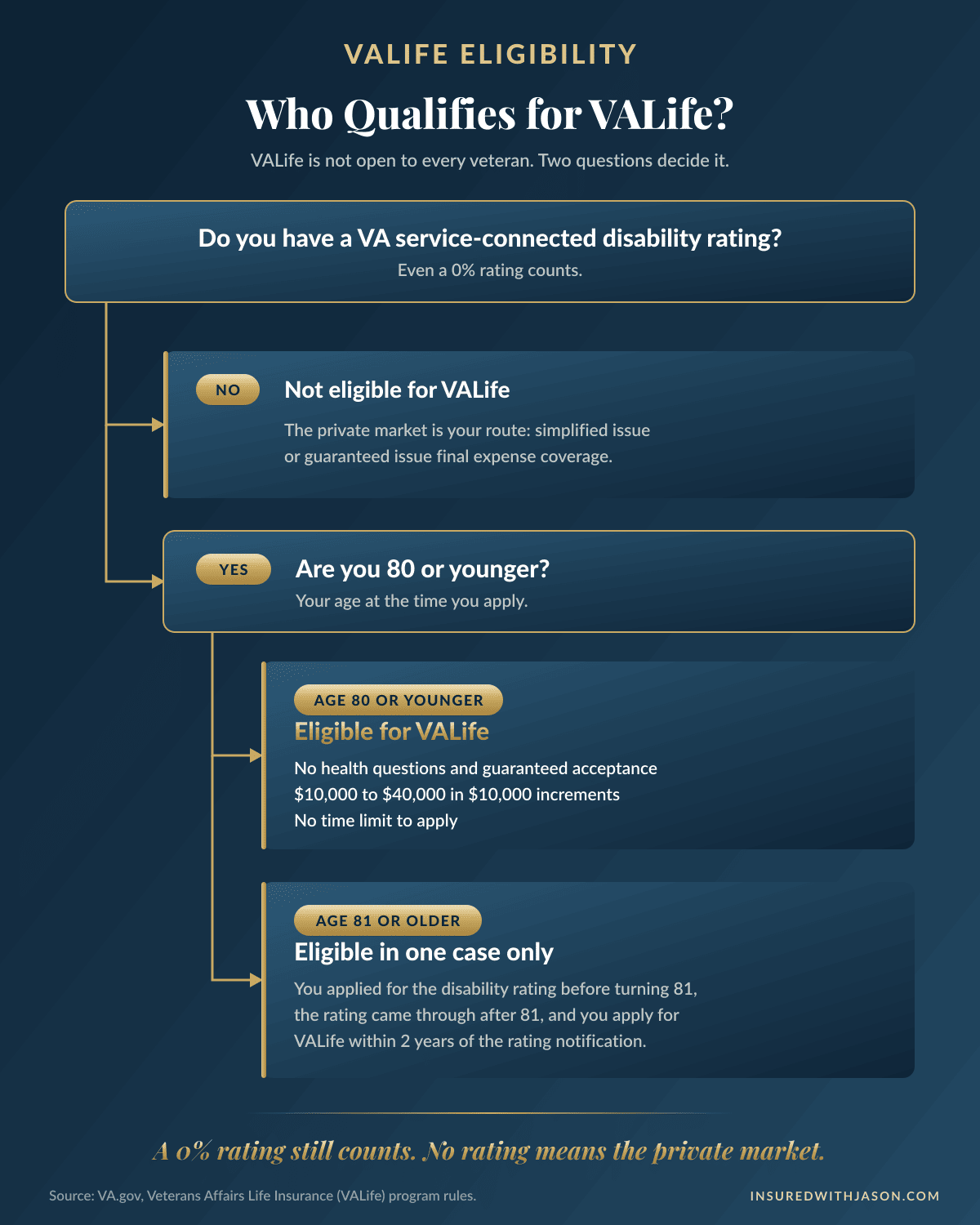
VALife’s gate is the disability rating, not health. Any rating qualifies, and no rating means the private market is your route.
The average VALife face amount in force in fiscal year 2024, across 45,700 policies. Most veterans buy near the $40,000 ceiling, a sign the cap is a real constraint for many families.
Source: Congressional Research Service
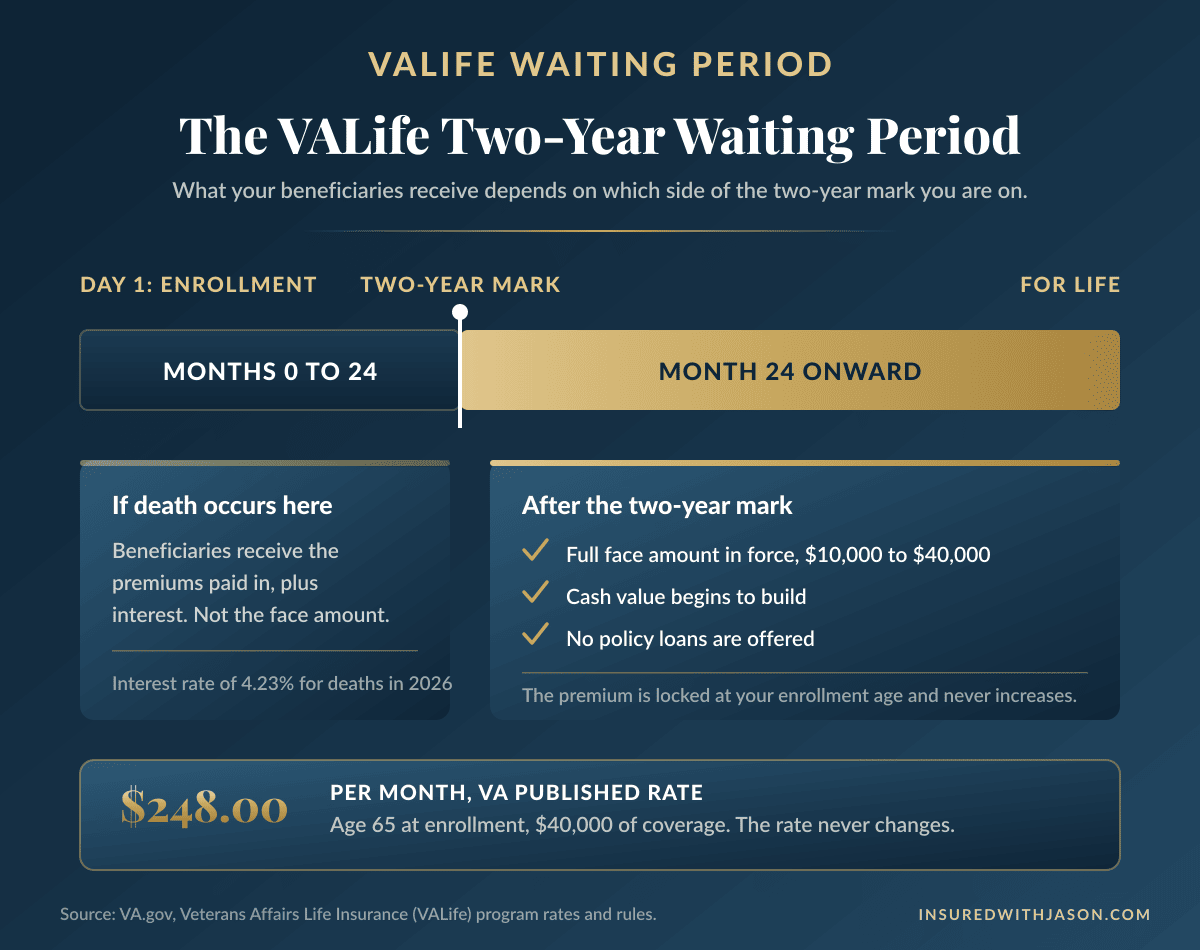
The two-year clock is VALife’s trade for asking no health questions: premiums back plus interest before the mark, full coverage after it.
VALife vs. Private Burial Insurance for Veterans: Which Is Better?
For a veteran who can pass basic health questions, private coverage usually wins, because it protects you from day one and often costs the same or less. For a veteran who can’t pass any health questions, VALife is genuinely hard to beat, and I’ll be the first to say so. The comparison only makes sense once you see that there are really three doors, not two.
Door one is private day-one coverage. You answer a short list of yes-or-no health questions, and if you pass, the full death benefit is in force from the first day, no waiting period at all. Door two is VALife: no questions, guaranteed acceptance, and a two-year wait for the full benefit. Door three is private guaranteed issue: also no questions, also a waiting period, and typically the most expensive of the three per dollar of coverage. VALife’s true peer is door three, and against that peer, VALife’s government pricing usually wins. Against door one, it usually loses on both speed and price.
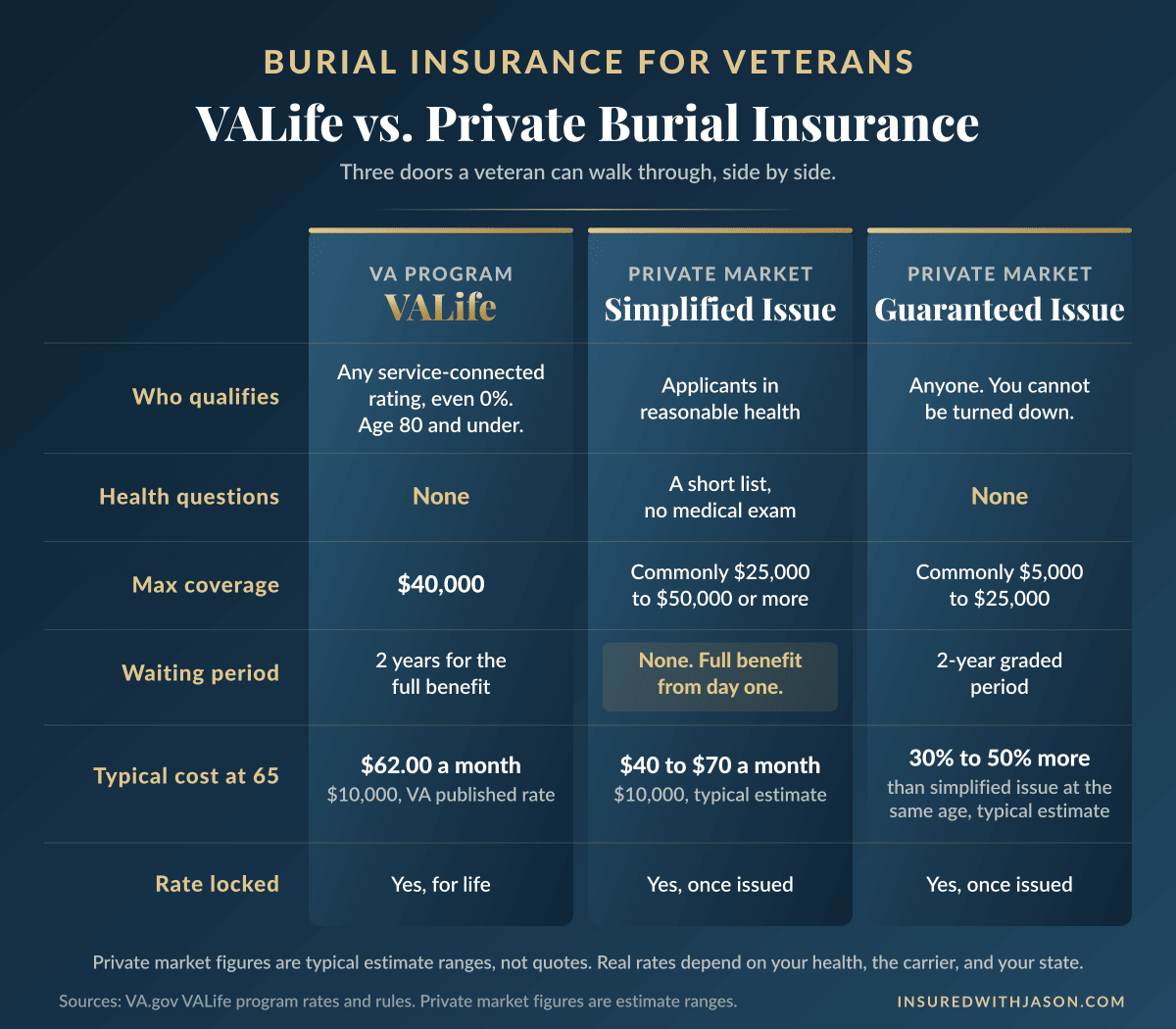
Three doors, one honest picture: day-one private coverage for those who qualify, and a real contest between VALife and private guaranteed issue for those who don’t.
| Private Day-One Coverage | VALife | |
|---|---|---|
| Who can apply | Any veteran, no rating needed | Service-connected rating required, age 80 and under |
| Health questions | A short yes-or-no list, no exam | None, acceptance guaranteed |
| When full coverage starts | Day one, if approved | Two years after you apply |
| Maximum coverage | Commonly $25,000–$50,000 or more | $40,000 |
| If you pass during year one or two | Full benefit paid | Premiums returned plus interest |
| Premium once issued | Locked for life | Locked for life |
VALife terms from VA.gov, current as of this article’s publication. Private policy features vary by company; approval depends on your health answers and prescriptions.
The VA publishes VALife’s exact rates. Private figures are typical estimated ranges, and your real quote depends on your health and the company.
| Age | VALife (VA published rate) | Private day-one (est. range) | Private guaranteed issue (est. range) |
|---|---|---|---|
| 55 | $40.10 | $30–$50 | $45–$70 |
| 60 | $50.00 | $35–$55 | $50–$80 |
| 65 | $62.00 | $40–$70 | $60–$95 |
| 70 | $78.00 | $50–$85 | $75–$115 |
| 75 | $99.50 | $65–$110 | $95–$150 |
| 80 | $127.50 | $85–$140 | $120–$185 |
VALife rates are the VA’s published monthly premiums for $10,000, fixed at enrollment age. Private columns are estimated market ranges for non-smokers and vary by health, gender, and company; a real quote is the only bankable number. Sources: VA.gov premium tables; market estimates current at publication.
Read the grid the way I do. A reasonably healthy veteran usually lands at or below VALife’s price with private day-one coverage, and gets full protection immediately instead of in two years. A veteran who can’t pass the health questions anywhere should compare VALife against private guaranteed issue, and in that lane, VALife’s price usually wins. Both findings can be true at once. That’s why the only wrong move is assuming instead of comparing.
So here’s my advice, plainly. Get both quotes. Let me shop my best price across the whole market, whether that turns out to be day-one coverage or guaranteed issue, and then check VALife’s published rate for your age, which sits right on the VA’s website in plain view. If VALife is your best option, I’ll tell you so, and you’ll enroll knowing you checked. If it isn’t, you’ll have found out before spending two years waiting on coverage you could have had the same day. The shopping costs you nothing, and everybody likes having someone work for them for free.
The S-DVI Trap: What Changed in 2026
Some veterans still carry an older VA policy called Service-Disabled Veterans Insurance, or S-DVI, which closed to new applicants at the end of 2022. If that’s you, the rules changed this year, and the change has teeth. Any veteran who applies for VALife on or after January 1, 2026 has their S-DVI policy end the day the VALife application is approved. That includes policies with premium waivers, and the waiver does not carry over, because VALife offers none.
Apply for VALife while holding S-DVI, and you spend the entire two-year waiting period with no full death benefit at all.
Your S-DVI ends the day you’re approved, and your VALife face amount doesn’t start for two years. The window that let veterans keep both policies during the wait closed December 31, 2025. If you hold S-DVI, compare everything, including private coverage, before you touch that application. The rules are spelled out on the VA’s VALife page linked above.
Will Health Problems Stop a Veteran From Getting Burial Insurance?
Health problems will not shut a veteran out of burial insurance, and your disability rating isn’t even on the application. Here’s what a private final expense application actually looks like. You answer somewhere between ten and fifteen yes-or-no health questions about your conditions today, and the company runs a prescription history check. That’s it. Nobody asks what the VA rates you, and nobody declines you for holding a rating. What matters is the condition you’re in at the time of the application.
Depending on those answers, you land in one of three lanes, and every lane is a real policy.
The full benefit is in force from the first day, at the best price.
- Clean answers to the health questions, even with managed conditions like controlled blood pressure or type 2 diabetes.
- A VA disability rating for things like hearing loss, tinnitus, or old injuries often lives comfortably in this lane.
Coverage with a partial benefit in the early years, then the full amount.
- A recent serious diagnosis or hospitalization that a company wants time and distance from before paying in full.
No health questions at all, with a waiting period as the trade.
- Conditions that decline everywhere else. This is the lane where VALife, if your rating qualifies you, deserves a hard look on price.
The point of working with an independent broker is that the lane isn’t the same at every company. One carrier’s decline is another carrier’s day-one approval, because each company picks the conditions it treats as its lowest risk. My job is matching your health answers to the company that likes them best.
Think your health rules you out? Find out in a minute.
See if I qualify →Do Veterans Get a Discount on Burial Insurance?
No private insurance company files a special discounted rate for veterans, and I won’t pretend otherwise. Final expense pricing is set by age, gender, tobacco use, and health, and it’s filed with state regulators. Your service doesn’t change the rate card, no matter what a mailer implies.
The real discount available to a veteran is the same one available to everyone, and almost nobody uses it: making the whole market compete for you. The spread between the best-priced company and the worst for the same person can be substantial, and the company that treats your specific health history best changes from person to person. That’s the shopping I do across more than 25 companies, and it costs you nothing. Add VALife’s transparent government rate to that comparison if you qualify, and you’ve seen the entire board before you commit a dollar.
If VALife is your best option, I’ll tell you to take it. The right thing to do is always worth more than a commission.
How Much Burial Insurance Does a Veteran Need?
A veteran should size burial insurance to the real bill minus the real benefits, and the math is simpler than most people fear. Start with the funeral you actually want, subtract the VA cash benefits you qualify for, subtract anything already in place, and insure what’s left. For many families, the burial insurance coverage amounts that come out of this math land between $6,000 and $10,000, and higher when a private cemetery is part of the plan.
How to figure out how much coverage a veteran needs
Build the number up from your real plans, not down from whatever an ad is selling.
- 1Start HereDecide burial or cremation, and where
A national cemetery, a state veterans cemetery, or a private one. That choice swings the cost more than any other.
- 2Get The Real NumberAsk a local funeral home for an itemized price list
By law, the FTC Funeral Rule, they must give you one when you ask.
- 3Don’t Forget ThisAdd cemetery costs if you’re going private
Plot, vault, marker, and the fee to open and close the grave. A national cemetery covers these for you.
- 4SubtractTake out the VA cash benefits you qualify for
Up to about $2,004 for most deaths, or $2,000 for a service-connected death, remembering your family fronts the bill and gets reimbursed.
- 5Subtract AgainTake out coverage already in place
An existing policy, savings set aside for this, or a VALife policy past its two-year mark.
- 6Your AnswerWhat’s left is your coverage number
That’s the amount to shop with, across the whole market.
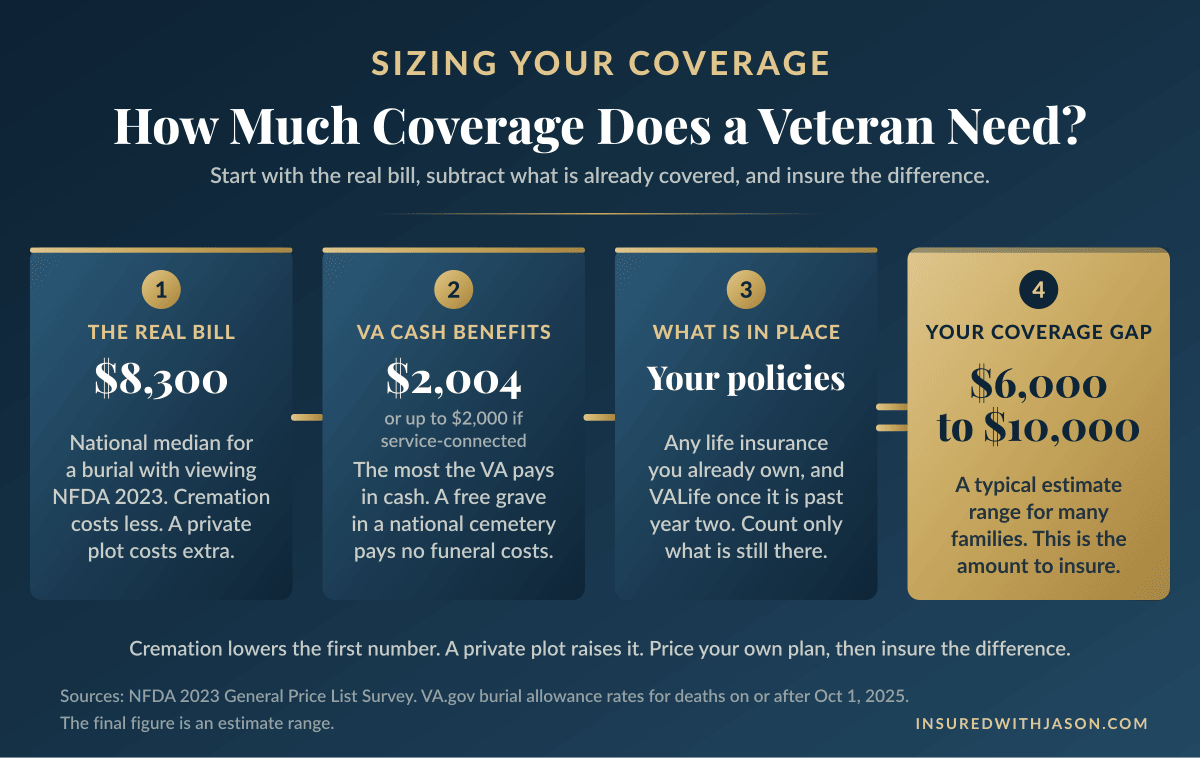
The sizing formula in one glance: the real funeral cost, minus VA benefits and existing coverage, equals the number to insure.
One planning note worth its weight: run this math for your spouse too. Their national cemetery eligibility rides with yours, but the funeral home’s bill for their service is entirely the family’s, with no allowance behind it. A household plan covers two people, not one.
Key veteran burial benefit terms, explained
Burial insurance for veterans: frequently asked questions
The questions veterans and their families ask most, answered plainly.
Does the VA pay for a veteran’s funeral in full? +
No. The VA pays cash allowances of up to $2,000 for a service-connected death or about $2,004 combined for most other deaths, against a median funeral cost of $8,300. Burial in a VA national cemetery is free, but the funeral home’s services, the casket or cremation, and transportation are still the family’s responsibility.
Is there really a $25,000 VA burial benefit? +
No. That figure appears in social media ads and unsolicited calls, and the VA does not pay it. The real maximums are $2,000 for a service-connected death, $1,002 plus $1,002 for most other deaths, and a $441 headstone or marker allowance. The VA also never charges a fee to schedule a national cemetery burial.
Can every veteran get VALife? +
No. VALife requires a VA service-connected disability rating, even a 0% rating counts, and an age of 80 or under, with a narrow exception for certain veterans rated after age 81. A veteran with no service-connected rating cannot enroll at any age and shops the private market instead.
What happens if a veteran dies during the VALife two-year wait? +
The beneficiaries receive the premiums paid plus interest, at 4.23% for deaths in 2026, rather than the face amount. The full coverage amount becomes payable only after the two-year waiting period ends, as long as premiums were paid throughout.
Does a surviving spouse need to file a claim for burial costs? +
Not for the automatic payment. When the VA learns of the veteran’s death, it automatically pays a set amount toward plot, interment, or transportation to a surviving spouse listed in VA records. The full burial allowance is a separate claim, and for a non-service-connected death that claim must be filed within two years of the burial.
Does the VA pay for cremation? +
Yes. The same allowances apply to all legal burial types, including cremation, burial at sea, and donation of remains to a medical school. The dollar amounts don’t change based on the type chosen.
Will my VA disability rating stop me from getting private burial insurance? +
No. Private applications ask ten to fifteen yes-or-no health questions and run a prescription check. They do not ask about your disability rating, and holding a rating does not disqualify you. What matters is your health at the time of the application, and many rated veterans qualify for day-one coverage.
Everyone who wore the uniform deserves the whole truth about what their family will face.
I’m not a veteran. My grandfather served in the U.S. Army in World War II, and I hold a deep respect for everyone who has given that sacrifice. I’ve seen the scars, and I’ve heard some of the horror stories. Honestly, I can’t imagine what some of you have been through, but I can do my very best at my job to show you the respect you’ve earned.
What I kept finding as I learned more about the misconceptions in this space bothered me: most veterans don’t know how much of the bill their family will actually face, most don’t know the VALife rules changed this year, and most have no idea they could probably qualify for coverage that protects them the same day instead of two years from now. So here it all is, in one place, with the real numbers. And if guaranteed issue is truly all you qualify for, I’ll tell you to price VALife before you buy anything from me, even when it doesn’t earn me a dime. Once you trust me with a question, you’re family, and I tell family the truth.
Claim every VA benefit you earned, and know they were never designed to pay the whole bill. If you can pass basic health questions, private day-one coverage is usually your best buy. If you truly can’t, price VALife against my best guaranteed issue rate and take the winner. The only mistake is assuming instead of comparing.
Let’s find the coverage that honors your plan
You served, and you’ve now seen the whole board: what the VA pays, what VALife offers, and what the private market can do for you. The next step takes about a minute. Tell me a little about yourself, and I’ll shop more than 25 companies for the coverage that fits, at a price that locks in at your age today. If VALife beats me, you’ll hear it from me first.
This article is for educational purposes only and is not legal, tax, or financial advice. VA benefit amounts, program rules, and insurance coverage and costs vary by person, company, and state, and government figures change on annual cycles. Please speak with a licensed professional about your specific situation before making a decision.
No exam. Day-one coverage possible.