
How to Get Burial Insurance on a Fixed Income
A level premium that never rises, sized to a budget that can carry it comfortably for the long haul.

- Yes, coverage fits a fixed income. Final expense policies are small whole life plans with a premium that locks at the start and never rises.
- The realistic monthly cost: roughly $24 to $70 for $10,000 of coverage between ages 50 and 65, climbing with age. Those are estimated market ranges, not quotes.
- Size it to your real plan. Cremation can mean $5,000 to $7,000 of coverage does the job; a full burial usually calls for $10,000 to $15,000.
- The best policy is the one you can keep. A policy that lapses protects nobody and wastes every dollar you paid in.
- If your health can pass a few questions, you can often get full coverage from day one, usually at a lower price than the no-questions plans on TV.
- Your family can help. An adult child can own and pay for the policy while you’re the insured, with your consent.
- Social Security’s one-time death benefit is $255, capped there in 1954 and frozen flat since 1981.
- Health issues? Most qualify
- Declined? Jason has next steps
- New policies up to age 85
- Fits a Social Security budget
- Free quotes, no commitment
- Just Jason, never a stranger
Your information goes to Jason. Not a call center. Not a lead list.
Burial insurance on a fixed income has to be sized to your budget first, because the old answers to a tight month are gone. When you were working, you could pick up overtime or an extra shift to get through a squeeze, but a retirement or disability check doesn’t grow, and every dollar of it already has a job.
So here’s the approach that works, and I’ll walk you through every piece of it: find the monthly amount your budget can carry comfortably for years to come, and then buy the most coverage that amount will get you at your age and health.





Can You Get Burial Insurance on a Fixed Income?
You can get burial insurance on a fixed income, and this coverage was genuinely designed for people in your exact situation. A final expense policy is a small whole life plan, usually somewhere between $2,000 and $25,000 of coverage, and it carries the one feature a fixed budget needs most: the premium is locked in the day the policy starts, and it stays there for the rest of your life. It won’t rise as you get older, and it won’t rise if your health changes, which means the payment you can afford today is the same payment you’ll be making at 85.
The coverage itself never expires either, as long as the premium keeps getting paid. And because these plans skip the medical exam, qualifying usually comes down to answering a short list of health questions, or in some cases none at all. For most people, getting approved turns out to be the easy part. The part that deserves real care is sizing the policy so your budget can carry it comfortably for as long as you live, and that’s exactly what the rest of this page will help you do.
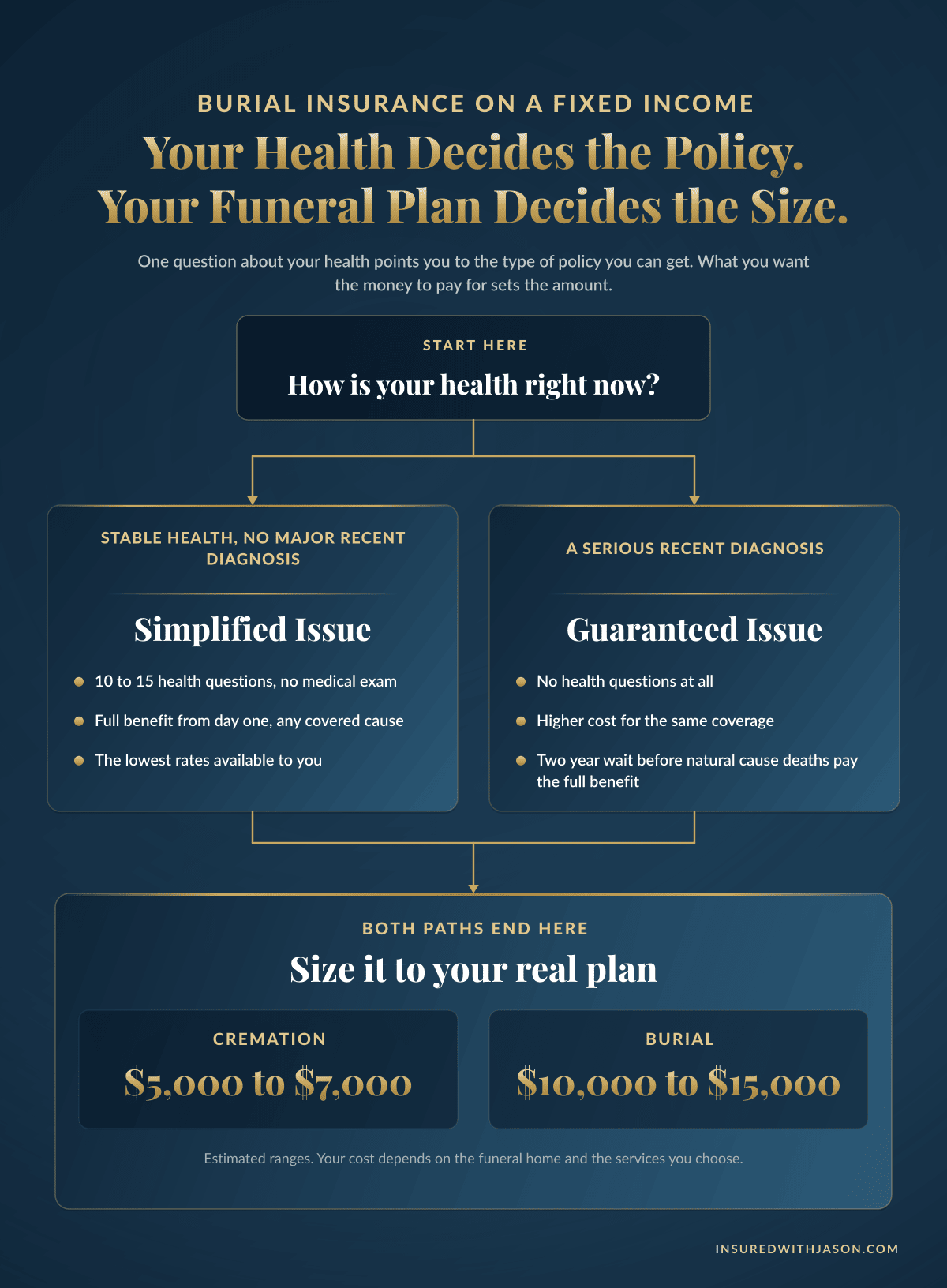
The whole decision in one glance: your health points to the policy type, and your funeral plans set the coverage size.
How Do You Find Room in Your Budget for a Final Expense Premium?
You find room for a final expense premium by trimming the spending you won’t miss, and then setting a monthly cap your budget can handle without any strain. I’ve sat with a lot of people working through this, and the money is usually hiding in the small automatic charges: the streaming service nobody watched last month, the app that quietly renews itself every year, the delivery membership that made sense at the time. Canceling the ones you don’t truly use costs you nothing you’ll miss, and the twenty or thirty dollars they free up each month can become the payment that protects your family.
Then be honest with yourself about the cap, because the goal is never to squeeze your budget until it hurts. The right premium is the one that leaves the rest of your month intact, every month, for years to come. If a number would keep you up at night, it’s too high, and there’s no shame in saying so.
How to find the premium money in a fixed budget
Work from what you already spend, not from wishful thinking.
- 1Start HereList every subscription and membership
Streaming, apps, magazines, delivery clubs. Cancel anything you haven’t truly used in the last two months.
- 2Look CloserCatch the small repeat purchases
The little charges that slip by on autopilot add up to real money over a month.
- 3Set The CapPick the number that never causes strain
The right premium leaves your month comfortable. If a number would keep you up at night, it’s too high.
- 4Hold The LineShop with that cap, not from it
That number is the ceiling we shop under, never an opening bid somebody talks upward.
See what coverage costs at your age.
Real numbers · No pressure · Takes a minute
How Much Funeral Coverage Can Your Budget Buy?
Your budget can usually buy more funeral coverage than you’d expect, once the coverage is sized to your actual plans instead of a number that only exists to sound safe. Here’s the part most people skip: the choice between burial and cremation swings the cost of your funeral more than anything else does. A full traditional burial, with the cemetery included, realistically runs $11,000 to $13,000 today. Cremation with a memorial service runs about $3,000 to $7,000, and a direct cremation can be handled for $1,500 to $3,000. If cremation is your plan, a $5,000 to $7,000 policy can respectably cover everything your family will face, and the premium on that policy is far smaller than the premium on coverage you never actually needed.
Once your plans set the target, your age and health set what burial insurance costs per month. For $10,000 of full day-one coverage, estimated monthly ranges run about $24 to $38 at age 50, $40 to $70 at 65, and $75 to $115 at 75, with women generally paying toward the lower end of each range. Those are market estimates rather than promises, and your real quote is the only number you can bank on. This is also where the order of operations earns its keep: you bring the comfortable monthly cap from the last section, and my job becomes finding the most coverage that cap will buy for someone your age, in your health. When we work in that order, you never end up owning a payment you regret.
Rates for the same coverage roughly double between age 50 and age 70.
Your premium is set by your age on the day the policy starts, and it locks there for life. On a fixed income, that makes waiting the most expensive move available, because the same coverage will simply cost more at every birthday you wait through.
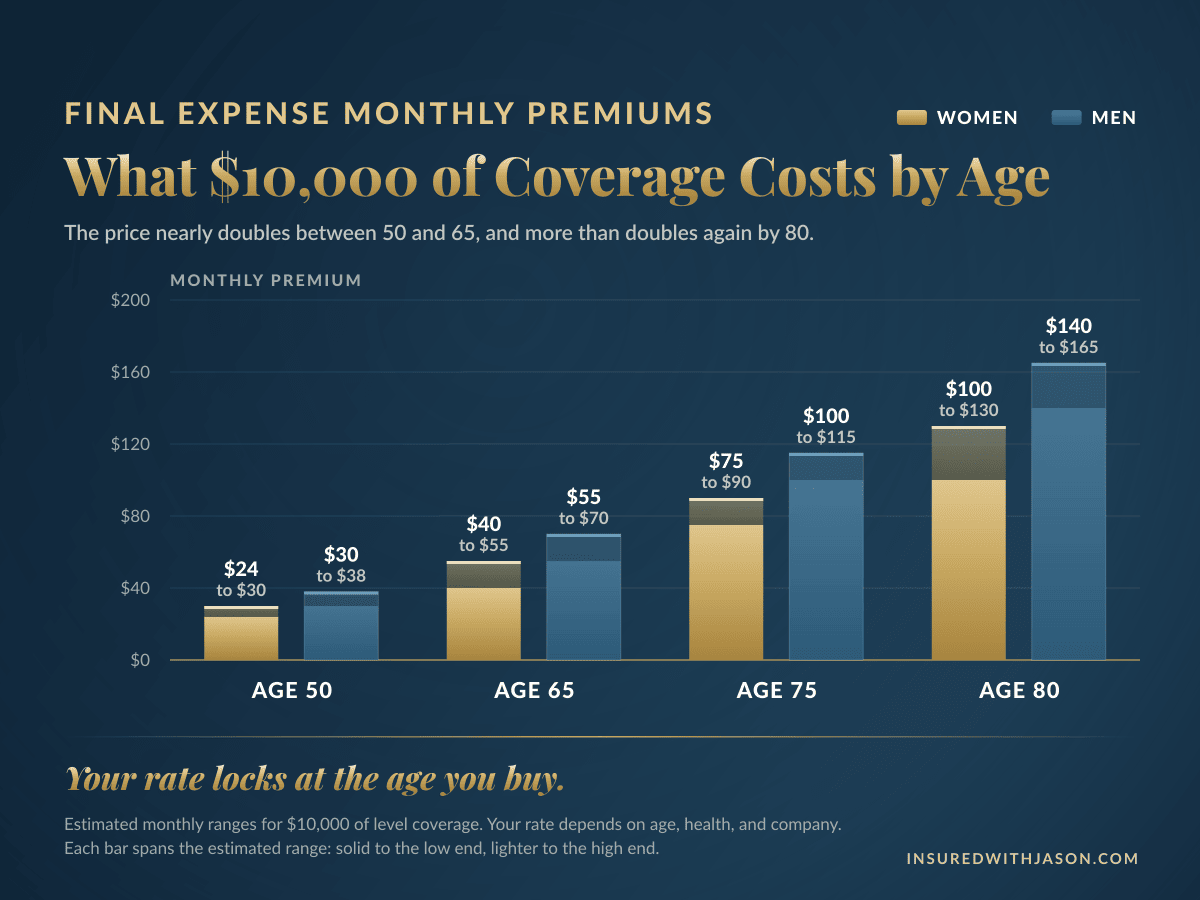
Estimated monthly ranges for $10,000 of day-one coverage. Age is the biggest price driver, and the rate locks the day you buy.
How much of my monthly money is too much to put toward a premium?
Worrying about overcommitting is the right instinct, so here’s how I think it through. Say someone has $300 a month genuinely left over after every bill: my rule of thumb is that a premium shouldn’t take more than about 30 percent of that free money, so I’d want them staying under $100, with the rest left alone to absorb inflation and surprises. That’s a ceiling and a sanity check, never a formula and never a target to spend up to.
What would change my answer: the math only works against what’s truly left after everything, not against the whole check, and if your income is about to step down, we size to tomorrow’s budget instead of today’s. Landing your exact number is a five-minute conversation.
What Wastes Money on Funeral Insurance?
The biggest money-waster on funeral insurance is a premium you can’t sustain, because a policy that lapses returns nothing and protects no one. Every dollar paid into coverage that later lapses is simply gone, and on a fixed income that is the one outcome worth building the whole plan around avoiding. I’ll be plain about my side of it, too: a policy that lapses doesn’t do me any good either, financially or otherwise, because nobody wins when coverage falls apart. The only outcome that works for you, for your family, and for the person who helped you buy the policy is coverage that stays in force until the day it’s needed. Choosing a smaller policy you can comfortably keep isn’t settling for less protection; it’s how you make certain the protection is actually there when your family reaches for it.
The second money-waster is paying for guaranteed acceptance coverage when your health never required it. The no-questions plans advertised on daytime TV are a genuine blessing for people with serious recent health events, and for those folks that coverage is the right answer. But if your health can pass a short list of questions, you can often get a policy that costs less and pays the full benefit from the very first day. Matching the policy type to your health is how every dollar you spend buys the most coverage it possibly can.
No-health-question policies carry a two-year waiting period for natural causes.
If the insured passes from natural causes in the first two years, the family typically receives the premiums paid back plus interest, not the full benefit. If your health can pass the questions, day-one coverage usually costs less and skips the wait entirely.
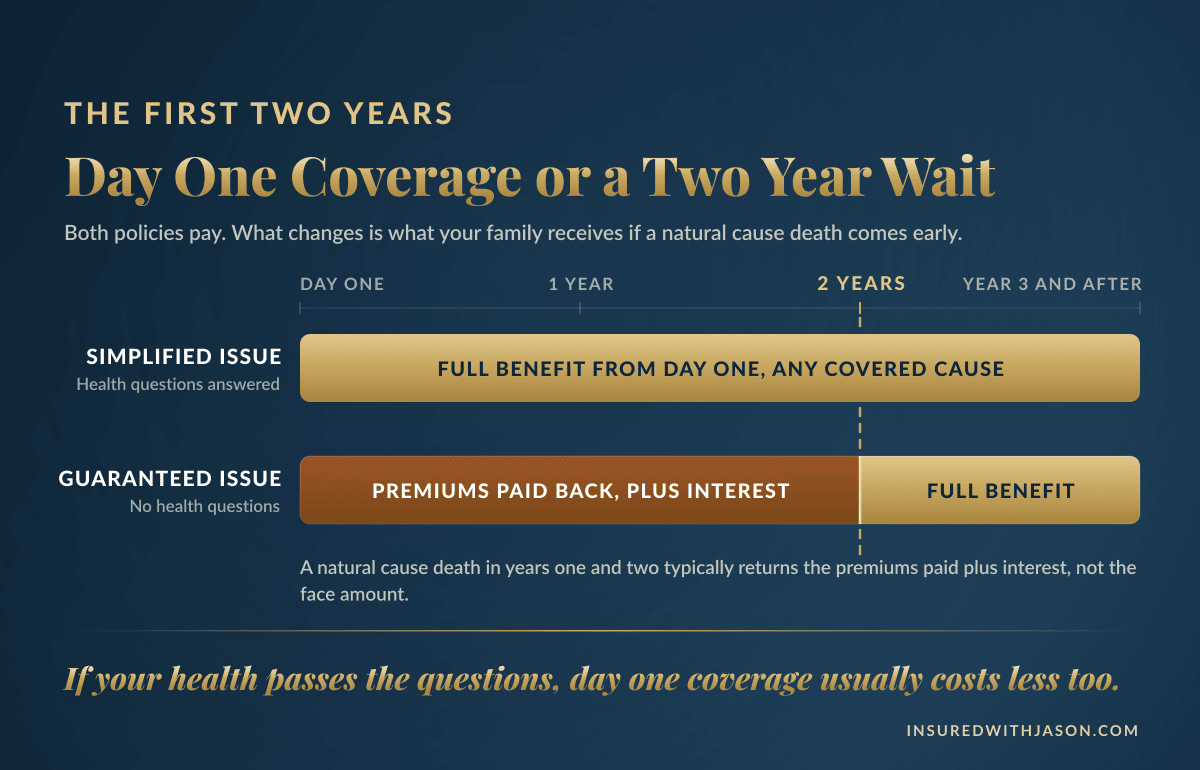
Two paths through the first two years: full benefit from day one when health questions are passed, versus the waiting period on no-questions coverage.
See if you qualify for day-one coverage.
Full coverage from the first day · No waiting
Can Your Family Help Pay for Your Burial Policy?
Your family can absolutely help pay for your burial policy, and for a lot of households it’s the arrangement that makes the most sense. If the comfortable cap in your budget still can’t reach the coverage you need, talking with your children about it isn’t a defeat; it’s planning, and it’s often a conversation they’re relieved to have. Without a policy, the full cost of a funeral lands on your kids all at once, during the hardest week of their lives. A small monthly premium they help with now is a far gentler way for them to meet the same expense, and many adult children are genuinely glad to be asked.
The arrangement can be as simple or as formal as your family wants it to be. Your children can chip in toward a policy you own, or an adult child can go a step further by becoming the policy’s owner, paying the premium directly, and being named the beneficiary. In every version, you are always the insured: the policy is on your life, you give your consent, and you answer the health questions yourself. That structure is completely standard in this business, it rests on the clear financial stake family members have in one another, and it can take the whole worry off everyone’s plate at the same time.
What if your income comes from Social Security or disability?
Can You Get Burial Coverage on Social Security Income?
You can get burial coverage on Social Security income, and millions of retirees do exactly that. The average retirement check is about $2,071 a month right now, and while benefits usually get a small cost-of-living bump each year, most households find that every dollar of the check is spoken for before it arrives. That’s exactly why the budget-first approach on this page fits Social Security households so well: the premium gets sized to what the check can comfortably spare, and because it’s locked, it never grows into a problem later.
Two practical notes are worth knowing. First, most companies can line up your premium draft with the day your check arrives, so the payment never catches your account short, and it’s well worth asking for. Second, please don’t count on Social Security itself to handle the funeral, because its one-time death benefit is $255, capped there in 1954 and frozen flat since 1981, and it won’t make a dent in today’s costs. The real protection has to come from a policy you put in place yourself.
Can You Get Final Expense Insurance on SSI or Disability?
You can get final expense insurance while receiving disability benefits, and depending on your condition, full day-one coverage is often still within reach. Receiving Social Security Disability Insurance doesn’t disqualify you from anything. The health questions on an application ask about your diagnoses, not the source of your income, and plenty of conditions that qualify someone for disability benefits can still pass a simplified application. The average disability check runs about $1,630 a month, so the same budget-first approach applies here; the comfortable cap just tends to sit a little lower, and the coverage gets sized to match it.
Is Supplemental Security Income different from Social Security?
Supplemental Security Income is a completely different program from Social Security, and this distinction matters enough to spell out carefully. Supplemental Security Income is a separate, need-based program for people with very limited income and assets. It happens to be run by the same agency, which is why the names get tangled, but it is not Social Security retirement, and it is not Social Security Disability Insurance. In my experience, most people who say “I’m on SSI” are actually receiving regular Social Security, and if that describes you, nothing in this subsection applies to you at all; your answers are in the section above.
For readers who truly receive Supplemental Security Income, the program limits how much you can own in countable assets, and a policy’s cash value can eventually count toward that limit if the policy is in your own name. Because of that, it may be a better idea to have your adult child own the policy, using the same family arrangement described earlier on this page, which keeps the cash value accessible to your family and outside your countable assets. And keep the timeline in perspective: cash value builds slowly over many years, so this is a planning consideration for down the road, not a problem sitting on your doorstep today. Before you buy, run your plan past your caseworker, and know that the Social Security Administration’s Supplemental Security Income pages spell out the current rules in full.
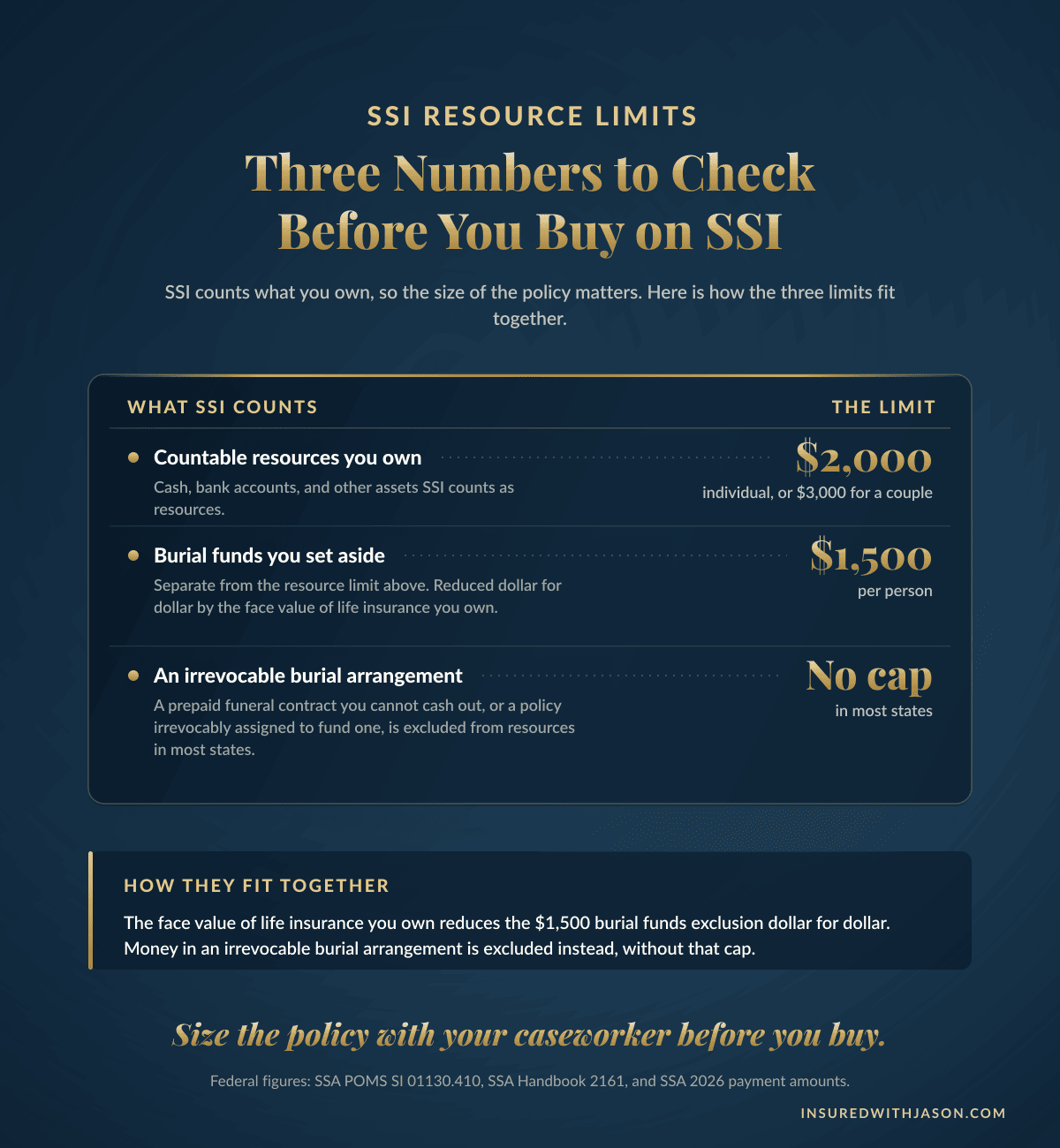
These rules apply only to Supplemental Security Income, a separate need-based program. They do not apply to regular Social Security retirement or Social Security Disability Insurance.
Find out what you’d be approved for.
Most people 50–85 qualify · Find your number
How Does an Independent Broker Find You the Cheapest Rate?
An independent broker finds you the cheapest rate by shopping your exact age and health across the whole market instead of a single company’s price sheet. Every insurance company prices health conditions differently, and the company that treats your specific situation as its lowest risk is the company that will offer you the lowest premium. There’s no way to know which company that is without comparing them side by side, so I shop more than 25 companies looking for exactly that match. It costs you nothing extra to shop this way, because the price through a broker is the same as the price you’d get going to that company directly.
And here’s something I want anyone on a tight budget to understand about how this works: when you buy burial insurance on a fixed income, my interests and yours genuinely line up. A policy that strains your budget and lapses pays me nothing, protects nobody, and wastes the time we both put into setting it up. The only outcome that does either of us any good is a policy sized so comfortably that it stays in force for the rest of your life, which is why I will never talk you past the cap your budget set.
Burial insurance on a fixed income: frequently asked questions
The questions people in your situation ask me most, answered plainly.
Does the premium on a burial policy ever go up? +
No. Burial insurance is whole life coverage with a level premium that locks the day the policy starts. It cannot increase because you got older, your health changed, or you received a new diagnosis. The payment that fits your budget today is the payment for life.
How much coverage do I actually need on a tight budget? +
For most families, $10,000 to $15,000 covers a full burial with the cemetery included. If cremation is your plan, $5,000 to $7,000 can respectably cover it, and a direct cremation can cost even less. Size the policy to your real plans, then match the premium to your comfortable budget cap.
Is a no-health-questions policy ever the right choice? +
Yes, when a serious recent health event would cause a decline on a policy with health questions. For that situation, guaranteed acceptance coverage is the right answer despite the higher cost and the two-year waiting period. If your health can pass the questions, day-one coverage usually costs less and pays the full benefit immediately.
Can my adult child pay for my policy? +
Yes. An adult child can be the policy’s owner, pay the premiums, and be named the beneficiary. You are always the insured: the policy is on your life, you give your consent, and you answer the health questions. Families use this arrangement every day to share the cost.
Will a burial policy affect my Supplemental Security Income? +
First, be sure you actually receive Supplemental Security Income, a separate need-based program. It is not Social Security retirement and not Social Security Disability Insurance, and those programs have no asset rules that a burial policy touches. If you truly receive Supplemental Security Income, a policy’s cash value can eventually count toward the program’s asset limit if you own the policy yourself, so having your adult child own it is often the cleaner path. Confirm your plan with your caseworker before you buy.
When your income can’t grow, every dollar has to do its job.
I know how hard it is to make ends meet on a fixed income. When you were working, a tight month had a fix, because you could always take on extra hours somewhere, but retirement and disability take that option off the table, and the stress of a budget that can’t grow is very real. I wrote this page because I want you to hear something from someone inside this business: it’s okay to live within your means and still protect your family. A smaller policy you can comfortably afford for the rest of your life is worth more than a bigger one that strains you, and shopping the whole market is how each of your dollars buys the most coverage it can. That’s a job I’d be glad to do for you.
Let’s find the coverage your budget can carry
You came here wondering whether real protection was even possible on your income, and now you know that it is when it’s built in the right order: your comfortable monthly number comes first, the coverage gets sized to your actual plans, and then the whole market gets shopped for the lowest rate at your age and health. Bring me the monthly amount your budget can comfortably spare, and I’ll compare more than 25 companies to find the most coverage it will buy you. Your rate is set by your age today and locked for life, so the most affordable day to start is always the one you’re standing in.
This article is for educational purposes only and is not legal, tax, or financial advice. Coverage, costs, and rules for life insurance plans vary by person, company, and state, and all premium figures shown are estimated ranges, not quotes. Please speak with a licensed professional about your specific situation before making a decision.
Takes about a minute