
The Burial Insurance Application Process: What to Expect
What they ask, what they check behind the scenes, and how to walk in prepared from the first call.

- The burial insurance application usually takes one phone call: a short set of health questions, no medical exam, and often an answer the same day.
- No needles, no nurse visit. Carriers verify your answers electronically, mainly through your prescription history and a coded industry database called the MIB.
- Your honest answers are your shield. They’re checked against those databases now, and they protect your family’s claim later.
- Coverage begins when the insurer receives your first premium, not when the paper policy arrives, and you can set that first payment up to about 28 days out to line up with Social Security.
- Every state gives you a free look period, usually 10 to 30 days after the policy is delivered, to cancel for a full refund.
- You can apply for a parent, as long as they consent and answer the health questions themselves.
- A no from one company isn’t a no from every company. Underwriting rules differ carrier to carrier, and a broker’s job is finding the one that says yes.
- Health issues? Most qualify
- Declined? Jason has next steps
- New policies up to age 85
- Fits a Social Security budget
- Free quotes, no commitment
- Just Jason, never a stranger
Your information goes to Jason. Not a call center. Not a lead list.
The burial insurance application process scares a lot of people out of ever applying, and the fear is the only hard part. Most people finish in a single phone call, and many hear a yes before they hang up. The ones that go smoothest have one thing in common: a list of prescriptions, recent health conditions, and beneficiary information sitting right there when the phone rings. Here’s the whole process, step by step, so you can be one of them.





What Happens During the Burial Insurance Application Process?
The burial insurance application process moves through six steps, usually inside a single phone call: a quote conversation, a short application with health questions, a pair of electronic checks that run in the background, a recorded interview at some companies, a decision, and delivery of your policy. There’s no medical exam anywhere in it. No nurse comes to your house, nobody draws blood, and nothing gets mailed to a lab.
That’s because burial insurance is built on what the industry calls simplified issue underwriting. Instead of examining your body, the insurance company examines information: your answers to a handful of yes or no health questions, verified against records that already exist. The old picture of applying for life insurance, with the needles and the waiting weeks for lab results, simply doesn’t apply here. And because there’s no exam, your honest answers do the job a physical checkup would have done, which is why the checks in the next few sections carry the weight they do.
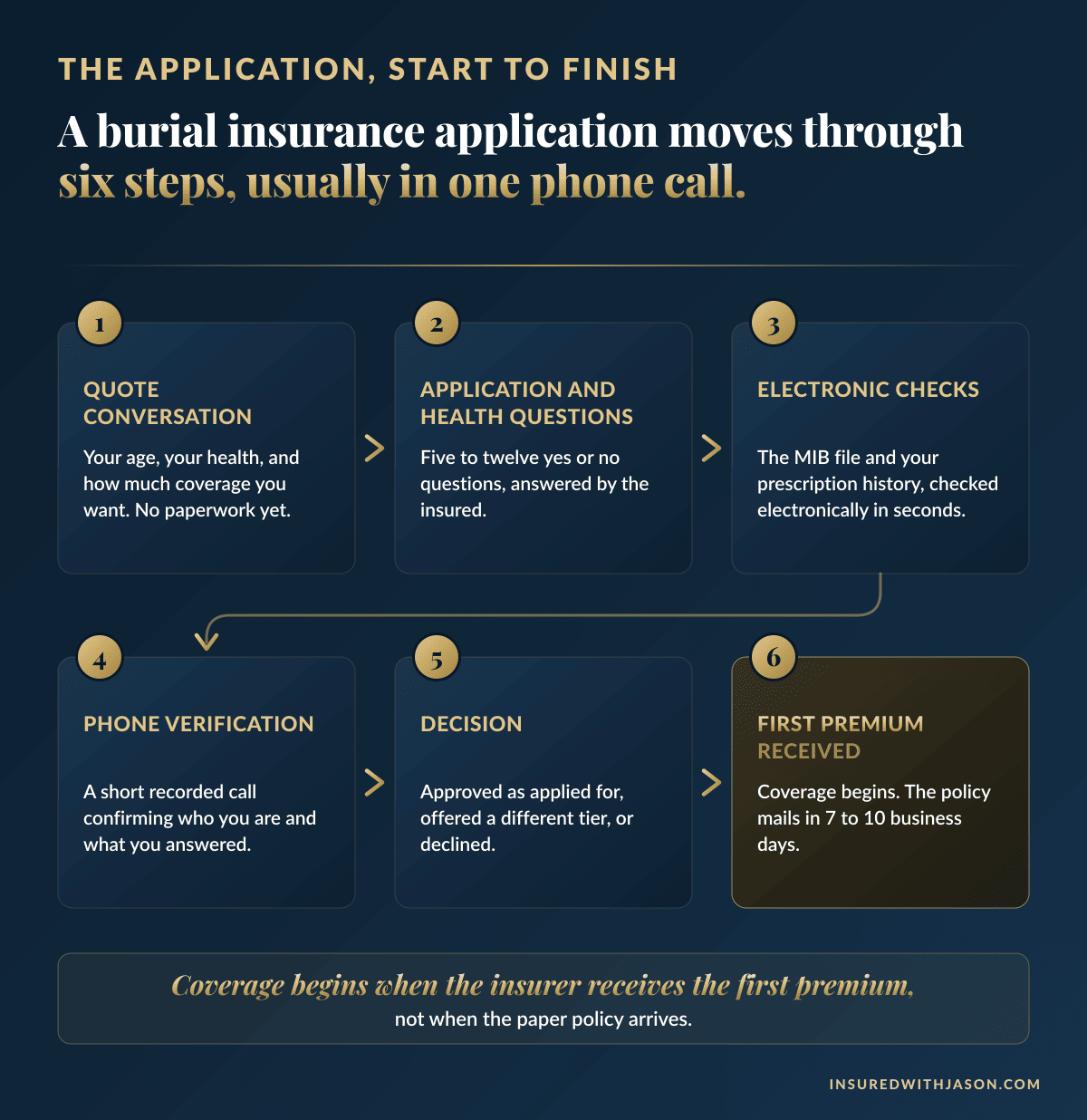
The whole application runs through six steps, and most people finish them in one call.
What Information Do You Need Before You Apply?
A final expense application asks for seven things in one sitting: your legal name, date of birth, Social Security number, and address; a government ID; your height, weight, and tobacco status; your current medications with dosages; any major diagnoses, surgeries, or hospitalizations from roughly the last two to ten years; your beneficiary’s full name and relationship to you; and the bank account or card for your first premium. Missing information is the number one reason applications stall, so gathering it first is the single best thing you can do for yourself.
The medication list deserves special care, because the insurance company will see your prescription history on its own, and the smoothest applications are the ones where your list and their records match. You’ll also want a coverage amount in mind. A funeral with a viewing and burial runs a national median of about $8,300, according to the National Funeral Directors Association, before the cemetery adds its own costs, so most people land somewhere between $5,000 and $25,000 in coverage.
How do you know the application is legitimate?
One more thing belongs on the table before you dial, because it stops a lot of people cold: how do you know the person on the phone is real? That’s a completely legitimate fear. Scams exist, and if I were in your shoes I’d be worried about the exact same thing. So protect yourself the simple way. Ask for the agent’s name and National Producer Number, which you can verify with your state’s insurance department, and ask which insurance company the application is going to before you share a Social Security number. Any legitimate broker will welcome both questions. I go one step further with my own clients: I offer to do the entire application together over FaceTime, Skype, or Zoom, so you can see me working at my desk, ask questions in real time as we go, and then get on the phone with the carrier together. Nothing settles nerves like watching the work happen.
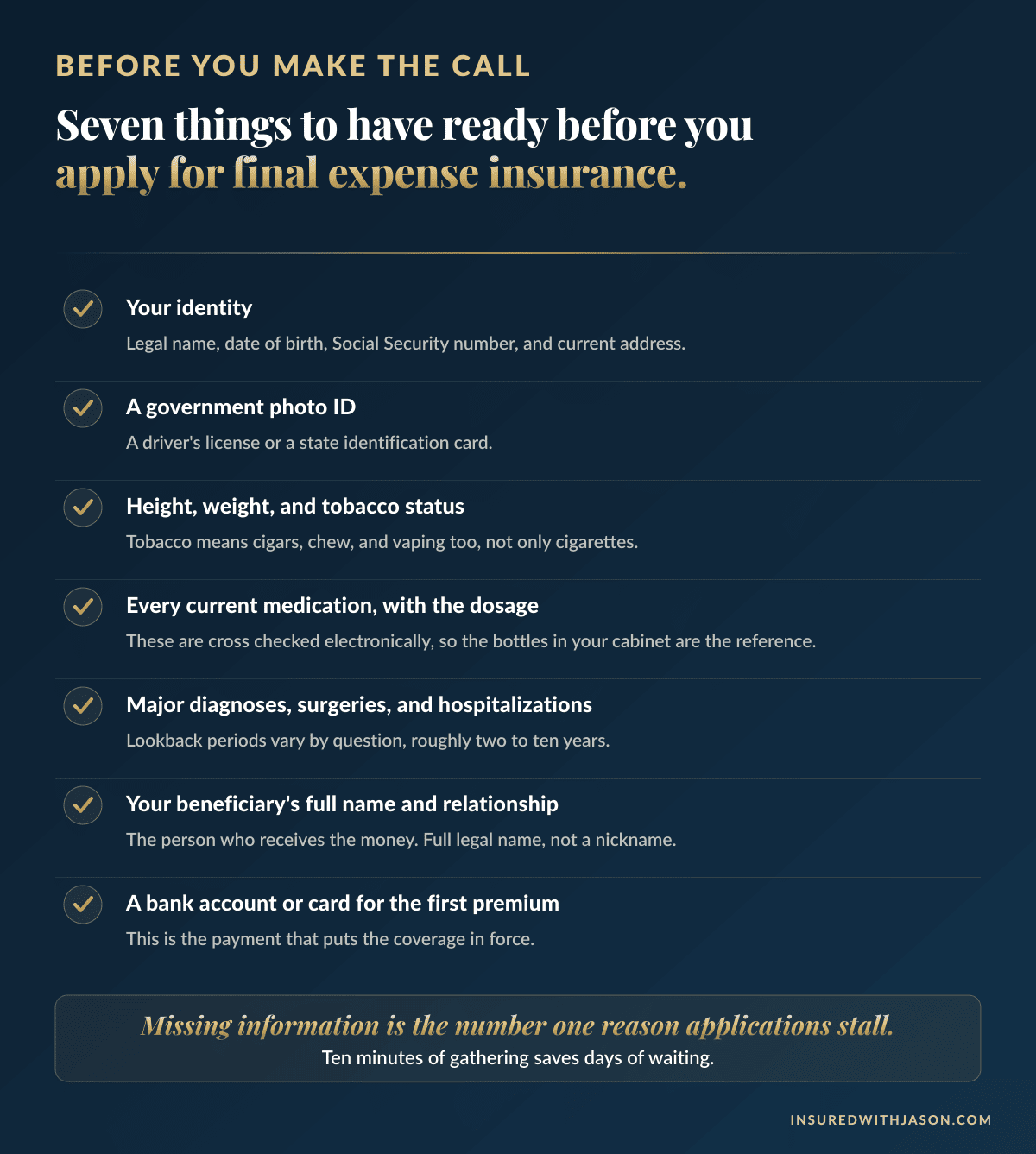
Have these seven things ready and the call moves fast.
What Health Questions Does a Final Expense Application Ask?
A final expense application asks somewhere between five and twelve yes or no health questions, and your answers decide which kind of plan you qualify for. The questions come in a deliberate order. The first few screen for the most serious situations, things like a terminal diagnosis, current nursing home care, or oxygen use for a lung condition. The rest are lookback questions, asking whether something happened within a window of roughly the last two to four years: a heart attack, a stroke, cancer treatment, and so on. The same condition can close one company’s door and leave another’s wide open, because every carrier writes its own questions and sets its own lookback windows. That, in one sentence, is why how you shop for burial insurance matters as much as your health does.
Answer every question honestly, exactly as asked. Your honest answers are your shield: for the first two years of any policy, the insurance company can review a claim against what you said on the application, and truthful answers are what keep your family’s payout beyond challenge. And honesty costs less than people fear. Conditions like controlled high blood pressure, high cholesterol, well managed diabetes, and sleep apnea on a CPAP often still qualify for coverage that starts day one. If you’re carrying a diagnosis and wondering where you’d land, the burial insurance with pre-existing conditions guide goes condition by condition, and the final expense eligibility page covers who qualifies in the first place.
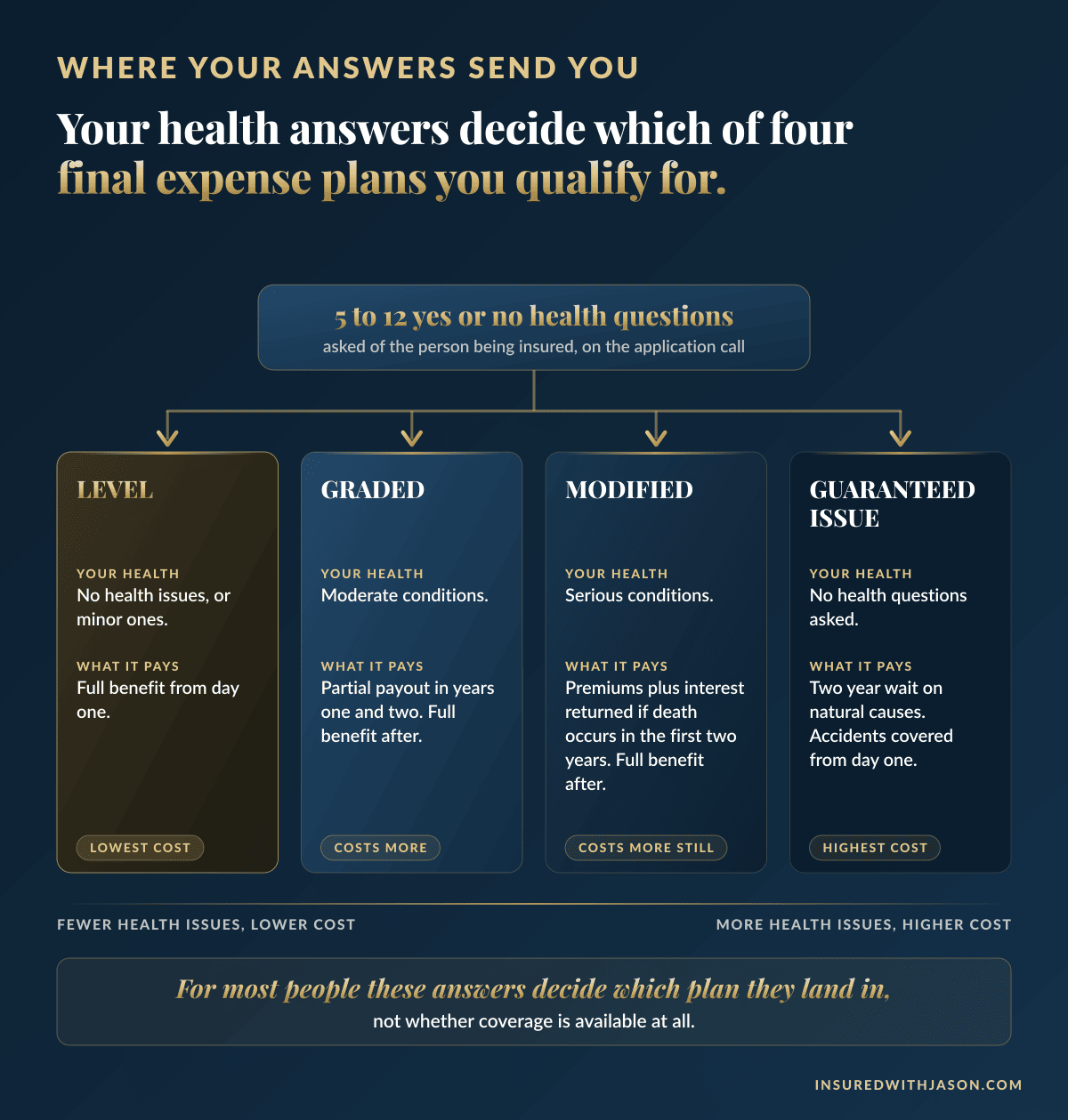
Your answers route you to one of four plans. The healthier the answers, the sooner the full benefit and the lower the cost.
The full benefit is payable from the effective date, at the lowest cost. This is the plan I shoot for on every application, because day one is decided by your health and the carrier match, never by steering.
- Answering no to the serious knockout questions, even with managed conditions like controlled blood pressure or diabetes.
- A broker who shops multiple companies to find the one that treats your health as its lowest risk.
A partial benefit is payable in the first two years for natural causes, then the full amount after. A common landing spot for moderate conditions inside a lookback window.
- A health event, like a heart attack or stroke, within the carrier’s two to four year lookback.
If death comes from natural causes in the first two years, the policy returns the premiums paid plus interest, often around 10 percent depending on the carrier. The full benefit is payable after that.
- More serious conditions that fall inside the questions but outside a decline.
No health questions at all. The trade-off is a waiting period, usually two years, for natural causes, while accidental death is typically covered from day one. It costs the most per dollar of coverage.
- Serious health conditions that answer yes to the knockout questions at every carrier.
Most health conditions still qualify for day-one coverage at the right company.
See if I qualify →Do They Check Your Medical Records?
No, burial insurance companies do not pull your medical records during a standard application. No charts, no lab results, no notes from your doctor’s office. What they run instead are two automated database checks that verify what you say rather than replace it, and understanding both is the part of this process almost nobody explains.
The first check is the MIB, the Medical Information Bureau. The MIB is a coded clearinghouse the industry has shared for over a century, and its file on you, if one even exists, contains category codes from past insurance applications rather than diagnoses or records. MIB records purge automatically after seven years, so unless you’ve applied for individually underwritten life or health coverage in that window, there’s likely nothing there at all. The second check is your prescription history. Services the carriers use pull roughly five years of actual pharmacy fill records: drug names, dosages, and fill dates. This is the check that surprises people, because a medication you genuinely forgot will surface on its own, and a mismatch between your answers and the pharmacy record is the most common reason an application slows down for a closer look.
Here’s the empowering part. Both of these databases are consumer reporting agencies under the same federal law that governs credit bureaus, and that gives you real rights. You can request your own MIB file for free once every 12 months, you can request your prescription report the same way, and you can dispute anything that’s wrong before it ever touches an application. If a company declines or rates you based on one of these reports, it must tell you so, name the database, and point you to a free copy. Checking your own file before you apply is one of the smartest and least known moves in this whole process.
The prescription database can see a fill from as recently as yesterday.
Pharmacy records update in near real time, which is exactly why an accurate medication list matters more than a perfect memory. The record speaks for itself either way; your list just makes sure you and the record agree.
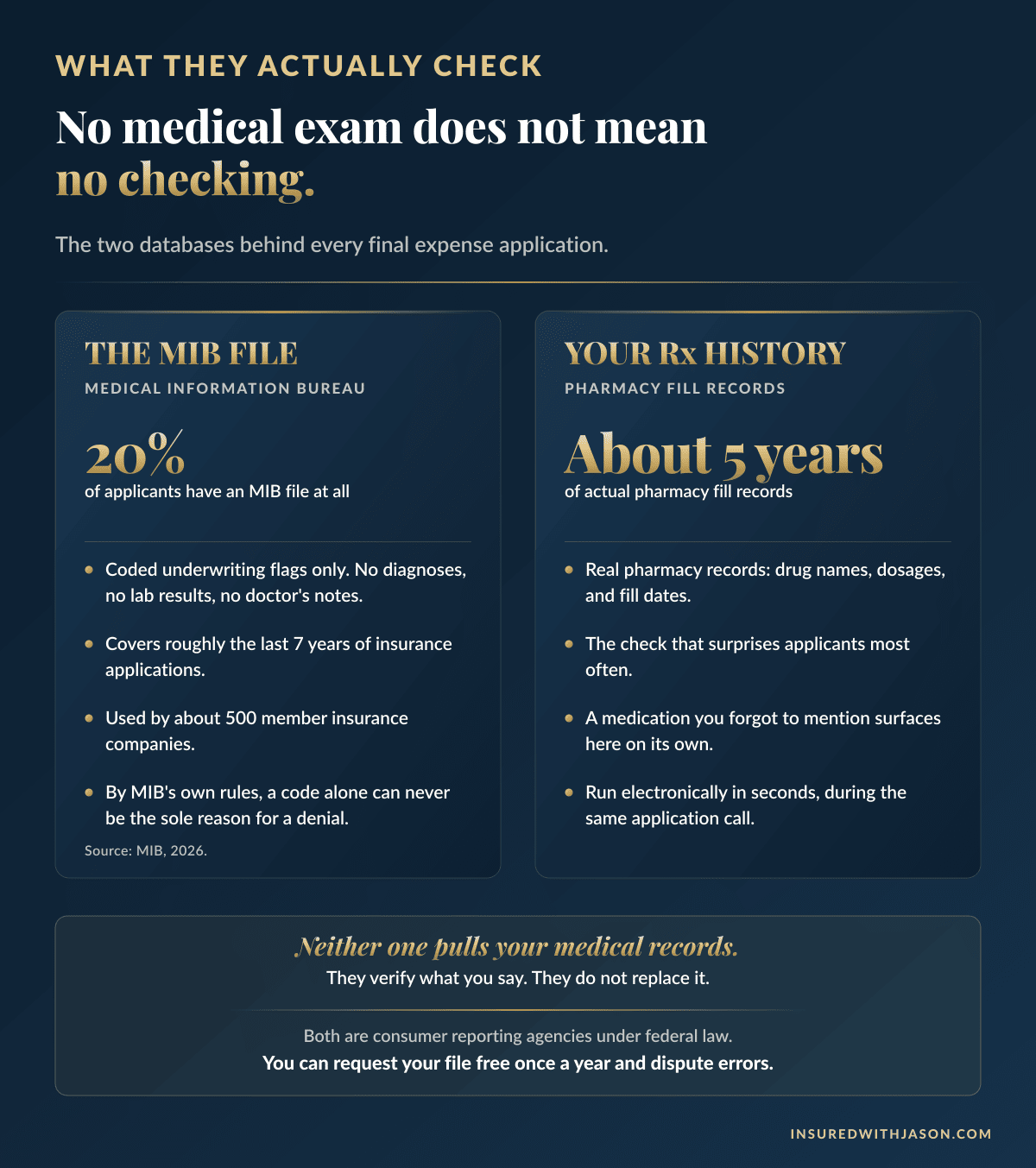
Two different databases, two different jobs, and neither one holds your medical records.
What Is the Phone Interview For?
At most final expense companies, the phone interview is the application itself, not a second hurdle after it. The health questions are asked live by a trained interviewer, your answers are recorded, and many carriers finish the call with a voice signature and a decision on the spot. Where a company does run a separate verification call, its job is simple: confirming your identity and your answers in your own words, so nothing gets transcribed wrong before the electronic checks run.
A good broker prepares you for that call, and there’s nothing mysterious about how. Before you ever get on the phone with a carrier, the broker walks through the same generic knockout health questions with you, explains any question written in medical or legal language until it makes plain sense, and confirms the company you’ve chosen is actually likely to accept your health picture. Not to shape your answers, ever. You answer everything honestly and in your own words. The preparation exists so a complicated question never catches you off guard and so your time is never wasted on a company that was going to say no. That’s how I run every application I’m part of, and I don’t send anyone off into the abyss either: I dial the carrier myself, stay on the line while you answer, and the whole thing usually takes ten minutes or less.
Every so often someone asks me whether they can just take the guaranteed acceptance plan and skip the questions altogether. I understand the instinct completely; nobody loves being quizzed about their health. But say someone in otherwise decent shape asks me that. Here’s how I think it through with them: the interview costs ten minutes, and skipping it costs real money and a two-year wait, because that same monthly premium can usually buy meaningfully more coverage through a few questions. And this policy was never about you. It’s about your family, and they’re the ones the extra coverage protects. If your health genuinely requires guaranteed acceptance, that’s a different conversation and an honest one. But trading half your family’s protection to dodge ten minutes on the phone with me sitting next to you? I’ve never once watched someone make that trade after hearing it out loud.
Curious which plan your health opens up? It takes about a minute to find out.
Show me my options →How Fast Can You Get Approved?
Most simplified issue applicants get their answer the same day, and many get it before the call ends. When your answers match the electronic checks cleanly, the decision is often instant. When something needs a human look, a flagged prescription or a mismatch, the file routes to manual review and typically comes back within one to three business days. A request for records from your doctor’s office can stretch things into weeks, but that’s rare for final expense. One accurate medication list in your hand is the single best way to stay in the fast lane.
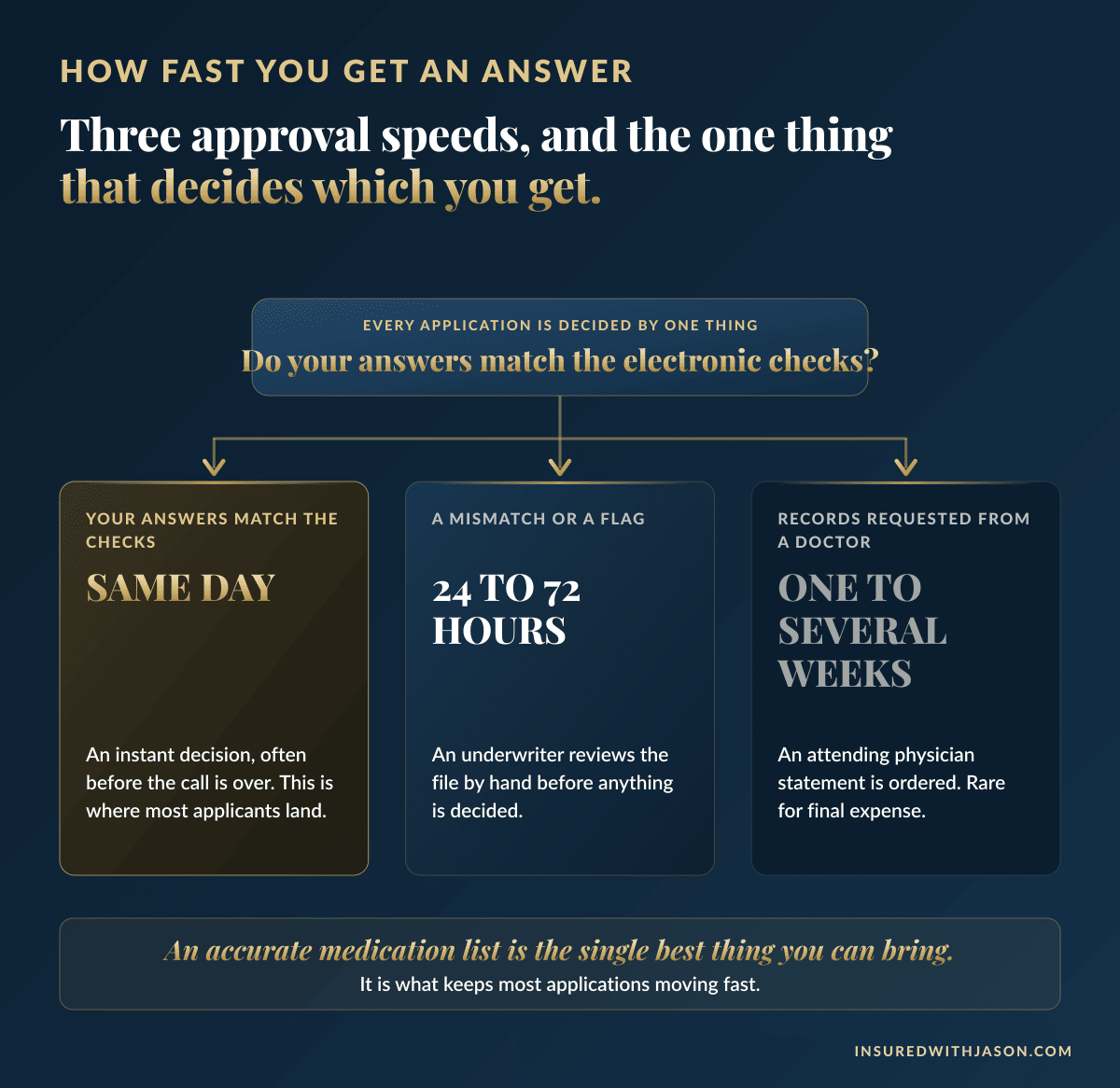
One thing decides your speed: how cleanly your answers match the record.
Getting approved and being covered are not always the same day. The approval is the yes. The first premium is the start.
What Happens After You’re Approved?
Coverage begins when the insurance company receives your first premium on an approved policy, not when the paper policy shows up in your mailbox. The surest way to have a level, no waiting period plan protecting you from day one is to remit that first payment at the time of application through an automatic bank draft. Once the premium lands, the policy itself follows by mail, usually within seven to ten business days, and your exact coverage dates are printed inside it.
Can you apply now and pay the first premium later?
Yes, and this is one of the most useful things I can tell you about the whole process. Say someone tells me their money is three weeks out because that’s when Social Security hits. Completely understandable, and very normal. Here’s what we do: we knock out the health questions, we knock out the phone application, and we set the automatic draft for the day their deposit arrives, up to about 28 days out with most carriers. From then on the payment recurs on that same date every month, timed to the money hitting the account, so there’s never a worry about the premium and never a second thought about it again. Some carriers have gotten even smarter about this with what’s called Social Security billing: instead of a fixed calendar date, the draft lines up with the deposit event itself, whichever day your Social Security actually lands that month. That solves the very fair objection that the payment doesn’t always arrive on the same date, and when a carrier offers it, it’s a beautiful thing. At that point it’s really done. It’s just not in effect yet. The one thing you have to understand going in, and my clients always do, is that the insurance company will not cover you before it receives that first payment. It’s a small, known risk you accept with clear eyes in exchange for handling everything while it’s top of mind, instead of hanging up, overthinking it for three weeks, and talking yourself out of protecting your family entirely. People do this all the time, and they love having it done.
And here’s the quiet bonus almost nobody notices: that gap is free thinking time. Your free look period, the state-required window of 10 to 30 days to cancel for a full refund, doesn’t start until the policy is delivered. So every day between your application and your first draft is extra room to settle your nerves, ask me questions, add coverage, lower coverage, or change a beneficiary, with nothing set in stone and the free look clock not even ticking yet. If your Social Security lands ten days out, that’s ten bonus days on top of a window many states stretch to a full 30 for seniors. The exact number of days is printed in the first pages of your policy, so open the envelope when it comes.
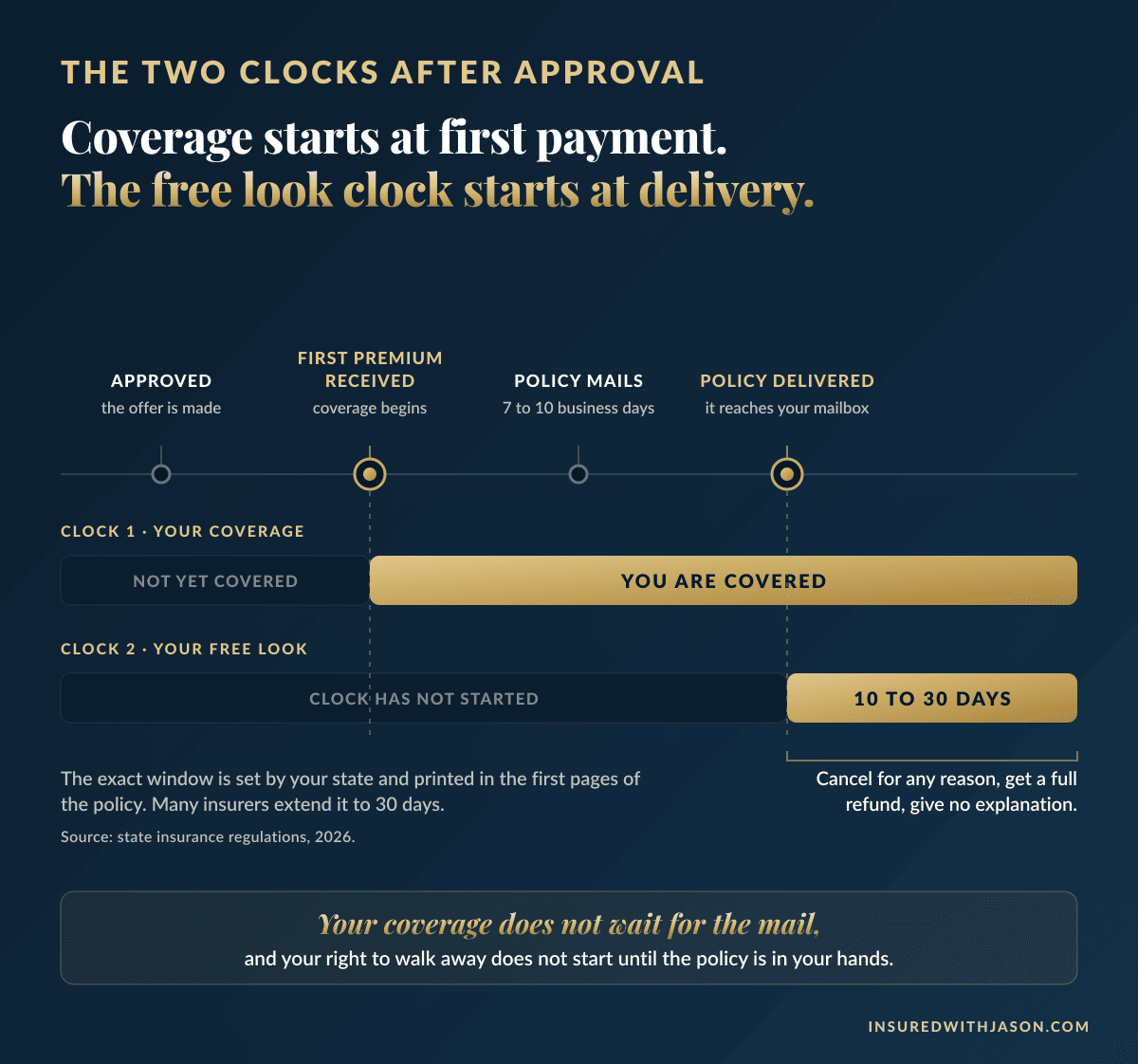
Two clocks people mix up: coverage starts at the first premium, and the free look starts at delivery.
See your exact price at your age, from across the whole market.
Get my price →What if the answer is no?
What If You’re Declined?
A decline from one company is not a final answer, because every carrier writes its own underwriting rules. The same condition that closes one door can qualify for day-one coverage somewhere else, which is why the first move after a no is simply asking your broker to shop the same health picture across other companies. If the level plans all pass, a graded or modified plan is the next rung, and guaranteed acceptance is the rung below that, always there, no questions asked. Your money is safe through all of it, by the way: the first premium typically isn’t drafted unless a policy is approved, so a decline usually means nothing was ever taken.
You also have rights most people never hear about. If a database report played any part in the decline, the company must send you a notice naming that database, and you’re entitled to a free copy of the report within 60 days and the right to dispute anything in it that’s wrong. Errors happen, someone else’s prescription on your file happens, and the dispute process exists precisely for that.
Is a modified plan even worth taking?
Nobody loves being placed in the less-than group; rejection stings at any age, and I understand it completely. But say someone calls me discouraged about a two-year wait. Here’s the arithmetic I’d walk through with them: every month you spend hemming and hawing adds another month to that two-year wait, and by the time some people finally act, the waiting period they dreaded would already have been behind them, with full coverage in force.
What would change my answer: the plan stops being worth buying when you no longer believe in the price-to-coverage ratio for your family. That’s a gut call only you can make, and it’s worth an honest conversation before you make it.
The one-time Social Security death payment, unchanged since 1954. It goes to an eligible spouse or child, never to a funeral home, and it was never designed to cover a funeral. It’s a backstop worth knowing about, not a plan.
Source: Social Security Administration
Can You Apply for a Parent?
Yes, an adult child can buy and pay for a burial policy on a parent, and families do it every day. The structure is simple: you can be the owner, the payor, and the beneficiary, while your mom or dad is the insured. The law recognizes your financial stake in a parent’s final expenses automatically, so insurable interest is never the obstacle. Consent is the one hard rule. Your parent must agree to the policy and answer the health questions personally, in their own voice, on the call. You can sit beside them, set everything up, and help them understand each question, but you cannot answer for them, and a power of attorney generally cannot buy a new life insurance policy for a parent who can no longer consent.
That last rule matters more than most families realize, and it’s where a trustworthy broker shows you who they are. If a son tells me his mother has good days and bad days with her memory, I’m going to be honest with him, gently: I’m just not comfortable handling that application, because what he’s describing is a parent who may not be able to make this decision for herself right now, and the kindest next step is a conversation with her doctor, not with an insurance broker. Any broker who’d proceed anyway is not protecting your family. The real lesson runs the other direction: the door for a level, day-one plan is open while a parent is healthy enough to answer for themselves, and the time to walk through it is early. The full walkthrough for this situation, from the conversation at the kitchen table to the roles on the paperwork, lives in the burial insurance for parents guide.
The burial insurance application: frequently asked questions
The questions people ask me most about applying, answered plainly.
Do they check my medical records when I apply for burial insurance? +
No. Standard final expense applications don’t pull medical records or order an exam. Companies verify your answers through two databases: your prescription fill history and the MIB, a coded industry clearinghouse that holds category codes rather than diagnoses.
Can one prescription get me declined? +
It can affect the outcome, because certain medications signal certain conditions to an underwriter. That’s not a reason for fear; it’s a reason for preparation. Bring an accurate medication list, answer honestly, and let a broker match you with a company that accepts your health picture.
How soon am I covered after I’m approved? +
Coverage begins when the insurance company receives your first premium on an approved policy. Pay at the time of application by automatic draft and a level plan protects you from day one. Defer the first draft, up to about 28 days at most carriers, and coverage begins when that payment lands.
Can I apply for my mom or dad? +
Yes, with their consent. You can own the policy, pay for it, and be the beneficiary, but your parent is the insured and must answer the health questions personally. A power of attorney generally cannot buy a new policy for a parent who can no longer consent, so the time to act is while they can.
What happens if I’m declined? +
You try the next door. Underwriting rules differ from company to company, so a broker shops your same health picture elsewhere first, then considers a graded or modified plan, and guaranteed acceptance remains open with no health questions at all. If a database report drove the decline, you’re entitled to a notice naming it, a free copy, and the right to dispute errors.
Is final expense the right policy for someone younger? +
Often not. A younger person with a family to protect and room in the budget can frequently get far more coverage per dollar through term life insurance. Final expense earns its place later in life, when a small permanent policy with easy approval is exactly what the situation calls for.
Fear of the unknown should never be the reason a family goes unprotected.
Applications scare people, and I get it completely: the unknown is real, and plenty of us have had our hopes up before and watched things not work out. I’ve seen that fear, plus the worry about scammers and the unscrupulous, talk good people out of coverage they wanted and would have qualified for. And I know what waits on the other side when it goes unbought, because an adult child blindsided by a massive bill in the worst week of their life has absolutely nobody to turn to. So I wrote out the whole process: what they ask, what they check, and what happens next, with nothing left in the dark. If certainty replaces the fear for even one person reading this, someone who closes this page thinking, this is real, and I can do this, then it did exactly what I built it to do.
Ready to walk through it together?
You now know every step of the application: what they ask, what they check, and when coverage begins. The fear of the unknown is out of the picture, and what’s left is a phone call most people finish in minutes. Your rate is set by your age the day you start, so the least expensive day to begin is the one you’re standing in. Get your quote below, and if you’d like, we’ll do the whole application together, on the phone or on a video call, so you can watch every step happen.
This article is for educational purposes only and is not legal, tax, or financial advice. Coverage, costs, and rules for life insurance plans vary by person, company, and state. Please speak with a licensed professional about your specific situation before making a decision.
Your answer in about a minute.