
How Burial Insurance Claims Work, From Filing to Payout
What happens when it’s time to file, how fast the money arrives, and how to set everything up today so your family never struggles with it.

- A burial insurance claim usually takes three things: the claim form, a certified death certificate, and the beneficiary’s ID.
- Approved claims on established policies are often paid within days, because final expense coverage is built to move fast.
- Your family can have the payout sent straight to the funeral home through an assignment, so they usually pay nothing out of pocket.
- A life insurance policy is a contract. When the application was answered honestly and the premiums are current, it pays as written.
- The real threats to a payout aren’t denials. They’re a policy that lapsed or a policy nobody knew existed, and both are preventable today.
- Request several certified copies of the death certificate, four to eight. Banks, accounts, and the court each need their own.
- Tell one trusted person the policy exists. That single conversation is the difference between a smooth claim and a search.
- Health issues? Most qualify
- Declined? Jason has next steps
- New policies up to age 85
- Fits a Social Security budget
- Free quotes, no commitment
- Just Jason, never a stranger
Your information goes to Jason. Not a call center. Not a lead list.
A burial insurance claim is the whole point of the policy. Every application question, every monthly payment, all of it exists to prepare for this one moment. I know that moment from both sides of the table, because I’ve helped families set up this coverage, and I’ve also been the son whose father left a policy behind for him.
So I can walk you through how the process works, how quickly it can move, and what it feels like when a parent’s planning reaches you at the hardest time of your life.





How does a burial insurance claim work?
A burial insurance claim works in five steps: your family notifies the insurance company, receives a claim form, returns it with a certified death certificate, the company reviews and approves the claim, and the payout goes to the person you named. That’s the whole road. No court, no lawyer, no waiting on an estate.
And that last part deserves a second look, because it surprises people. A life insurance payout with a named beneficiary passes outside the estate entirely. The money goes directly from the insurance company to your person, which is why it moves in days while everything else a family settles can take months. The policy is a contract, the terms are printed in black and white, and nobody has to argue for what it says.
Here’s the whole arc in one picture.
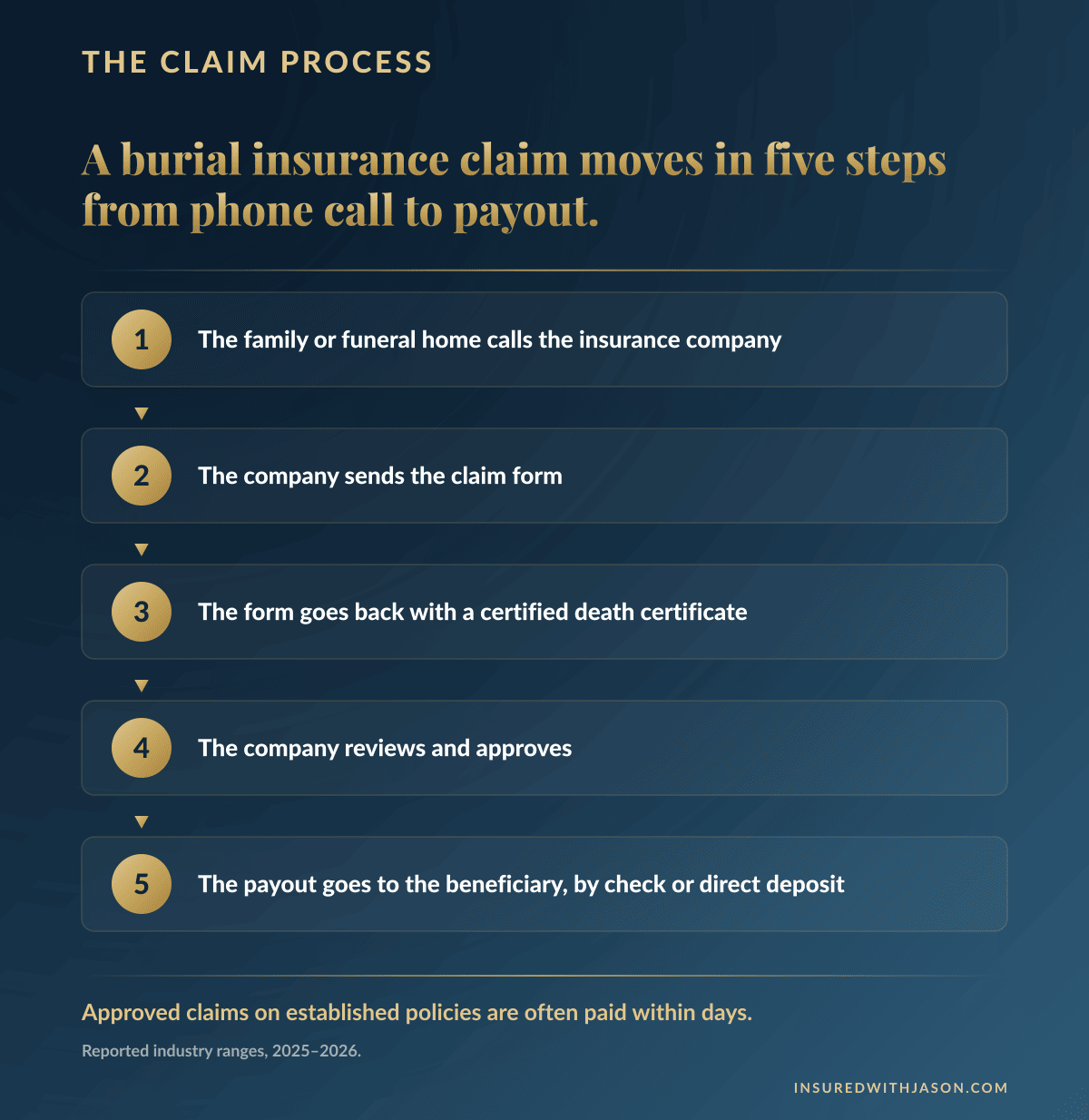
From the first phone call to the payout, a burial insurance claim is a five step process.
How does your family file a burial insurance claim?
Your family files a burial insurance claim by calling the insurance company, completing the short claimant’s statement it sends, and returning it with a certified copy of the death certificate. Many companies now take the whole thing by phone or online. The beneficiary files directly, in their own name, and needs nobody’s permission to do it.
Filing the claim, start to finish
This is everything your family does, in order.
- 1Make The CallNotify the insurance company
Call the number on the policy, or call me, and say you need to start a claim. The company opens the file and sends the claim form.
- 2The FormComplete the claimant’s statement
A short form about the insured and where to send the money. Many companies take it by phone or through an online portal.
- 3The CertificateAttach a certified death certificate
Some funeral homes offer to order certified copies when arrangements are made, or your family requests them from the county. One of them goes to the insurance company.
- 4Get PaidChoose check or direct deposit
Once the claim is approved, the payout goes to the beneficiary, or to the funeral home first if an assignment is in place.
What documents does your family need to file the claim?
The claim packet is three things: the insurance company’s claim form, a certified copy of the death certificate, and the beneficiary’s identification. The policy number helps, but it isn’t required. The company can locate the policy with the insured’s name and Social Security number.
Now, one piece of advice I give every client, because I learned it the hard way: request several certified copies of the death certificate, four to eight of them. Some funeral homes offer to order these as part of their service when arrangements are made; otherwise your family requests them from the county or your state’s vital records office. Nearly everything your family closes out will want its own: the insurance company, each bank, the accounts, and the court if an estate is opened. Some companies require a certified original and keep it.
When my own father passed, my aunt was helping settle his affairs alongside my sister and me. Handing her a certified copy meant she could submit paperwork in places I couldn’t be at the same time, and that mattered more than I can tell you. A few of those copies also went out to companies that kept them, which is exactly why you order more than you think you’ll need. To be clear, these go only to people you trust completely with your family’s affairs. The point is that settling things is usually a team effort, and copies are what let the team work.
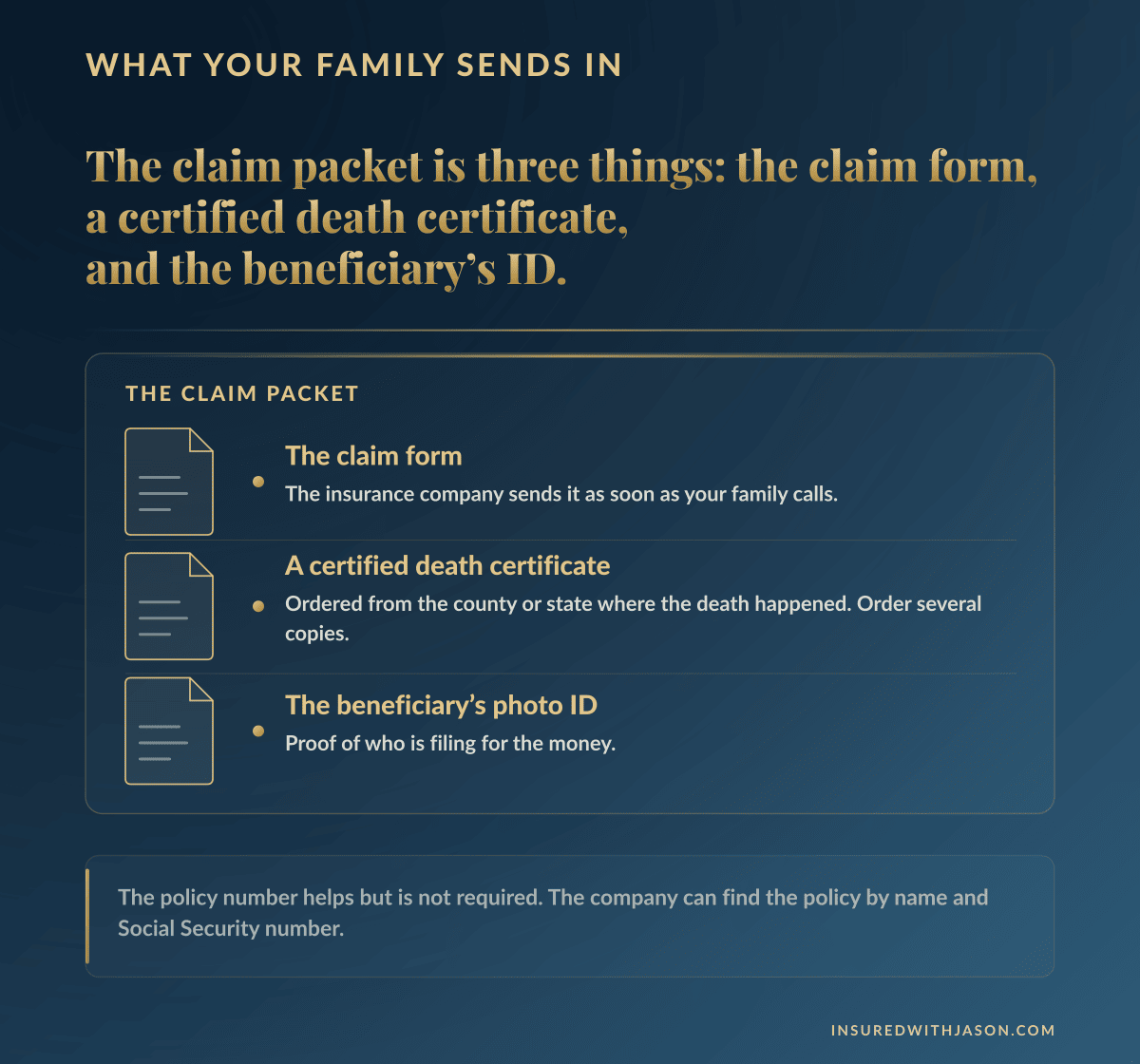
Three documents complete a burial insurance claim packet.
How long does a burial insurance claim take to pay out?
An approved burial insurance claim on an established policy is often paid within days, with reported industry timelines running as fast as 24 to 72 hours after approval. This coverage was built to move quickly on purpose. Insurance companies know exactly what it’s for, and funeral costs can’t wait around.
So where does the time actually go on a claim that takes longer? Usually into the paperwork, not the insurance company. The certified death certificate is the one piece your family gathers from the outside, and until it arrives, there’s nothing for the company to review. That’s the honest picture: the pace of most claims is set by how quickly the documents come together, and the company’s part moves fast once they do. The policy my own father left behind paid quickly, and I’ve watched the same speed from the other side of the table.
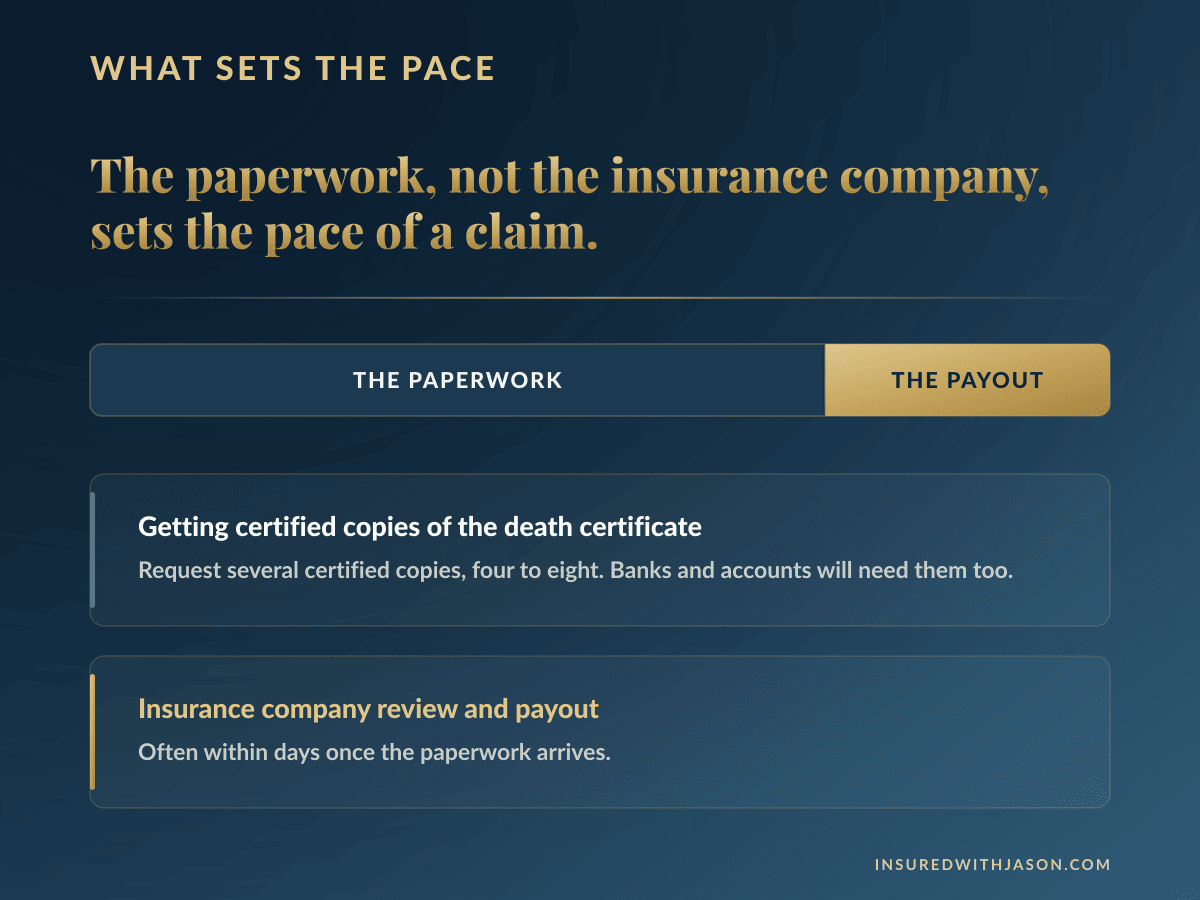
The paperwork sets the pace of a claim. The insurance company’s part moves in days.
Most states set legal deadlines for paying life insurance claims, and interest builds on the payout while a family waits.
These prompt-payment laws are one more reason claims move quickly. The law is on your family’s side, and insurance companies have every reason to pay on time.
Coverage that’s built to be there fast when your family needs it.
See your rate →Can the payout go straight to the funeral home?
Yes. Through a simple arrangement called an assignment, the insurance company pays the funeral home directly for the funeral bill, and whatever remains goes to your beneficiary. Here’s how it works: at the arrangement meeting, your beneficiary signs a form assigning the funeral bill’s amount to the funeral home. The funeral home then files the claim itself, gets paid straight from the policy, and your family usually pays nothing out of pocket at all.
Funeral homes handle these constantly, and it’s often the smoothest path there is. And because the funeral home is caring for your loved one, no one can confirm the passing more directly, so with an assignment in place, things can start moving even before the certified death certificate arrives.
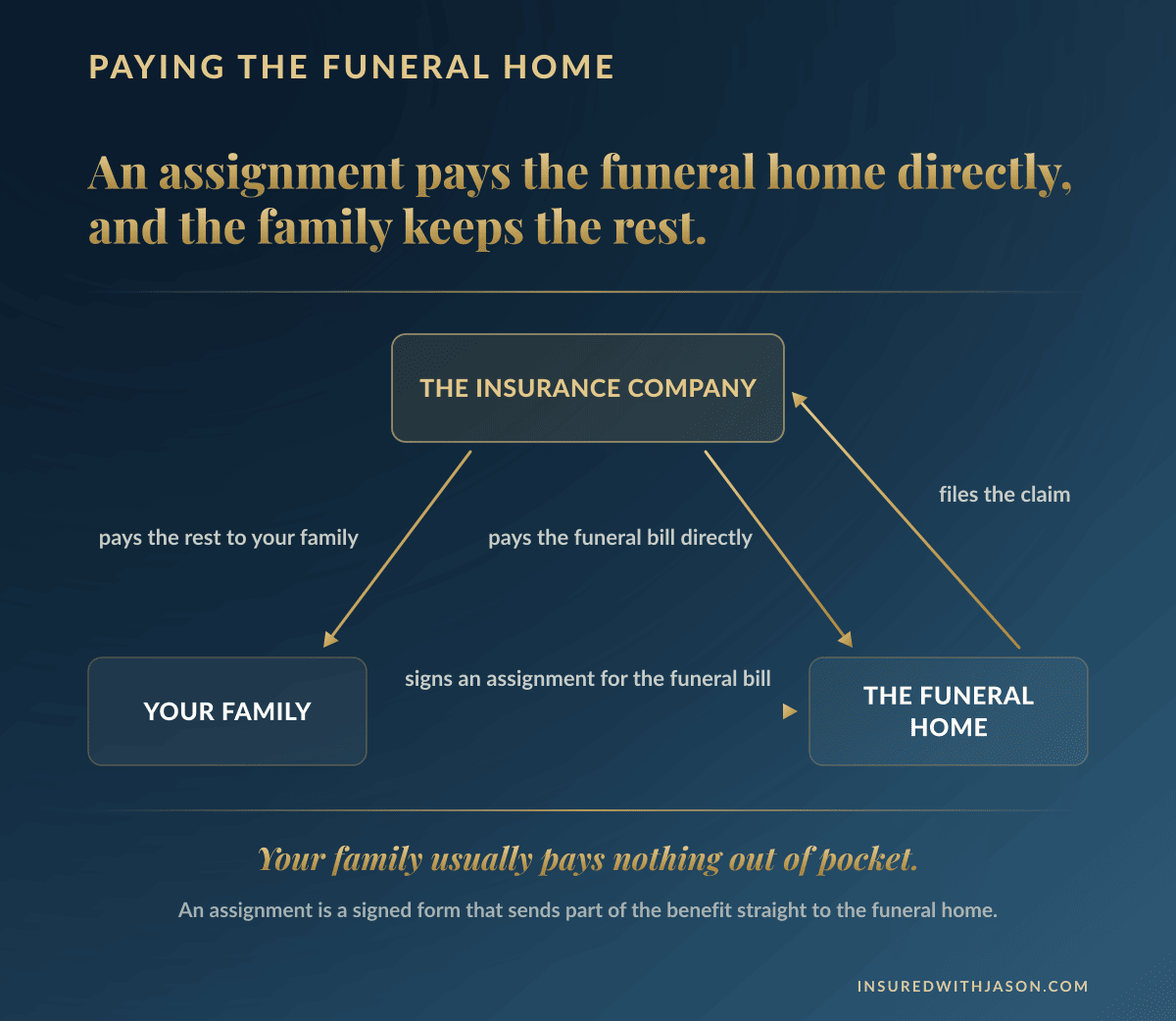
An assignment routes the funeral bill straight to the funeral home, and the remainder to the family.
Should you name the funeral home itself as your beneficiary?
Here’s how I think it through. For most people, an assignment already does the job: the funeral home gets paid directly, nothing gets locked in years ahead of time, and whatever remains stays with the people you love. But say someone calls me who has no one they’d trust with this, and they want every wish settled in one sitting. Naming the funeral home is a legitimate way to do exactly that. The services get chosen, the wishes get written down, and the one party that has to be involved already knows everything.
What would change my answer is whether there’s a person in your life you’d trust to name. If there is, name the person and let an assignment handle the funeral bill. If there isn’t, this arrangement exists for that exact situation, and it’s worth a real conversation.
What if the claim comes sooner than anyone expected?
What happens if you pass during the waiting period?
A passing during the waiting period pays exactly what the policy’s printed schedule promises, and that schedule was part of the deal from the first day. A level policy has no waiting period at all, so the full amount is payable for natural causes from day one. A graded policy pays a stated percentage of the coverage amount during the first two years, then the full amount after. And a guaranteed acceptance policy pays back every premium plus interest for a natural passing in the first two years, with the interest often running 10 to 30 percent depending on the company. That’s meaningfully more than a savings account would have paid on the same money over the same two years. Accidental death is typically covered in full from day one on all of them. Our guide to the types of final expense insurance walks through these tiers in full.
Here’s how I look at a payout that lands inside that window. A graded or guaranteed acceptance policy was usually the strongest coverage that person’s health could qualify for, and its owner chose it knowing exactly how the first two years pay, because the schedule is explained at purchase and printed in the policy itself. So when a graded policy pays a percentage in month fourteen, that isn’t a policy falling short. That’s a policy keeping its exact promise, and delivering something real at a moment when the alternative was nothing at all.
One thing I’d add, and it matters: your beneficiary only knows how your policy pays if you tell them. The owner is the one who hears the explanation at purchase, so a short conversation now is the only way that understanding reaches the person who’ll one day file the claim. We’ll come back to that conversation at the end of this page, because it belongs on your to-do list.
Why would a burial insurance claim be denied?
A burial insurance claim from an honest application on a policy that’s in force is very rarely denied. Insurance regulators’ own claim data puts denied and disputed claims together at roughly two percent of all life insurance claims, and the situations behind that small number trace back to a short, specific list.
A passing inside the first two years can prompt a routine review of the application before payment. For an honest application, that’s a delay, not a denial, and the claim pays as written. A policy that lapsed before the passing has no coverage left to claim against, which is why keeping the premium current matters more than anything else on this page. Most policies exclude suicide during the first two years and return the premiums instead. And every state bars anyone who caused the death from collecting, with the benefit passing to the next beneficiary in line. That’s the whole list. Outside of it, the policy is a contract in black and white, and it pays what it says. Answering the health questions truthfully during the burial insurance application process is what locks that certainty in.
That review window has a name worth knowing: the contestability period. For the first two years of any life insurance policy, the insurance company keeps a standard legal right to check the application’s answers before paying a claim. It’s a routine provision, it exists on every policy including ones with no waiting period, and after two years it closes and the protection becomes about as strong as a contract gets. People often mix it up with the waiting period, and they’re two different clocks doing two different jobs.
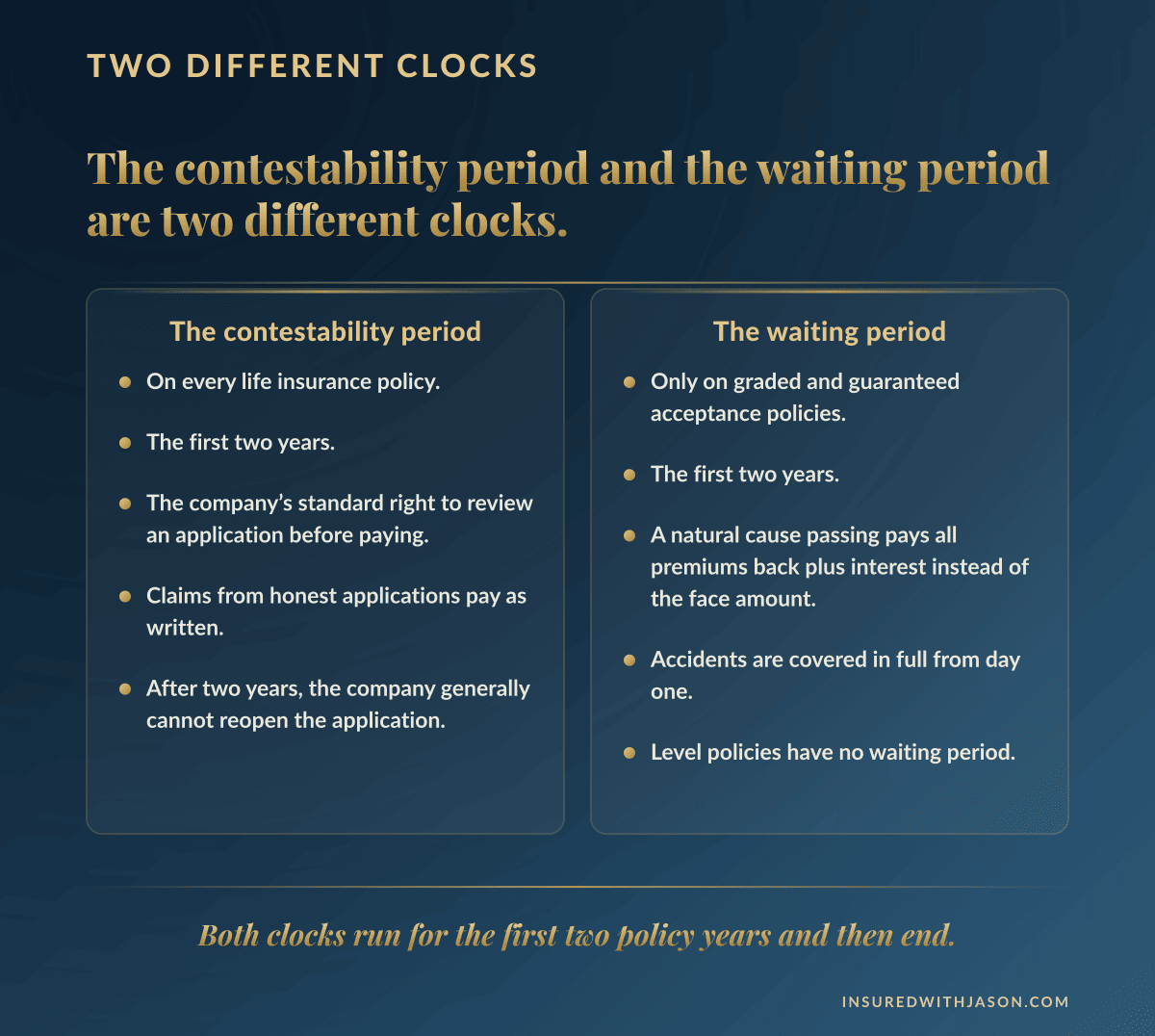
Every policy has a contestability period. Only graded and guaranteed acceptance policies have a waiting period.
So if the insurance company almost never says no, what’s the real risk to the payout? It’s quieter than a denial, and it’s the one thing I plan against with every client.
The real threat to a payout isn’t the insurance company. It’s a policy that quietly lapses when money gets tight.
Two protections handle it. Size the coverage so the premium fits your budget comfortably through lean months, with room for surprise bills and rising prices. And put the payment on automatic bank draft so it never depends on remembering. A policy that stays in force pays. Every time it’s supposed to.
The only people who definitely don’t get covered are the ones who do nothing.
What happens if there’s no beneficiary?
If your primary beneficiary has passed and no backup was named, the payout goes to your estate, and that means probate: a slower court process instead of a direct payment. The money still arrives, it just takes the long road. The fix costs nothing. Name a contingent beneficiary, your backup, when the policy is set up, and review your beneficiaries after any major life change like a marriage, a divorce, or a death in the family. Two minutes of paperwork keeps the payout on the fast, direct path.
And if a policy exists that nobody knows about? The money doesn’t vanish. Families can search for a lost policy for free through the national policy locator run by state insurance regulators. It works, and it has reunited families with billions of dollars. But a search takes months, and the better plan is making sure your family never needs one, which brings us to the last two sections of this page.
Does anyone help your family file the claim?
Your family never has to figure out a burial insurance claim alone. The insurance company’s claims department walks beneficiaries through filings every single day. The funeral home can carry the whole claim through an assignment. And if I wrote the policy, your family gets me too.
Here’s what that looks like in my practice. Nobody pays me to help with a claim, and no contract requires it. I do it because it’s the right thing to do. Your family member trusted me with this coverage, and I honor that trust all the way through, including when they can’t be here anymore. Most families just want to be pointed in the right direction fast, and I understand that completely. They’ve got a lot to handle, so I get them the right phone number and the policy information right away, and they take it from there. Some want more. They can send me the death certificate and I’ll get the filing started, or we’ll get on the phone with the insurance company together and walk through it side by side. Whatever your family needs that day, the offer is always on the table.
A policy with a person behind it, from the first question to the final claim.
Start with a quote →What can you do about all of this today?
What can you do today so the claim is easy for your family?
Five things you do today decide how the claim goes tomorrow: tell one trusted person the policy exists, put the premium on automatic draft at a size your budget can always carry, name a contingent beneficiary, review your beneficiaries after big life changes, and keep the policy number with your important papers. Every one of them takes minutes. Together they close every gap this page has covered.
The first one is the heart of it, so let me show you what it looks like done right. My own father never mentioned his policy to me. That was his business, and I respect it to this day. But he told my grandmother, and when he passed, she let my sister and I know what he had set up for us and why. One person in the loop, with the policy information and a number to call. That was the whole system, and it worked exactly the way he planned it.
Your person doesn’t have to be your beneficiary, and you don’t have to share amounts or details you’d rather keep private. Nobody knows your family better than you do. All the job requires is one trusted soul who can say, when the day comes, this policy exists, here’s the number, call this broker, he’ll handle the rest. And if your policy is graded or guaranteed acceptance, tell your person how it pays in the first two years while you’re at it. That single sentence spares them any confusion at the worst possible time to feel confused.
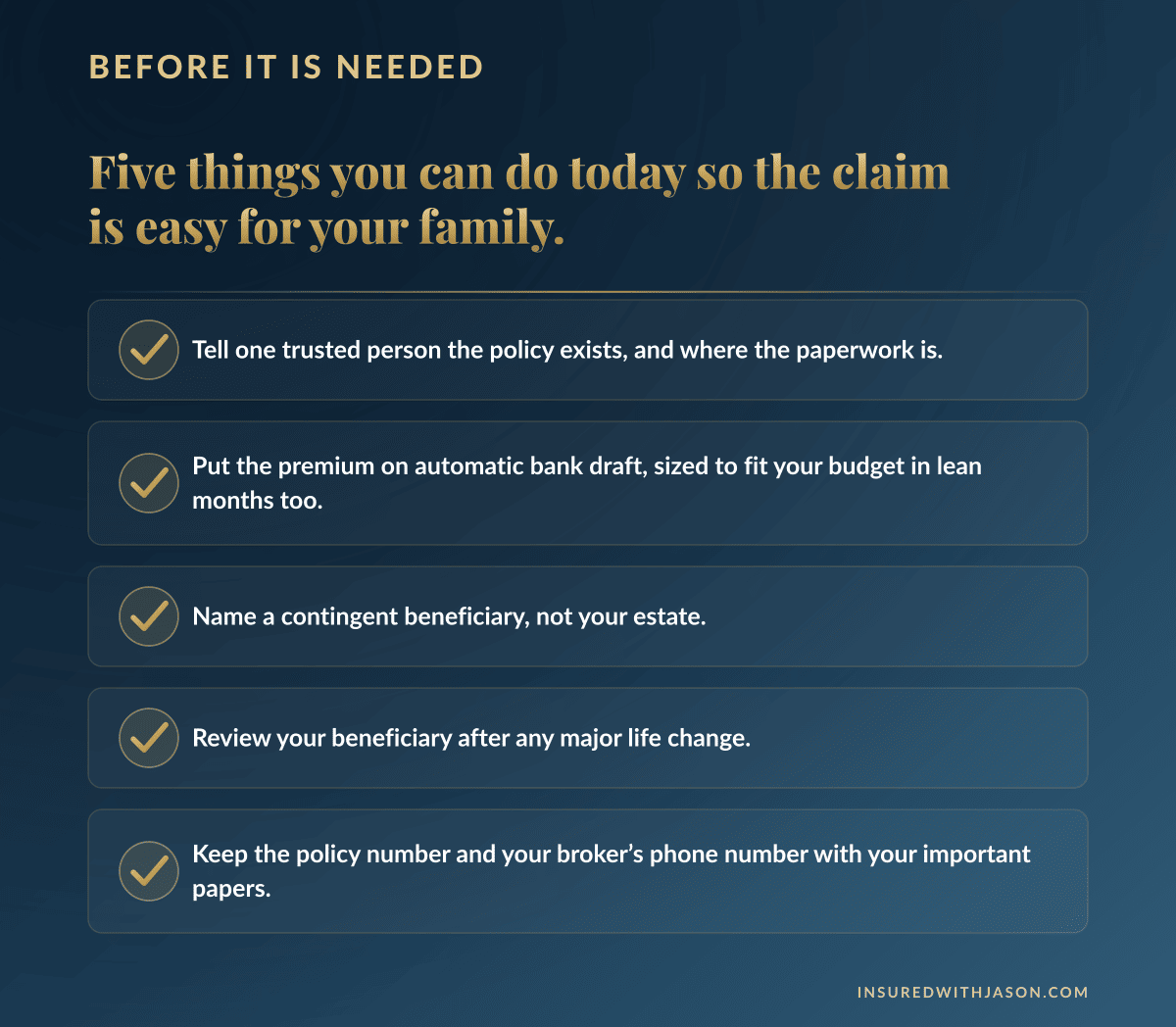
Five moves today make the claim simple for your family tomorrow.
Benefits matched to families through the free national policy locator since 2016, much of it money nobody knew existed. One conversation with a trusted person today means your family never has to search.
Source: National Association of Insurance Commissioners, 2025
If you want the bigger picture on this coverage itself, from what it covers to what it costs, our complete burial insurance guide starts at the beginning. This page is about the finish line, and the finish line is decided at the start.
The claim is the whole point, and I’ve lived both sides of it.
I’ve spent my career helping families put this coverage in place, and then one day I was the son a policy paid out to, at the worst moment of my life. My father never told me about it. He told my grandmother, and when he passed, she let my sister and I know what he had done for us. That policy was my dad protecting us one last time, and I feel that love every single day. I can’t tell him what it meant, so I tell the people considering this coverage instead: it means the world. A claim is not paperwork to me. It’s a promise being kept, and if I can help your family through that moment someday, I will.
Burial insurance claims: frequently asked questions
The questions families ask me most about claims, answered plainly.
How long does a burial insurance claim take to pay out? +
Approved claims on established policies are often paid within days. Final expense coverage is built to move quickly because funeral costs can’t wait, and the longest part of most claims is simply gathering the paperwork.
Can the funeral home file the claim for your family? +
Yes. Through an assignment, the funeral home files the claim and gets paid directly by the insurance company, and any money left over goes to your beneficiary. Most families pay nothing out of pocket this way.
Does your family need a lawyer to file a burial insurance claim? +
No. A named beneficiary files directly with the insurance company, and the payout passes outside of probate. There’s no court, no waiting on an estate, and no legal fees.
What documents does your family need for the claim? +
Three things: the insurance company’s claim form, a certified copy of the death certificate, and the beneficiary’s identification. The policy number helps, but the company can locate the policy without it.
Who receives the money if the beneficiary has already passed away? +
The contingent beneficiary named on the policy receives it. If no contingent beneficiary was named, the payout goes to the estate, which is slower. Naming a backup today keeps the money on the fast, direct path.
What happens if nobody knew the policy existed? +
The money doesn’t disappear. Families can search for a lost policy for free through the national policy locator run by state insurance regulators, and unclaimed benefits are eventually turned over to the state to be claimed. Telling one trusted person today means your family never has to search.
Set up right, a burial insurance claim is the easiest paperwork your family will handle that week: three documents, a few days, and the money lands exactly where you aimed it. The setup is the part you control, and it’s the part I help with.
Let’s set your family up for the easy claim
You came here to make sure the payout will actually reach your family, and now you’ve seen the whole road: a short form, a certificate, money that moves in days. The last step is making sure the policy behind it is set up right. Let’s find coverage that fits your budget through good months and lean ones, at a rate that locks in at your age today.
This article is for educational purposes only and is not legal, tax, or financial advice. Coverage, costs, and rules for life insurance plans vary by person, company, and state. Please speak with a licensed professional about your specific situation before making a decision.
Compare rates from 25+ companies.