
Burial Insurance Comparisons: All of Your Other Options
Burial insurance, life insurance, prepaid plans, savings, and trusts, side by side, with a straight answer about who each one fits.

- Burial insurance, final expense insurance, and funeral insurance are three names for the same small whole life policy.
- Burial insurance pays cash to the person you name, usually within days of a clean claim, and they can use it for anything.
- A prepaid funeral plan pays the funeral home for specific services instead. It can lock in prices, but it stays tied to that one provider.
- Term life buys more coverage per dollar while you’re healthy, but it can end before you need it. Burial insurance never expires as long as you pay.
- Savings and POD accounts are free and flexible, but they only hold what you’ve built so far. The coverage stands at the full amount from the first premium.
- Health issues? Most qualify
- Declined? Jason has next steps
- New policies up to age 85
- Fits a Social Security budget
- Free quotes, no commitment
- Just Jason, never a stranger
Your information goes to Jason. Not a call center. Not a lead list.
Burial insurance comparisons all come down to one thing: timing. Savings take years to build, term insurance can expire while you still need coverage, and a prepaid plan ties your money to one funeral home.
Burial insurance puts the full amount behind your family from day one. Below, every option gets a fair look at what it does well and who it fits best.





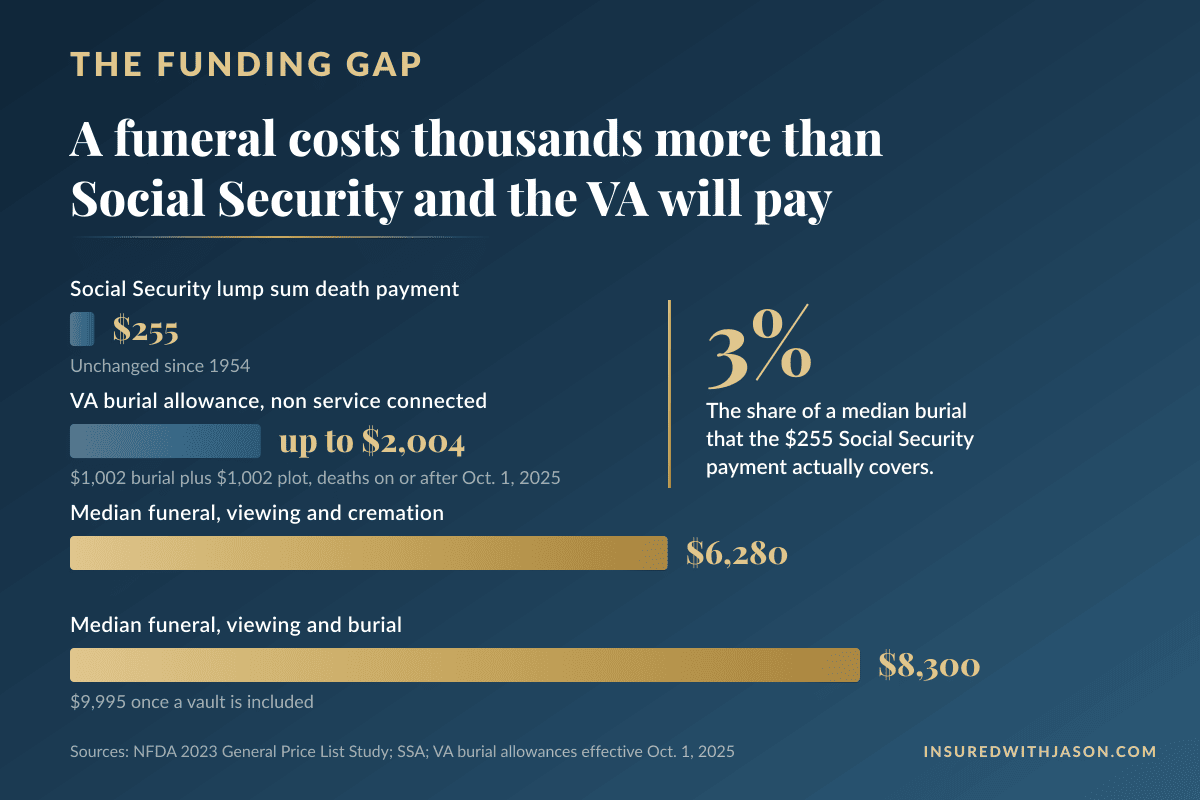
The gap every option on this page exists to fill: government benefits cover a small fraction of a funeral.
Burial Insurance vs. Final Expense vs. Funeral Insurance
Burial insurance, final expense insurance, and funeral insurance are three names for the exact same policy. Underneath every one of those labels sits a small whole life plan, usually between $5,000 and $50,000, built to cover a funeral and the bills that arrive with it. The names come from marketing, not from any difference in the product. Whichever name is on the brochure, the benefit is paid in cash to the person you choose, and they can use it for the funeral, the last electric bill, or anything else your family needs.
One lookalike is genuinely different, and it’s worth knowing on sight: pre-need insurance. Pre-need is sold through a funeral home, it’s tied to a specific set of arrangements you pick out in advance, and the benefit goes to the funeral home to deliver those services, not to your family as cash. It has its place, and we’ll compare it fairly in the prepaid section below. Just don’t confuse it with the policy the other three names describe. If you’re new to how the policy itself works, the full guide to burial insurance walks through it from the ground up.
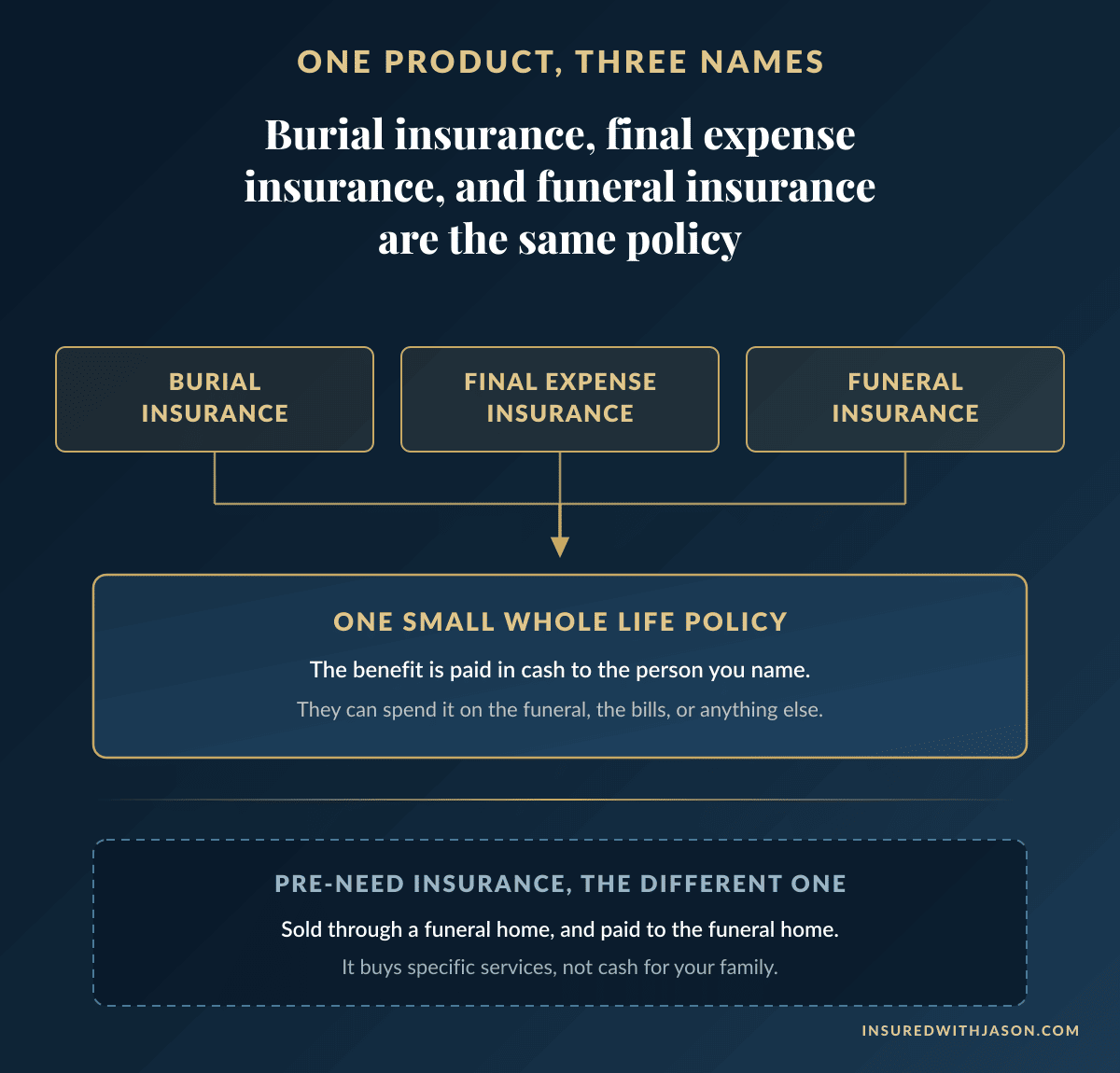
Three names, one policy. Pre-need is the different one, and it pays the funeral home instead of your family.
Burial Insurance vs. Life Insurance
Burial insurance is life insurance. It belongs to the same family as every other form of life insurance, so this comparison isn’t insurance versus something else. It’s a question of size and purpose. Traditional life insurance is usually sized for the big jobs: replacing a working income, paying off a mortgage, funding a spouse’s retirement. That coverage often runs $100,000 and up, and qualifying typically means a full application and sometimes a medical exam.
Burial insurance is sized for one specific job: the funeral and the final bills, without touching anything else your family has. Because the amounts are smaller, the underwriting is far gentler. Most final expense plans ask a short set of health questions with no exam, most people between 50 and 85 can qualify, and the premium locks in at your current age and never rises. When someone calls me unsure which they need, I start with one question: what is this money for? The answer to that almost always picks the coverage for us.
Burial Insurance vs. Term Life Insurance
The difference between burial insurance and term life insurance comes down to time. A term life insurance policy covers you for a set window, usually 10 to 30 years, and it buys more coverage per dollar than any other policy while you’re healthy. That’s its whole design: big protection for the years a family depends on your income. The trade is the calendar. When the term ends, so does the coverage, and most companies stop offering new term coverage somewhere around age 75 to 80.
Burial insurance runs the opposite direction. The amounts are smaller, but the coverage is permanent. As long as the premium is paid, the protection is there at 78, at 88, at whatever age the bill finally arrives.
Here’s how I actually walk through it. Say a healthy 58-year-old calls me and realizes he could get $50,000 of term coverage for close to the price of a $15,000 final expense policy. I’d never talk him out of the term. More coverage for less money is a real advantage, and if he believes he has a long runway, it can be a smart buy. What I make sure he sees is the other end of it: when that term expires around 78, he’s shopping again, at 78, in whatever health 78 brings. So we price both today, including what final expense coverage costs a 78-year-old right now, so he’s comparing apples to apples. Then it’s his call. I offer both, and I’m glad to place either one, as long as he understands exactly what he’s choosing.
| Burial Insurance | Term Life | |
|---|---|---|
| How long it lasts | Your whole life, as long as premiums are paid | A set term, usually 10 to 30 years, then it ends |
| Typical coverage amount | $5,000 to $50,000 | $50,000 and up |
| Medical exam | No exam; short health questions | Often required |
| Premiums | Locked at purchase, never rise | Level during the term, then rise sharply to renew |
| Built for | The funeral and final bills, at any age | Big protection during the working years |
General product features; details vary by company and state.
One independent broker compares the whole market for you.
Find my lowest rate →Burial Insurance vs. Whole Life Insurance
Burial insurance is whole life insurance, scaled to one job. A traditional whole life insurance policy carries larger amounts, fuller underwriting, and a bigger cash value component. Burial insurance keeps the same permanent structure and level premiums, shrinks the coverage to funeral size, and simplifies the health questions so more people can qualify, faster. If you want permanent coverage well beyond final expenses, traditional whole life is the conversation. If the funeral is the job, burial insurance does it with less hassle. And one honest detail almost nobody mentions: live long enough, to 100 or beyond on most plans, and the coverage pays out to you while you’re still here.
Burial Insurance vs. Prepaid Funeral Plans
A prepaid funeral plan pays a funeral home in advance for a funeral you design now, while burial insurance pays your family cash to spend as they need. That one difference drives almost the entire decision, so it’s worth slowing down on.
A prepaid plan does a few things well. You sit down with a funeral director, choose the arrangements, and pay in a lump sum or installments, and items sold as guaranteed are locked at today’s prices, which matters with funeral costs rising steadily. But understand what you trade for that price lock: control. Your money is committed to one funeral home and one set of arrangements, decided years in advance. If your family’s needs change, if you move, or if that funeral home isn’t who you’d choose ten years from now, unwinding the deal ranges from complicated to impossible, especially on an irrevocable contract. Your family can’t redirect a dollar of it.
Funeral prices have climbed about 3.65% a year since 1986, faster than overall inflation.
That long climb, tracked by the Bureau of Labor Statistics, is why a price lock sounds appealing, and why the coverage amount you choose today should leave a little room for tomorrow.
Now the frank part, because you deserve it. A prepaid plan ties your money to one funeral home. If you move across the country, the plan may not move with you, and the price lock often doesn’t. And if that funeral home closes, changes owners, or mishandles the money, your funds can be at real risk. This isn’t theoretical: prosecutors have brought major cases where prepaid funeral money simply disappeared. States know it, which is why most require some or all of a prepaid payment to sit in a regulated trust, and several run recovery funds for prepaid customers. If you go this route, ask three questions in writing: what percentage of my money goes into the trust, is this contract revocable, and what happens if I move?
Burial insurance answers those three questions by design. The coverage is fully portable, because it isn’t attached to any funeral home. The money stays under your family’s control, so they can use any provider they choose and put every leftover dollar wherever it’s needed. And the funds sit with a regulated insurance company rather than a local business. You give up the price lock; you gain flexibility and control.
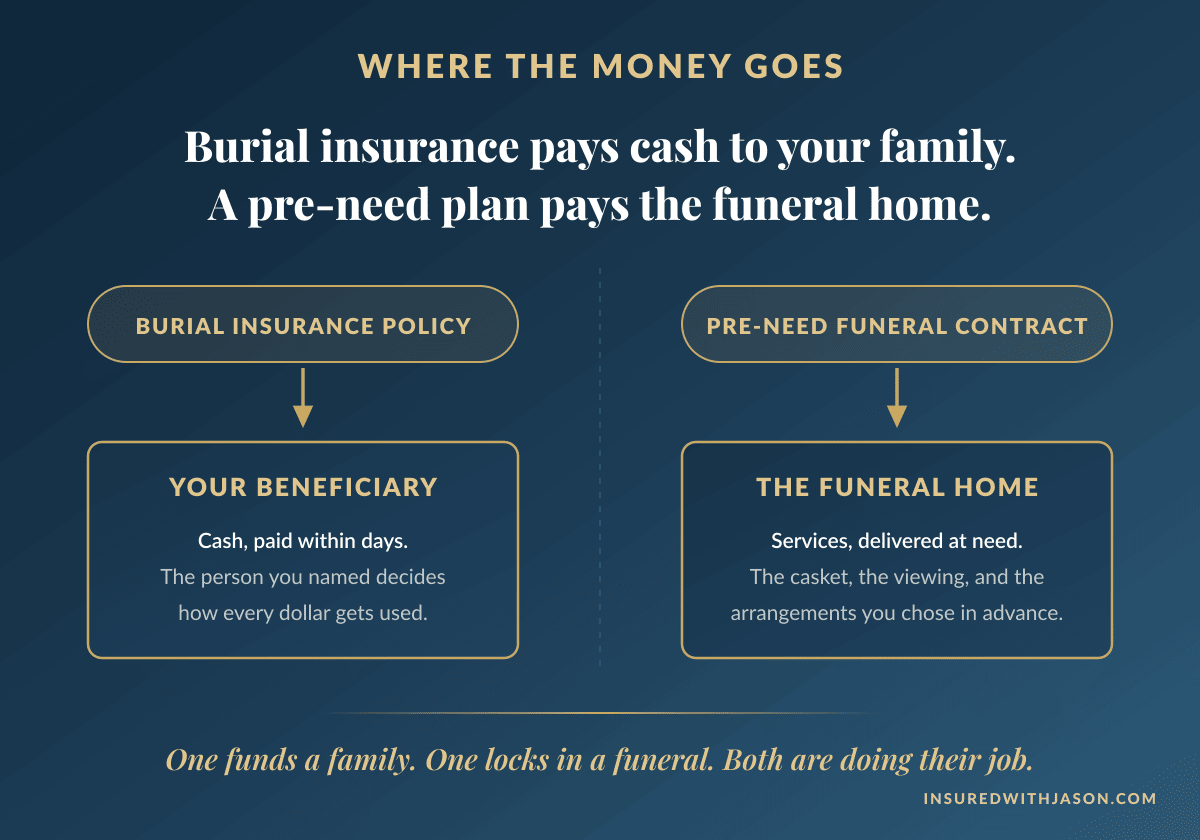
Where the money goes is the whole decision: cash to your family, or services from one funeral home.
Burial Insurance vs. Just Saving the Money
Saving the money yourself is free, flexible, and slow, and slow is the exact problem burial insurance was built to solve. A savings account holds whatever you’ve managed to put in it so far. A policy stands at the full amount from the first premium. If the worst happens next year, savings hands your family a head start; the insurance hands them the whole answer.
And let me say something plainly, because it matters: most people who buy final expense coverage haven’t set the money aside. That’s not a failure. It’s the most common starting point there is, and it’s exactly the situation this coverage was designed for. Setting cash aside is one way to handle this; a small monthly premium that guarantees the full amount from day one is another. Neither one needs defending.
Let’s also be straight about what final expense insurance is, because this is where the comparison usually goes sideways. Burial insurance is not a savings account, and it was never meant to be one. You’re buying a guarantee: the full benefit stands behind your family even if tomorrow is all the time you get, and the insurance company is on the hook for it from day one. That guarantee is what the premium buys. And yes, if you’re fortunate enough to live a long life, you may pay more into the policy. That’s not the coverage failing. That’s how any insurance works, because the company has to be able to keep the same promise for every family, including the one whose claim arrives in the first year. What you bought was every single day of protection along the way.
You’re not buying a savings account. You’re buying the promise that the policy pays tomorrow, no matter how long you live.
I’ll tell you why I stopped comparing insurance to savings accounts altogether. My own father had substantial assets when he passed, multiple six figures, and I was earning a six-figure salary as a locomotive engineer on the railroad. On paper, his small final expense policy made no sense, and had he asked me first, I would have told him not to buy it. Then he was gone, and the paper meant nothing. His money sat out of reach behind probate for months. I had just finished an aggressive push to pay off my debt, so I was debt free with no cash in the bank. And my income stopped cold for weeks, because I couldn’t work. Every dollar of that coverage went to absorbing the loss. I was the last person on earth who would have recommended it, and I was the person who needed it.
Here’s the lesson I carry from it. Savings measure what a family is worth on paper. A funeral measures what’s reachable, in the right hands, in the first month. Those are two different questions, and an account that’s locked in probate or already drained by an emergency answers neither. If your family truly has liquid cash they could hand over on day one, saving can genuinely win, and I’d tell you so. For everyone else, the protection exists so nobody has to find out the hard way which question their money answers. If the monthly payment is the worry, the guide to final expense cost per month shows how to size a premium that stays comfortable for life.
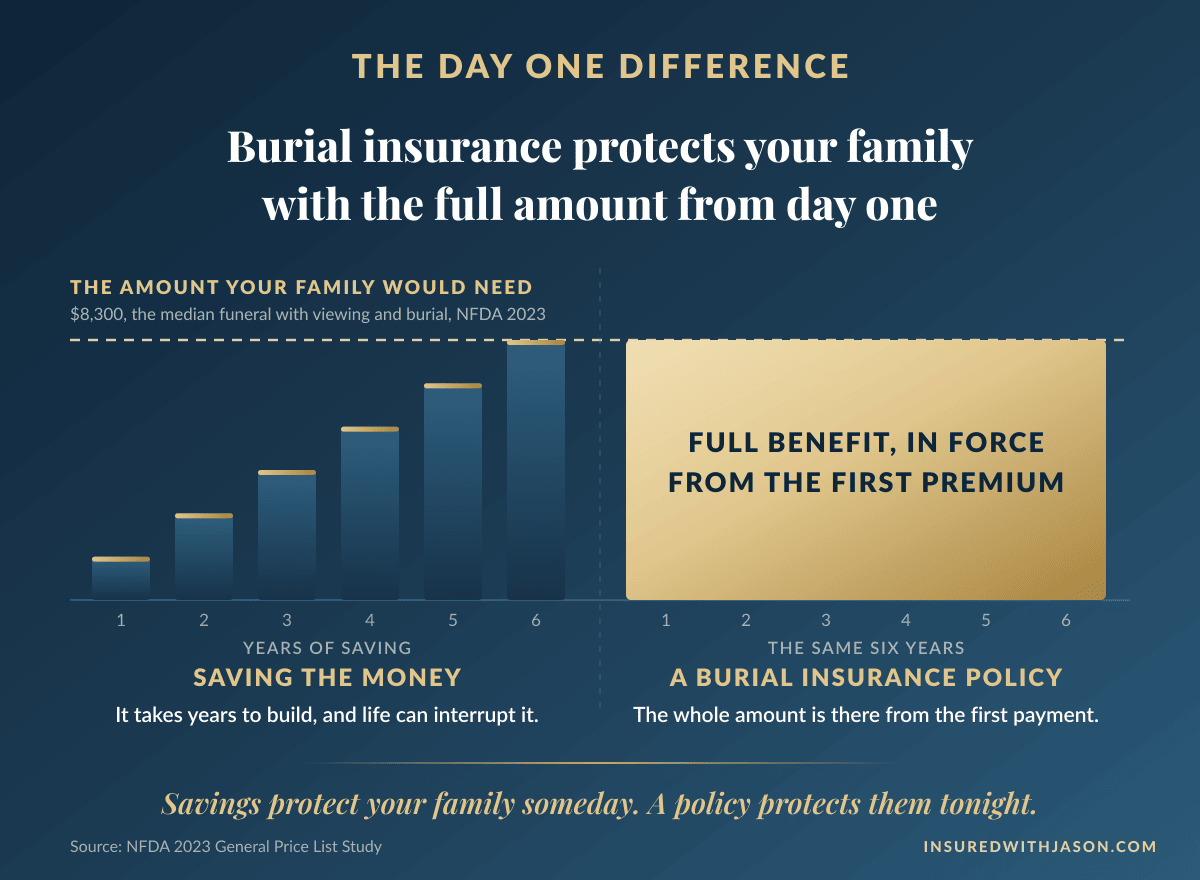
Savings build toward the goal over years. The policy stands at the full amount from the first premium.
Burial Insurance vs. a Funeral Trust or POD Account
A POD account and a funeral trust are both bank-side tools for the same job, and each has one thing it does better than anything else. A POD account, short for payable on death, is free: you name a beneficiary on a bank account, and when you pass, that person presents a death certificate and ID and receives the money within days, skipping probate entirely. It’s a smart backstop for fast cash, and setting one up costs nothing but a trip to the bank.
Its limits are just as plain. A POD account only holds what you’ve saved, the money counts as your asset for Medicaid, and in most states creditors can reach those funds if your estate can’t cover its debts. An irrevocable funeral trust solves the Medicaid problem specifically: money placed in one is set aside for funeral costs and, within state limits, doesn’t count against Medicaid eligibility. The trade is right in the name. Irrevocable means you can’t take it back.
Medicaid is also where final expense coverage needs an honest look. Say someone tells me Medicaid may be in the picture for them or a spouse within a few years. That changes the conversation, because a policy’s cash value can count as an asset. We’d pull up the cash value illustration together so they can see exactly what Medicaid would see, and we’d talk through whether an irrevocable arrangement, like a funeral trust or an irrevocable assignment of the policy, fits their situation better. And that’s the point where I tell them to loop in whoever handles their Medicaid planning, because that side of the table deserves a professional who works it every day.
I have a CD set aside for my funeral. Do I still need a policy?
Say a 68-year-old calls me with a $12,000 CD she put away years ago for exactly this, daughter named on the account, money untouched. If that CD stays parked and it’s truly earmarked for the funeral, she’s all set, and I’d tell her exactly that.
What would change my answer: a second purpose for that money. If she’d rather the CD itself go to her daughter, or she wants more than the funeral covered, a policy can take over the first job so the CD is free to do the other one.
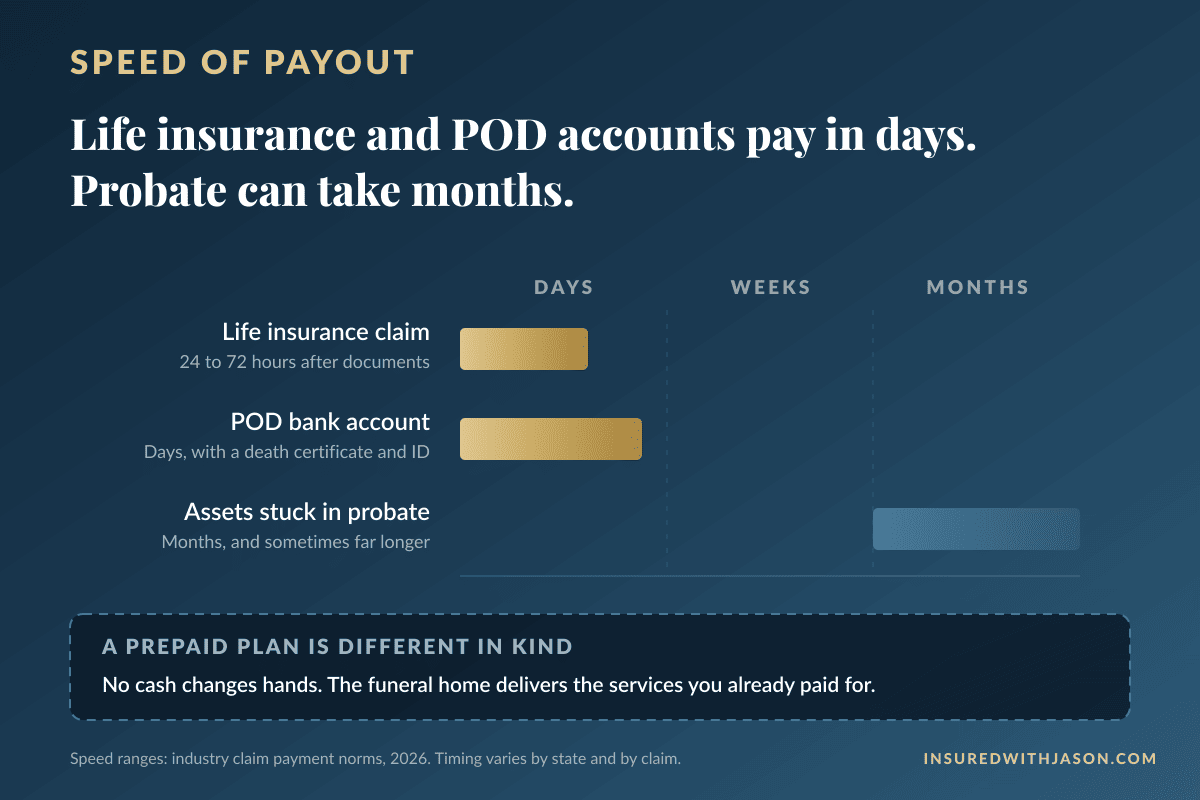
Speed matters more than most people expect: insurance and POD accounts pay in days, while probate can hold money for months.
See what coverage would cost at your age.
Get my quote →Can You Have Burial Insurance and a Prepaid Plan?
Yes, you can have burial insurance and a prepaid funeral plan at the same time, and plenty of families do. They handle different jobs. The prepaid plan locks in the funeral itself, down to the details. The insurance puts cash in your family’s hands for everything the funeral home’s bill doesn’t touch: time off work, a few months of rent or the mortgage, a credit card that needs closing out, a gift to a grandchild. The one thing to watch is double-paying. If the prepaid plan already covers the service in full, size the coverage to those other purposes, not to a funeral that’s already bought.
The two even work together at claim time. A beneficiary can sign an assignment of benefits, a simple form directing the insurance company to pay the funeral home its exact bill straight from the policy, with every remaining dollar going to the family. Funeral homes accept these routinely, and helping a family through that paperwork is part of what I do when the day comes. The rule I come back to is simple: every dollar of coverage should have a name on it. When each dollar has a purpose, you buy exactly what your family needs and not an ounce more.
So which one actually fits you?
Which Way of Paying for a Funeral Fits You?
The right way to pay for a funeral is the one that matches what you want to control, what your health allows, and what your money is already doing. Burial insurance comparisons all end at the same place: your actual situation. If you want your exact funeral locked in at today’s prices and you’re settled where you are, a well-protected prepaid plan does that job. If Medicaid is on the horizon, an irrevocable funeral trust is the tool built for it. If your family could comfortably cover everything in cash tomorrow, savings with a POD beneficiary is free and fast. And if you want a guarantee that doesn’t depend on how long you have, how the next few years go, or which funeral home your family calls, burial insurance is built for exactly that.
There’s no perfect option here, because there’s no future where the bill never arrives. There’s only the option that fits your life. And if what you want is something guaranteed, in force from day one, paid in cash to the person you love, a burial insurance policy is an ironclad way to get it done.
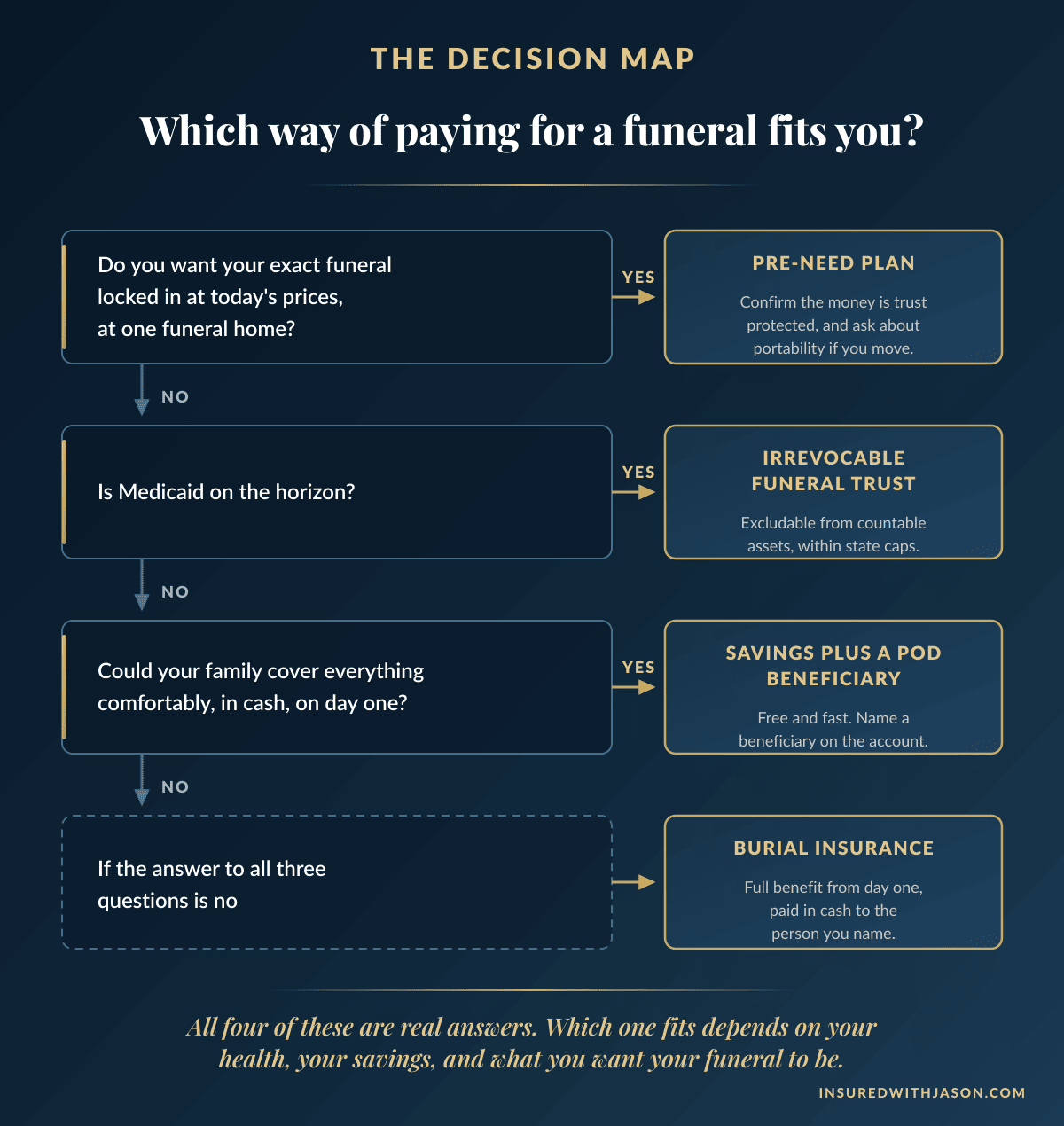
Four honest paths to the same destination. Start with what you want to control, and the map picks your lane.
Burial Insurance Comparisons: Frequently Asked Questions
The burial insurance comparisons people ask me about most, answered plainly.
Is burial insurance the same as final expense insurance? +
Yes. Burial insurance, final expense insurance, and funeral insurance are three marketing names for the same small whole life policy. Pre-need insurance is the different one: it is sold through a funeral home and pays the funeral home for pre-arranged services rather than paying cash to your family.
Can you have burial insurance and a prepaid funeral plan at the same time? +
Yes. They do different jobs: the prepaid plan locks in the funeral itself, while the policy puts cash in your family’s hands for everything else, like final bills, time off work, or a gift to a grandchild. Just size the policy to those other purposes so you are not paying twice for the same funeral.
Is burial insurance worth it if I already have savings? +
It depends on whether that money is truly set aside, reachable by your family on day one, and free of any other job. Savings that are earmarked and untouched can genuinely cover a funeral. A policy earns its place when the savings have a second purpose, when the money could get drained by an emergency, or when it would sit locked in probate when your family needs it most.
How much does Social Security pay toward a funeral? +
Social Security pays a one-time death benefit of $255, and only to an eligible surviving spouse or dependent child. Against a median funeral cost of $6,280 to $9,995, it covers a small fraction of the bill, which is why families rely on insurance, savings, or a plan for the rest.
How fast does burial insurance pay out compared to the other options? +
A clean burial insurance claim commonly pays within days of the paperwork arriving, and a POD bank account pays within days as well. A prepaid plan delivers services rather than cash, and money without a named beneficiary can sit in probate for months. An assignment of benefits also lets the funeral home be paid directly from the policy, with the remainder going to your family.
You deserve to see every option side by side, in plain English.
There’s a lot of confusion out there, and a lot of very different products competing for the same dollars and the same job: making sure your funeral never lands on your family. I wrote this page because I believe people choose well when they can see all their options clearly. I’ll be honest about where I stand, too. I believe in sure things, in guarantees, and in the features, safety, and regulations that stand behind an insurance policy. But I also believe the right answer changes with the person: sometimes it’s final expense, sometimes it’s term, sometimes it’s a larger whole life policy. They all fit different people for different reasons, and understanding the difference is how you find yours.
Let’s find the option that fits you
You came here to compare your options, and now you’ve seen them all side by side. The next step is simple: tell me a little about your situation, and I’ll shop the whole market to find the coverage that fits, at a price that locks in today. Remember, the rate is set by your age right now, so the cheapest day to start is the one you’re standing in.
This article is for educational purposes only and is not legal, tax, or financial advice. Coverage, costs, and rules for life insurance plans, prepaid funeral arrangements, trusts, and government benefits vary by person, company, and state. Please speak with a licensed professional about your specific situation before making a decision.
Independent broker · No spam calls