
Burial Insurance Riders and Policy Features
Every add-on on your quote falls into one of three buckets. Two questions tell you which one it is.

- A rider is an add-on attached to your burial insurance policy. Some are built in at no charge, some cost extra, and some aren’t insurance at all.
- A living benefit usually lets you access part of your death benefit early after a qualifying diagnosis. The amount you use is subtracted from what your family receives.
- On most graded and guaranteed issue policies, accidental death usually pays the full benefit from day one, even during the two-year waiting period.
- A child rider covers all eligible children under one flat premium, and many let the child convert to their own policy later with no new health questions.
- A funeral concierge is a service arranged by the carrier and delivered by an outside company. It sits outside the insurance contract, and your family is never required to use it.
- You’re allowed to skip every extra. The main thing is coverage for your final expenses at a price you can comfortably afford for life.
- Health issues? Most qualify
- Declined? Jason has next steps
- New policies up to age 85
- Fits a Social Security budget
- Free quotes, no commitment
- Just Jason, never a stranger
Your information goes to Jason. Not a call center. Not a lead list.
Burial insurance riders put a lot of people in an awkward spot. An agent explains a living benefit, a child rider, maybe a planning service, and suddenly you feel like you’re supposed to want all of it. So let me be the one to say it: you’re allowed to hear every feature and answer “I just want to cover what I came here to cover.” That’s exactly how you price a policy you can afford for the long haul.





What is a rider on a burial insurance policy?
A rider is an add-on attached to your base policy that changes or expands what the contract does. The base policy is simple: you pay a level premium, and when you die, your beneficiary receives the death benefit. Everything else a burial insurance policy can carry sits on top of that, and it all sorts into three buckets.
First, there are provisions built into the contract at no added charge, like a living benefit you can draw on after a serious diagnosis. Second, there are optional riders you choose and pay a small stated amount for, like accidental death coverage or a child rider. And third, there are services that come along with the policy but aren’t insurance at all, delivered by outside companies the carrier partners with. Carriers rarely label them this cleanly on a quote, which is why the next section matters more than any other on this page.
Which burial insurance benefits are free, and which ones cost extra?
Two questions sort any item on your quote: does it add to your monthly premium, and if you ever use it, does it come out of the death benefit? Ask both, and the mystery is gone. Living benefit provisions and the service extras usually add nothing to your premium. Optional riders like accidental death coverage and child riders add a stated amount each month. And a living benefit, while free to carry, reduces the final payout if you use it, because the money you take early is your own death benefit arriving ahead of schedule.
Now, a fact of life you’ve known for decades: there is no such thing as a free lunch. Every feature costs somebody something, somewhere. But here’s the honest way to weigh that. If two policies cost you personally the same, and one comes with these features while the other doesn’t, that is the clearest indication they are a true benefit to you. And if the plain policy is meaningfully cheaper, the plain policy is usually the winner, because the coverage itself is the reason you’re here.
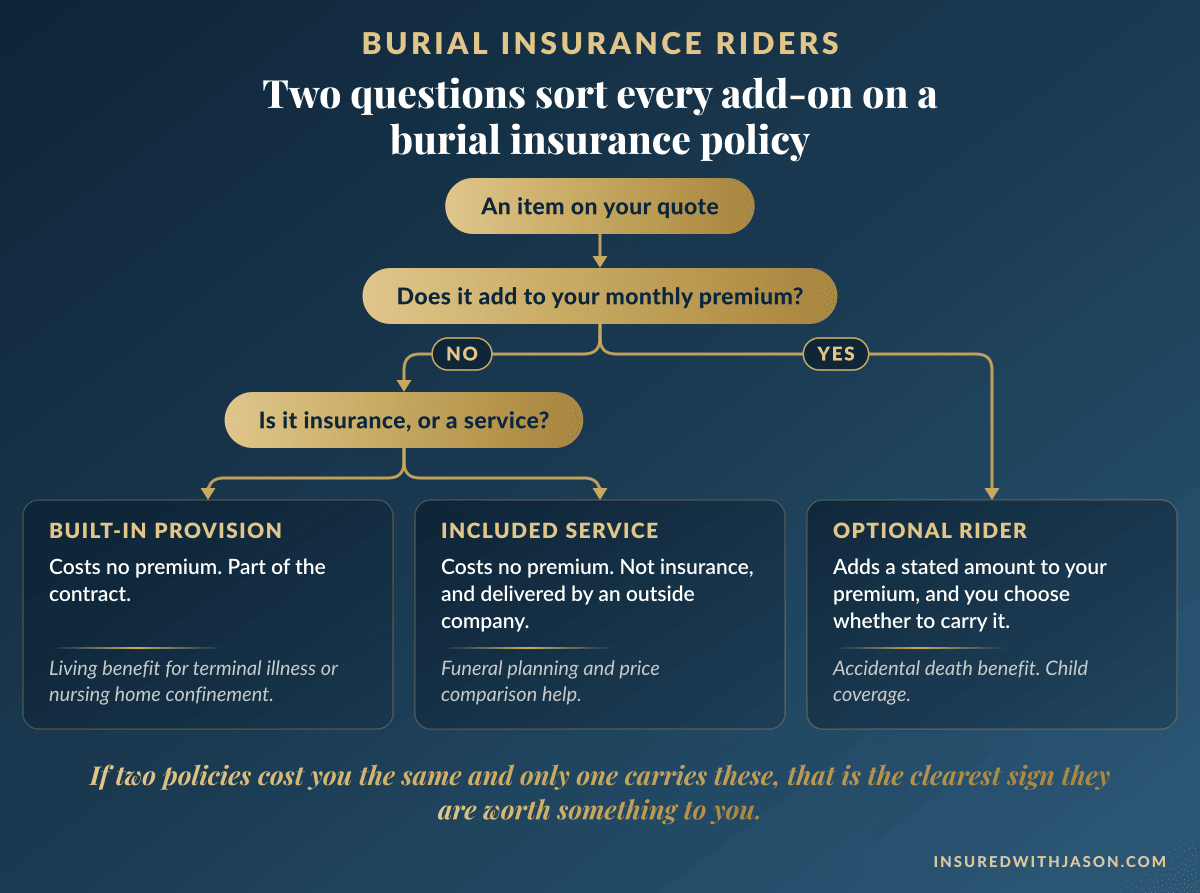
Two questions sort anything on a burial insurance quote: does it add premium, and is it insurance or a service.
How living benefit riders pay you while you’re still living
A living benefit, often called an accelerated death benefit, lets you draw part of your own death benefit early after a qualifying event. On final expense policies, the trigger is usually a terminal illness diagnosis, or confinement to a nursing home for around ninety days or more, and the amount you can access is commonly capped at about half the death benefit. The money is paid to you directly, and it’s yours to spend on anything: care, bills, or a trip you’ve been putting off. Your doctor certifies the condition, the carrier pays you, and when you pass, your family receives the rest.
Here’s the honest part. The amount you take early, along with any processing fee, is subtracted from what your family receives at the end. That’s not a trick; it’s one benefit paid in two pieces at two different times, and state insurance regulators set the rules for how carriers must disclose it. On most level plans this provision is built in at no added premium, and a terminal illness payout is generally free of federal income tax. So while nothing in life is truly free, a policy that includes a living benefit at the same price as one that doesn’t is simply giving you more.
One distinction worth a moment, because seniors hear these terms mixed together at kitchen tables all the time. Some policies also include a chronic illness provision, triggered when someone can no longer manage everyday activities like bathing or dressing on their own. That is still an acceleration of your death benefit, paid from the same pot.
A chronic illness benefit on a burial policy is not long-term care insurance.
Long-term care insurance is a separate product under a different section of federal tax law, with its own rules, and a chronic illness rider legally can’t even be marketed under that name. On a small final expense policy, what you’re getting is early access to your own death benefit. If long-term care coverage is what you actually need, that’s a different conversation with someone who handles that product.
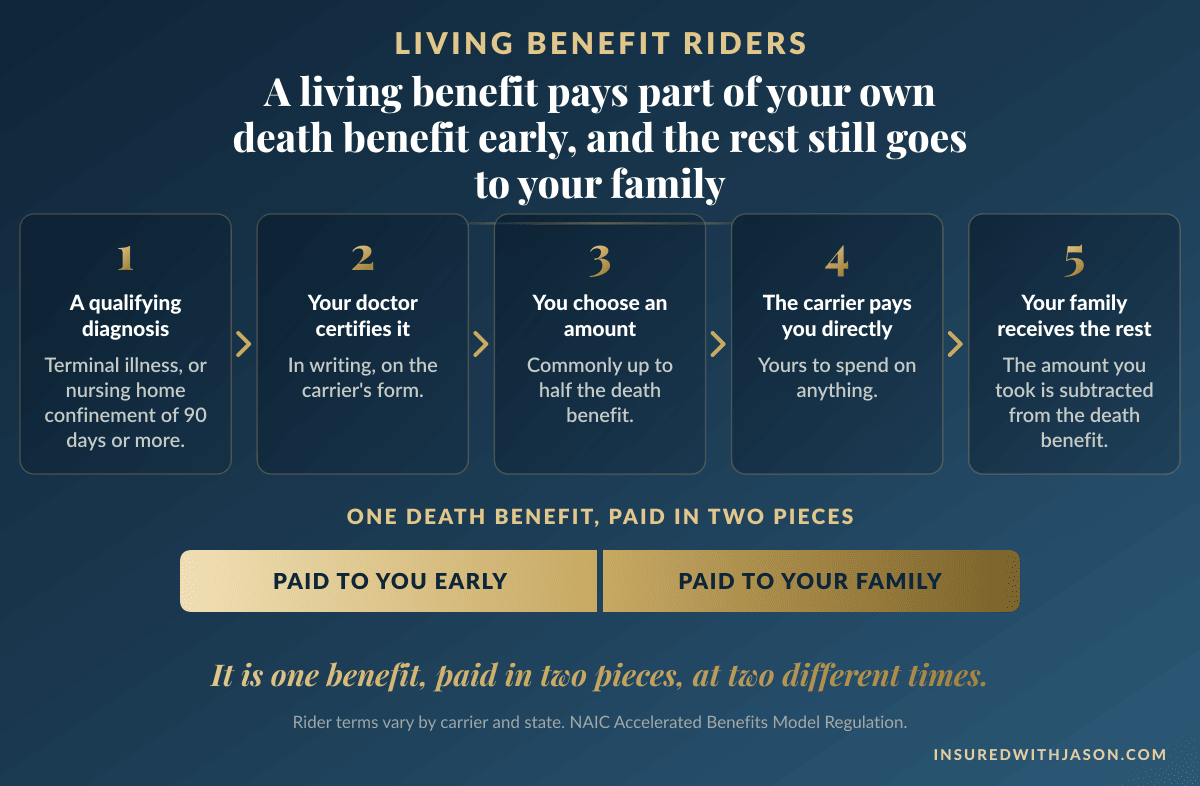
A living benefit is one death benefit paid in two pieces at two different times.
What happens if you pass away during the waiting period?
What the accidental death rider does inside a two-year waiting period
On most graded and guaranteed issue policies, accidental death usually pays the full benefit from day one, even though natural death is still inside the waiting period. If you’re not sure what those terms mean, here’s the short version, and the full picture lives in my guide to the types of final expense insurance. Policies with no health questions, or easier ones, usually carry a two-year waiting period: pass away from natural causes during it, and your family receives every premium you paid back, plus interest, commonly in the range of five to ten percent depending on the carrier. But if death comes from an accident, most of these policies usually pay the entire face amount from the very first day. Almost nobody explains that, and it genuinely matters to the exact people who end up with these policies.
Let me be straight about the order of importance, though, because I am with my own clients. The two-year wait is the headline of a guaranteed issue policy, and it deserves to be understood first, not softened. The accidental provision is the footnote that follows: what you have during those two years is not nothing, and after them, it is everything. And keep in mind that many people who assume they’ll face a waiting period actually qualify for day one coverage, even with pre-existing health conditions, which is why I always shop for day one first.
There’s also a separate, optional accidental death rider you can add to a regular level policy for a small monthly charge. It pays an additional amount, often equal to the face value, if death results from a covered accident. Say someone with day one approval asks me whether to add it. Here’s how I think it through: at seventy-plus, accidents are a minority of deaths, so I’d personally probably leave it. But I’m not them, and I won’t tell them what to do either way. Someone who has lost a friend to an accident may find real value in knowing the benefit doubles in that scenario, and that belief is theirs to weigh. Just read the definitions before you add one, because “accident” is defined narrowly in these riders and carries exclusions.
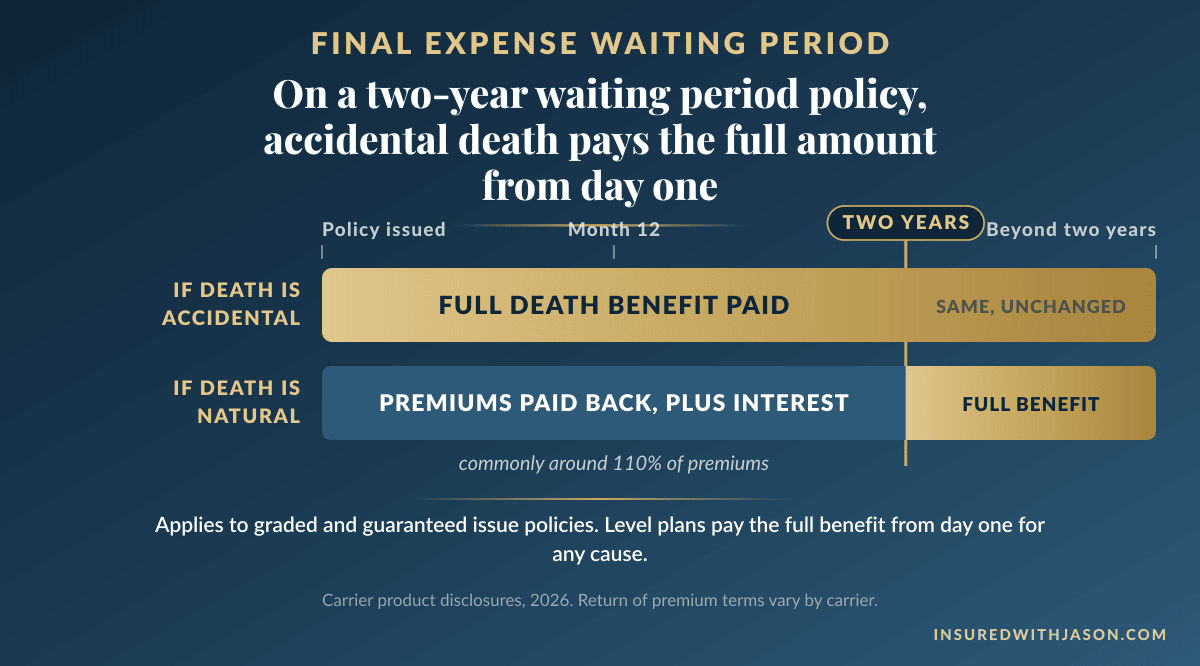
Accidental death usually pays the full benefit from day one, even while natural death is still in the waiting period.
How a child or grandchild rider works on a final expense policy
A child rider adds a small amount of term life coverage on your children under one flat premium, no matter how many children you have. Coverage is typically sold in small units, commonly a few thousand to twenty-five thousand dollars per child, and the monthly cost is modest. One premium, every eligible child, including ones born after the policy starts.
And here’s the part most people skip, because it’s the real value. Many child riders carry a conversion privilege: when the rider ends, usually in the child’s early twenties, the child can convert to a permanent policy of their own, often for several times the rider’s amount, with no new health questions. The small death benefit is not usually the point. The guaranteed insurability is, because a child’s health can change while nobody is paying attention, and the conversion door stays open regardless.
On grandchildren: some carriers, not all, offer a rider that covers grandchildren by name. Where a rider covers only children and stepchildren, a grandchild will not be eligible, and legal guardianship is usually the exception. If your carrier’s rider doesn’t reach your grandkids, a separate small policy on the grandchild is the normal route, and it needs a parent’s involvement.
Now, when someone hesitates on adding child coverage, here’s how I actually handle it. They called me to get coverage on themselves, not their children, and hesitation signifies doubt. That doubt is powerful enough for me to listen to. So I’d say skip it, take care of yourself first, and if you come to a conclusion later that you want coverage on your children or grandchildren, we’ll talk and figure that out then. Nobody benefits from resenting a policy over a few dollars a month, and what would change my answer is simple: a person who genuinely wants it, rather than one talking themselves into it at the kitchen table.
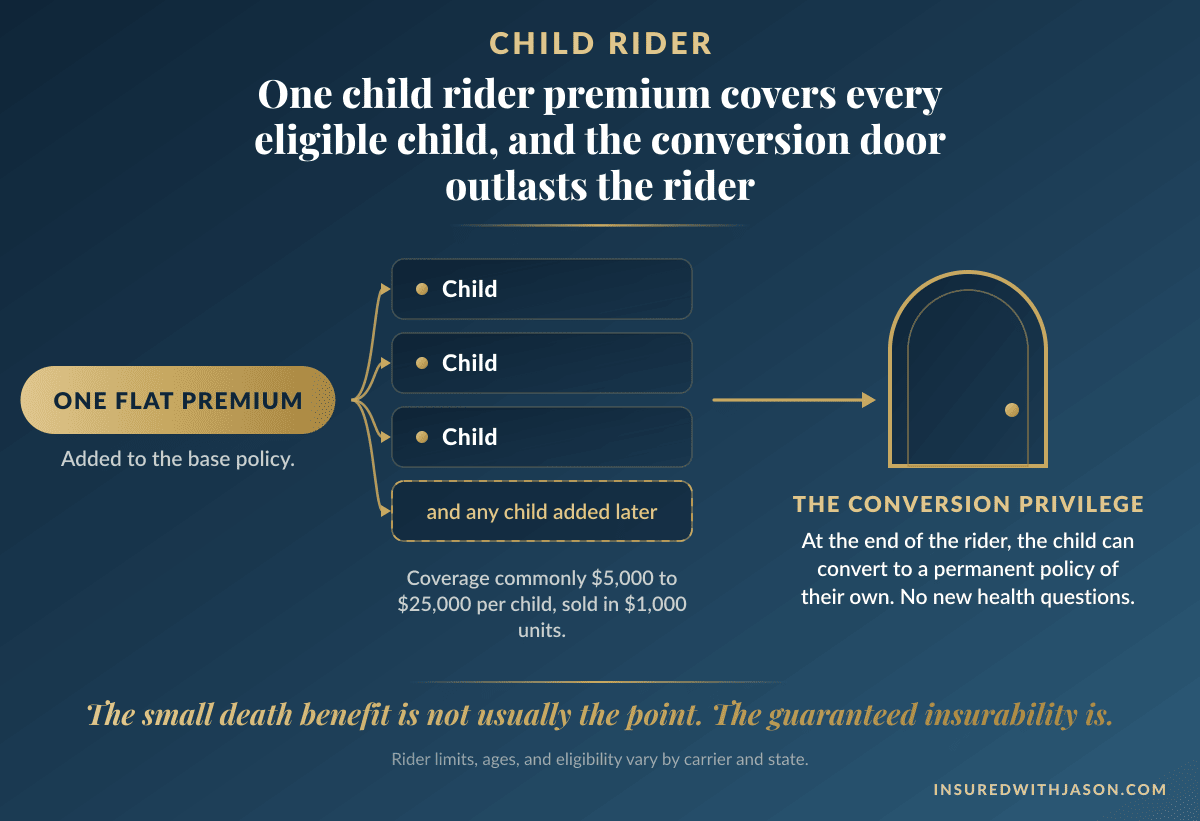
One flat premium covers every eligible child, and the conversion privilege is the lasting value.
Not sure where to start?
Get a straight answer from an independent broker
What a funeral concierge benefit actually does for your family
A funeral concierge is a planning service that helps your family arrange the funeral, and its most valuable job is comparing and negotiating funeral home prices on their behalf. The versions bundled with life insurance typically include help planning the service, price comparison across local funeral homes, will and directive preparation, and secure storage for the documents your family will need. The price comparison is the part that stretches your death benefit further, because a family shopping in the fog of the first two days rarely shops at all.
Now let’s be precise about what this is, because the carriers who offer it are upfront about it themselves. The concierge is not a rider. It’s a service arranged by the carrier and delivered by an outside company, and in several states it’s expressly offered outside the insurance contract entirely. That distinction matters in two honest ways: a benefit outside the contract can be changed, and your family is never required to use it. The death benefit is paid to your beneficiary either way, obligation-free.
So how should it weigh in your decision? The same way as every feature on this page. Some carriers include it; if you can find solid coverage for meaningfully less without it, the cheaper coverage may attract you, and I’d fully support that. If the next lowest carrier lands at the same price or within a dollar of the one carrying it, the service may genuinely appeal to you. I can’t answer that for you, and I wouldn’t try. How much weight it carries in an informed decision is up to the person making it.
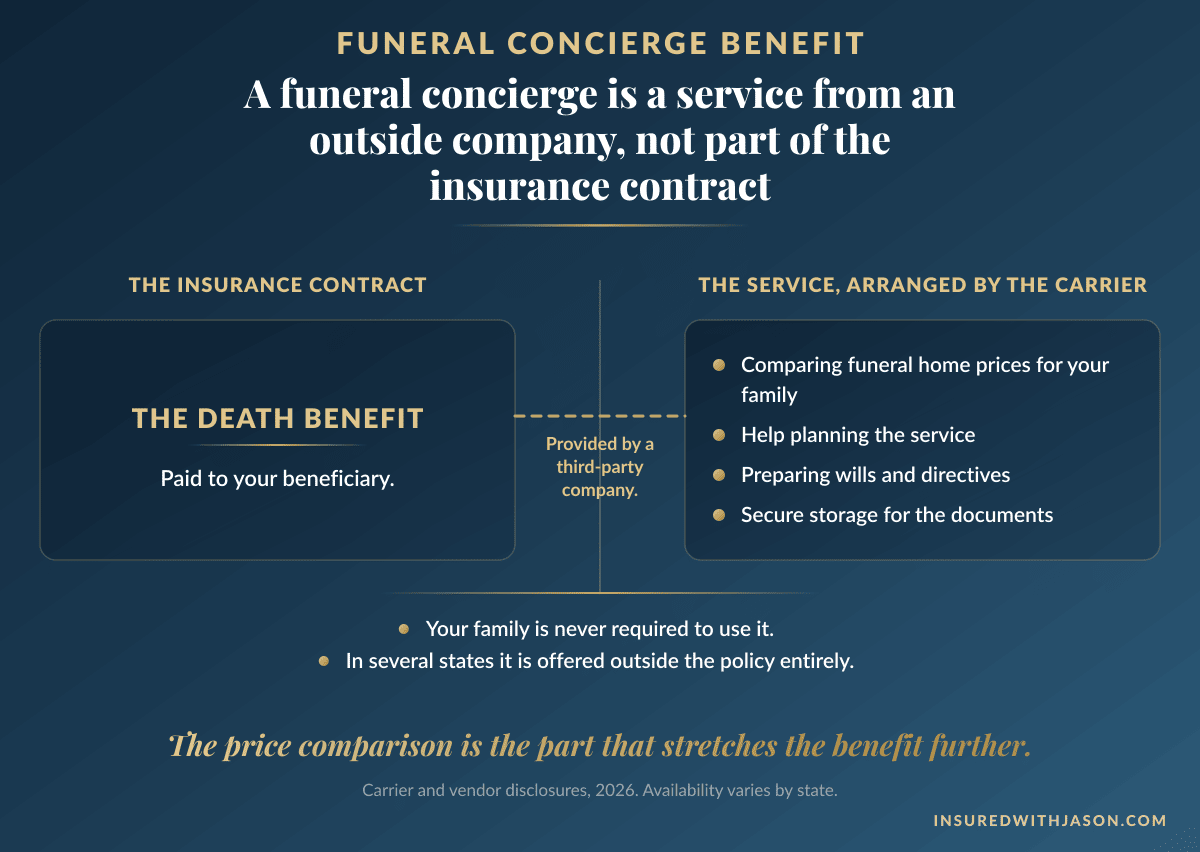
The concierge is a genuinely useful service, and it lives outside the insurance contract.
The riders you will see less often
A handful of other riders and extras show up on final expense policies less frequently, and each one deserves a quick, plain definition. Here they are, so nothing on a quote ever catches you flat-footed.
Less common burial insurance riders and extras, explained
What do you get before adding anything at all?
What comes with the policy itself, beyond the death benefit
Before a single rider is added, a final expense whole life policy already carries a set of features built into the contract. Your premium is level, set at issue, and never rises with your age or health. The death benefit on a level plan never shrinks. A free look period, often around thirty days, lets you return the policy after delivery for a full refund if it isn’t what you expected, which means the decision is never a trap. And if you ever had to stop paying after years of premiums, most policies can convert the value you’ve built into a smaller, fully paid-up policy rather than simply vanishing.
The policy also builds cash value, slowly, and you can borrow against it. Here’s how I think about that one: I don’t advocate borrowing against a small policy unless there’s a real plan to pay it back, and nobody should buy a policy planning on it. But if the dryer dies or a flood hits and the money is there, that’s a decision only the person can make, and it’s worth simply knowing the option exists. An outstanding loan reduces what your family receives, and paying it back restores it.
Some carriers will give a smoker the non-tobacco rate today, as long as they agree to quit within the first two years of the policy.
Keep the agreement and the lower rate stays for life. Break it, and the premium moves to the tobacco rate. It’s a real feature, and for the right person it saves genuine money, because tobacco rates on burial insurance often run substantially higher.
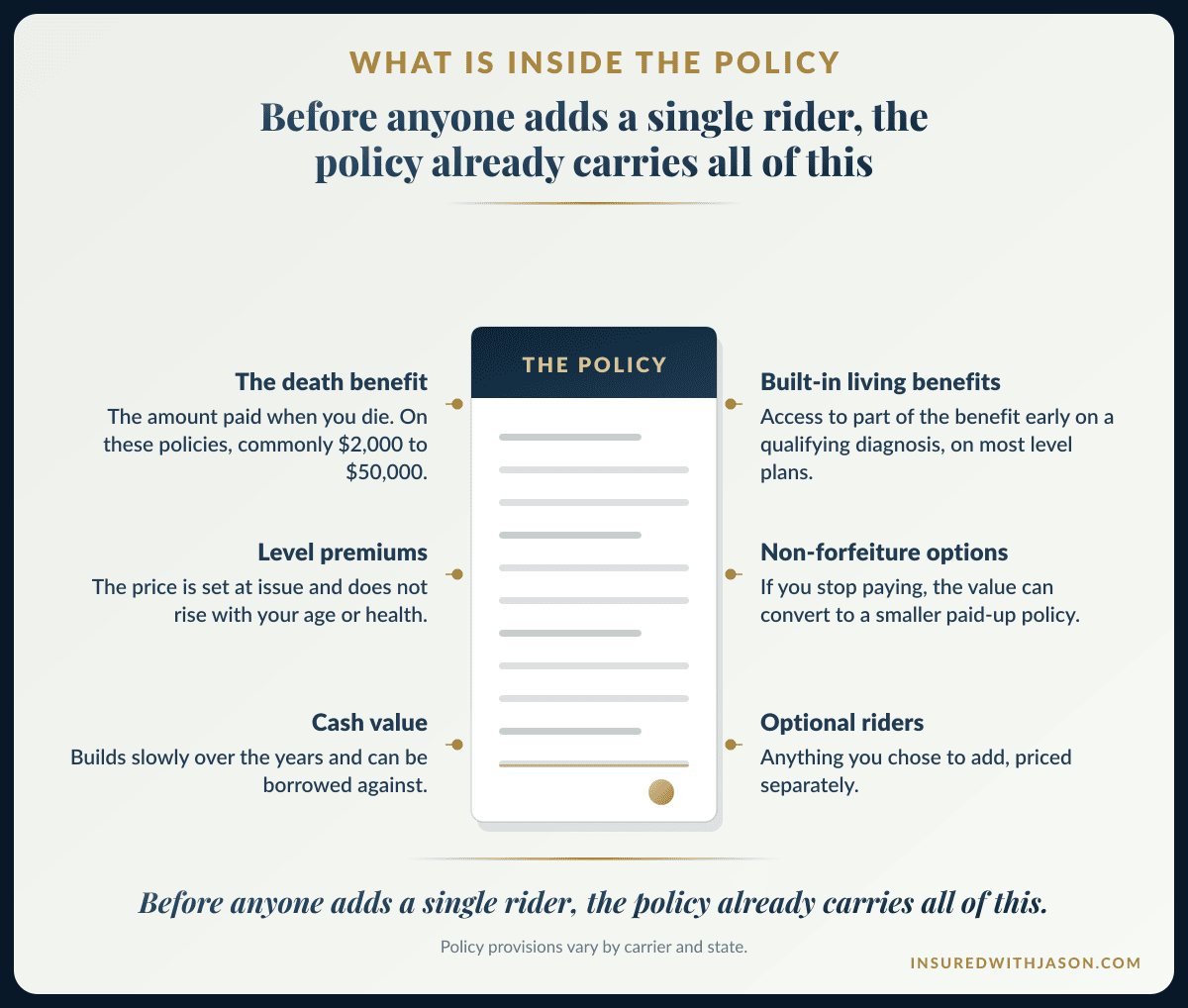
Before a single rider is added, a final expense whole life policy already carries all of this.
Do burial insurance riders raise your premium?
Built-in provisions and bundled services add nothing to your premium, while optional riders add a small stated amount you can see on the quote. Most optional riders can also be dropped later, which lowers the payment back down. The thing to keep in view is proportion: because burial insurance face amounts are small, even a modest rider charge is a meaningful slice of the total premium, and over the years those slices add up. That’s the honest math to run before adding anything, and it pairs with knowing what final expense insurance costs per month before any rider touches it. One more practical note: most riders are elected at the application, not added later, so the application is the moment to decide. If circumstances change down the road, adjusting a policy after it’s in force usually means a separate small policy rather than a new rider.
Is it worth paying more each month for a policy with more features?
Say someone’s comparing two solid policies, and the one carrying the living benefit and the planning service costs eight dollars a month more. That’s nearly a hundred dollars a year, and thousands over the life of the policy, and I have a hard time advocating for that trade. Honestly, I might not even show that policy, except to illustrate what the next one up costs and why it’s probably not worth it. But flip the numbers: if the two are within a dollar or two of each other, virtually the same price, I’d take the one with the features every time, because at the same cost they’re a true benefit to you.
What would change my answer: the size of the gap. At virtually the same price, the features win. At a real monthly difference, the lower premium wins, because the coverage itself is the main thing.
Keep the main thing the main thing: the most coverage at the lowest price, ideally with day one coverage and no waiting period. Everything else is a nice to have, not a must have.
Burial insurance riders: frequently asked questions
The questions people ask me most about riders and features, answered plainly.
Is a rider the same as the death benefit? +
No. The death benefit is the core of the policy, the amount paid to your beneficiary when you die. A rider is an add-on attached to that base policy. Some riders are built in at no charge, and some are optional extras you pay for.
Do burial insurance riders cost extra? +
Some do and some don’t. Built-in provisions like a living benefit usually add nothing to your premium. Optional riders like accidental death coverage or a child rider add a small stated amount each month, and most can be dropped later if you change your mind.
Is a living benefit rider really free to use? +
It’s free to carry, since it usually adds nothing to your premium. Using it is different. The amount you take early, along with any processing fee, is subtracted from what your family receives. There is no such thing as a free lunch, but at the same price, a policy that includes one is giving you something real.
Does accidental death coverage apply during the two-year waiting period? +
Usually, yes. On most graded and guaranteed issue policies, accidental death pays the full benefit from day one, while natural death during the first two years returns your premiums plus interest. Check your policy’s terms, because carriers vary.
Can a child rider cover my grandchildren? +
Sometimes. Some carriers, not all, offer a rider that names grandchildren. Where the rider covers only children and stepchildren, grandchildren won’t be eligible unless the grandparent has legal guardianship, and a separate small policy on the grandchild is the usual route instead.
Do I have to use the funeral concierge service? +
No. It’s an optional service arranged by the carrier and delivered by an outside company, and your family is never required to use it. The death benefit is paid to your beneficiary either way.
Can I add a rider after my policy is already in force? +
Usually not. Most riders are elected on the application, which makes the application the moment to decide. If your situation changes later, a small separate policy can often do the same job, and that’s a good conversation to have with your broker.
Nearly everything on this page is a genuine benefit to somebody. But the reason you came here comes first: coverage for your final expenses, ideally with day one coverage and no waiting period, at the lowest price you can comfortably afford for the rest of your life. If the policy that wins on price happens to carry extra features, enjoy them. If it doesn’t, you haven’t lost the main thing.
You’re allowed to keep it simple.
There’s a lot of confusion around these features, especially between accidental coverage and day one coverage, and around what a living benefit or a nursing home provision actually does. I wanted one page that explains all of it plainly. But I also wanted to be the person who tells you this: when a broker walks you through every feature, you are allowed to say none of it interests you, and that you just want to cover what you came to cover. That’s not rude, and it’s exactly how you price a policy you can afford for the long term. Be fair to the broker in that moment too, because explaining the whole policy is the job, not a sales pitch, and most of us have skipped a feature we assumed nobody wanted and heard about it later. Hear it all, keep what serves you, and let the rest go.
Let’s find the coverage that fits you
You now know what every item on a burial insurance quote actually is, which ones cost money, and which ones come along at no charge. The next step is seeing what the whole market offers you. I’ll shop every carrier I represent, show you the real numbers with the features laid out plainly, and you decide what’s worth it to you. Your rate is set by your age right now, so the cheapest day to start is the one you’re standing in.
This article is for educational purposes only and is not legal, tax, or financial advice. Coverage, costs, riders, and rules for life insurance plans vary by person, company, and state. Please speak with a licensed professional about your specific situation before making a decision.
Takes about a minute.