
8 Burial Insurance Mistakes and Scams to Avoid
Eight burial insurance traps that cost families real money, and the simple due diligence that avoids every one of them.

- Your rate locks at the age you buy, and a $10,000 policy at 70 often runs roughly twice what it costs at 50.
- The same coverage amount can carry very different prices from one company to the next, so compare several before you commit.
- Accidents cause only about 3% of deaths after age 65, which makes an accidental-death-only policy the wrong product for this job.
- A policy you can comfortably afford for life beats a bigger one that lapses, because a lapse ends the protection your family was counting on.
- Read the policy during the free-look window, verify every detail, and make sure your beneficiary knows the coverage exists.
- Health issues? Most qualify
- Declined? Jason has next steps
- New policies up to age 85
- Fits a Social Security budget
- Free quotes, no commitment
- Just Jason, never a stranger
Your information goes to Jason. Not a call center. Not a lead list.
The biggest burial insurance mistakes have nothing to do with fraud, because this is one of the most tightly regulated purchases you can make. Every agent must hold a state license, every company answers to your state’s Department of Insurance, and independent rating firms grade each insurer’s financial strength in plain view. The real risks are simpler and closer to home: waiting too long, buying the wrong kind of coverage, or taking the first price you hear. Here are eight mistakes worth knowing before you buy, and the easy way to avoid every one of them.





The biggest burial insurance mistake: waiting too long to buy
Waiting is the most expensive burial insurance mistake because your rate is set by your age on the day you apply, and it locks there for life. A $10,000 whole life policy that runs roughly $20 to $38 a month at 50 often runs $55 to $100 at 70, and the climb gets steeper from there. Those are estimates, and your health, your state, and the company all move the needle, but the direction never changes. Every birthday you wait, the same coverage costs more.
And price is only half of it. A new diagnosis can move you from full day-one coverage into a waiting-period plan, and most insurance companies stop issuing new coverage somewhere between 80 and 85. The door doesn’t just get more expensive. Eventually it closes.
Is there ever a good reason to wait? A few, honestly. Say someone calls me right after a one-off health event, a bad fall or a scare that looks worse on paper than it really is. Sometimes waiting a stretch gets them a better answer from the health questions. Some conditions even qualify for day-one coverage again once enough time has passed. But here’s the hinge: if you can get coverage today at a price that does the job for your family, there is no time like the present, because the risk of waiting is that something happens in between and you’re not covered at all. If a bigger policy isn’t in the budget yet, a smaller one you start now beats a bigger one you plan to buy later, because later always costs more.
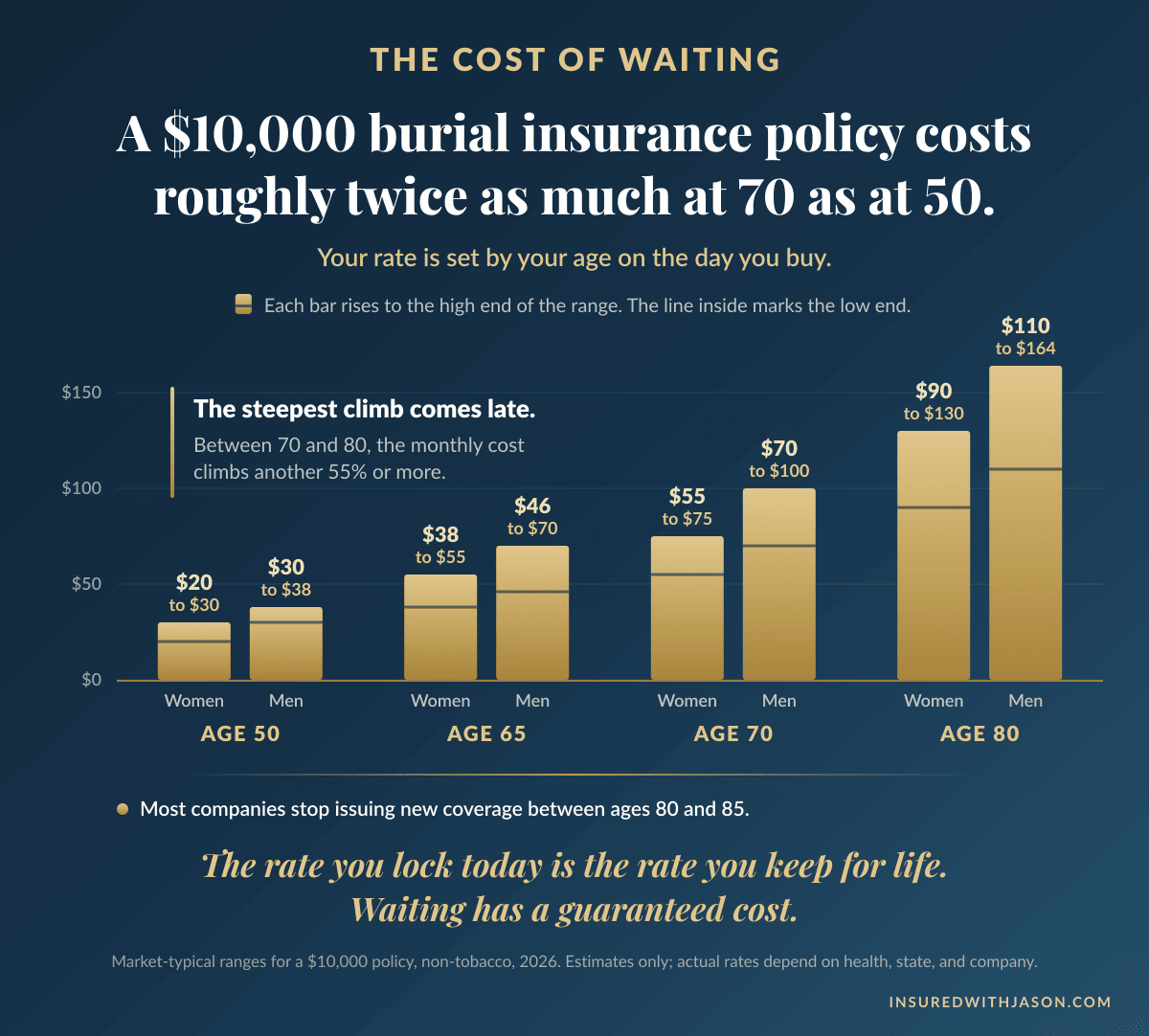
The rate you lock today is the rate you keep for life, and waiting has a guaranteed cost.
Buying from the first (or only) company you talk to
Buying from the only company you called is how careful people quietly overpay, because every insurer prices and underwrites differently. The same person, the same coverage amount, the same health answers can come back with very different monthly premiums depending on which company is quoting. One insurer may decline a condition another covers from day one. A captive agent can only show you one company’s products. An independent broker shops the whole market and shows you where you land everywhere at once. That difference is the entire reason my job exists, and you can read more about it in how to shop for burial insurance.
While you’re comparing, verify whoever you’re talking to, and yes, that includes me. Look up their national producer number, check their license through your state’s Department of Insurance, and look at the financial ratings of any company they suggest. If you’re still leery, ask for a video call. Any agent worth your business understands that when you’re handing over personal information, they may have to give a little to earn your trust, and that’s completely normal.
Is that $9.95 policy from the commercial ever the right move?
Honestly, I can’t say it never is, because I’d have to quote it against the market to know, and that’s exactly the point. What I can tell you as fact: that price usually buys one “unit” of coverage, which can be as little as $1,000 or so, a fraction of a real funeral. Do I think it beats what a broker can find by shopping the whole market? Probably not. But there’s only one way to find out.
What settles it: quote it side by side against everything else. If the TV offer genuinely wins on price and coverage, take it. It rarely does, but the comparison costs you nothing.
Find your lowest rate today.
One independent broker shops the whole market for you
Falling for the “free government burial program” ads
No universal government burial program exists, so any mailer or phone call promising free final expense coverage from a “state program” is marketing, not a benefit. The real government help is narrow and specific. Social Security pays a one-time death payment to an eligible spouse or child. The VA pays burial allowances for eligible veterans, up to $2,000 when a death is service-connected. That’s genuine help, and it still leaves most of a funeral bill standing. I break down every real benefit, dollar by dollar, in free burial insurance and government benefits.
The pattern to watch for is simple: an official-sounding name, a request for your personal information to “verify eligibility,” and pressure to act right now. A legitimate organization doesn’t call you out of the blue to pay your funeral bill. When in doubt, hang up and check with your state’s Department of Insurance.
The one-time Social Security death payment has not changed since 1954. It covers only a small fraction of today’s median funeral, which the National Funeral Directors Association put at $8,300 with viewing and burial in 2023.
Source: Social Security Administration; NFDA 2023 General Price List Study
Buying an accidental-death-only policy by mistake
An accidental-death-only policy pays nothing when death comes from natural causes, and after age 65 natural causes account for nearly 97% of deaths. Per the CDC’s final 2023 data, accidents cause just 3.2% of deaths among people 65 and older. Heart disease, cancer, and stroke do the rest, and an accident-only policy covers none of them. That’s why it costs so little. It almost never has to pay.
Here’s how this mistake usually surfaces. Somebody tells me they have a full policy at a price that’s insanely cheap compared to everything else on the market, and you can almost do the math on the spot. Figure how many years you’d have to keep paying before the company even broke even on your death benefit. If the answer is far longer than anyone could ever live, you have a pretty good idea you’re holding coverage for an extremely narrow set of events. True burial insurance is whole life insurance. It pays for any cause of death, and the price reflects that promise. If you’re looking at your own coverage and you’re not comfortable with accident-only protection, that’s the moment to sit down and figure out exactly what you have and what your family actually needs.
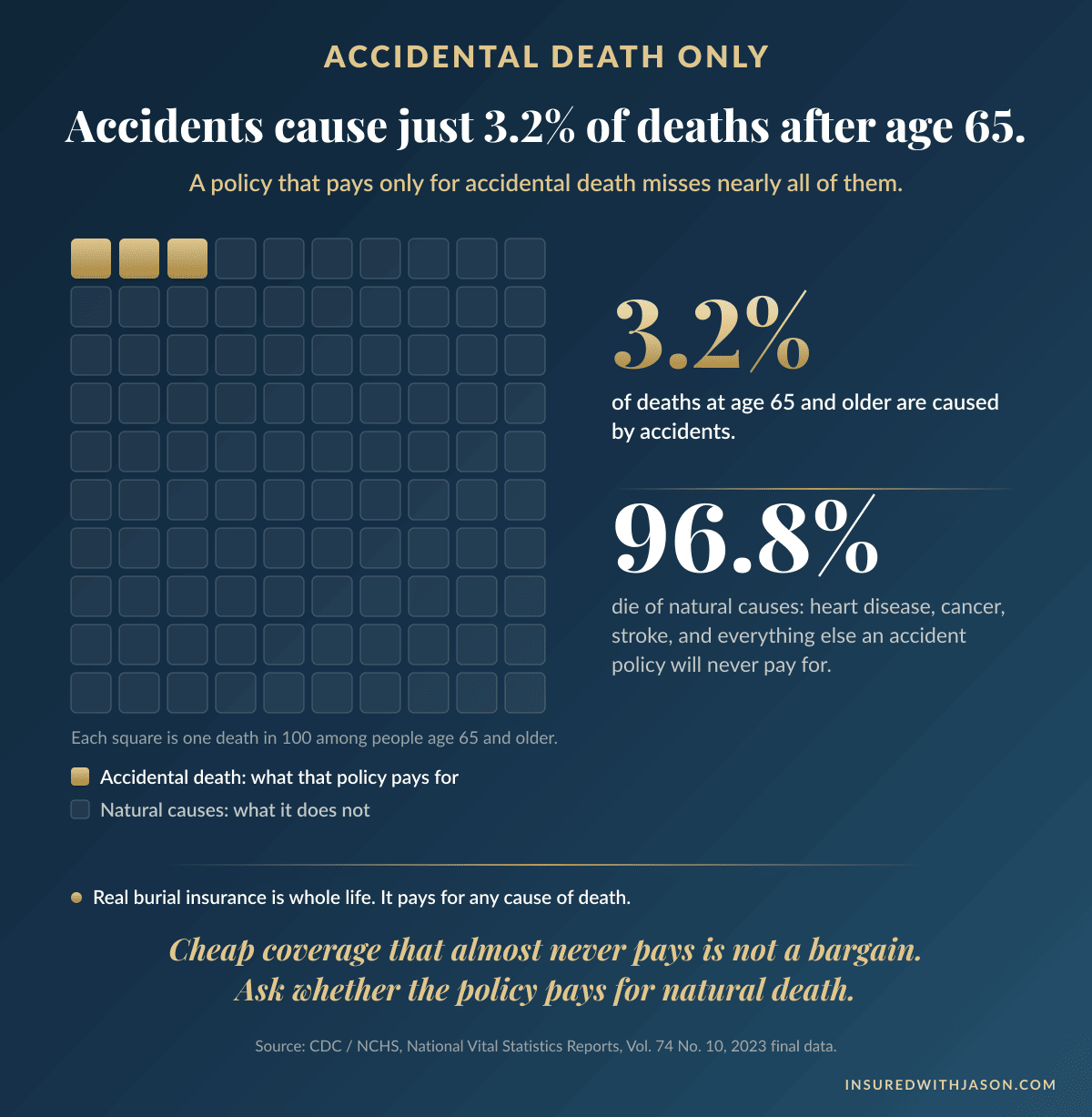
Cheap coverage that almost never pays is not a bargain, so check whether your policy pays for natural death.
Not knowing if your policy has a waiting period
Some burial insurance policies pay the full death benefit from day one, and others carry a two-year waiting period for natural causes, so knowing which one you’re buying is not optional. Coverage generally comes in three tiers. Level coverage pays in full immediately and requires answering health questions. Graded coverage pays a partial benefit in the first year or two, then the full amount. Modified and guaranteed issue plans return your premiums plus interest if you pass from natural causes inside the first two years, then pay in full after that. And guaranteed issue life insurance, the kind with no health questions and no medical exam, always carries that two-year waiting period as the trade-off.
Two things worth knowing before you sign. First, accidental death is typically covered in full from day one even on graded and modified plans, so the waiting period applies to natural causes only. Second, plenty of people who could qualify for day-one coverage end up in a guaranteed issue plan simply because nobody asked them the health questions. That’s money and protection left on the table. My honest advice on expectations: you can’t know your tier until you talk to a broker, and a five-minute conversation with a competent licensed life insurance broker can turn that unknown into a definite answer, whether that’s day-one coverage from selected companies or a clear picture of exactly where you stand. The types of final expense insurance page walks through all three tiers in detail.
Buying more coverage than you can afford
Buying more coverage than you can afford for life is the mistake that hurts families most, because the policy usually lapses, and a lapse ends the protection with little to show for it in the early years, when the cash value has barely had time to build. Research from the Society of Actuaries shows roughly one in ten simplified-issue whole life policies lapses per year in the early years. The person who bought big to protect their family ends up with no coverage at all, which is the exact opposite of what they set out to do.
I understand why it happens. You’re excited, and it’s good to be excited. You love your family, and that’s completely normal. But dial it down just a little, because it will probably sit with you a lot better in the end. Size the premium to what fits comfortably after all your bills, this year and every year after, and give every dollar of coverage a purpose so the payment always feels worth making. A $7,000 final expense policy your family actually receives is worth exactly $7,000 more than a $20,000 policy that lapsed three years before they needed it. And if funeral costs are the target, the final expense cost per month page shows what right-sized coverage really runs.
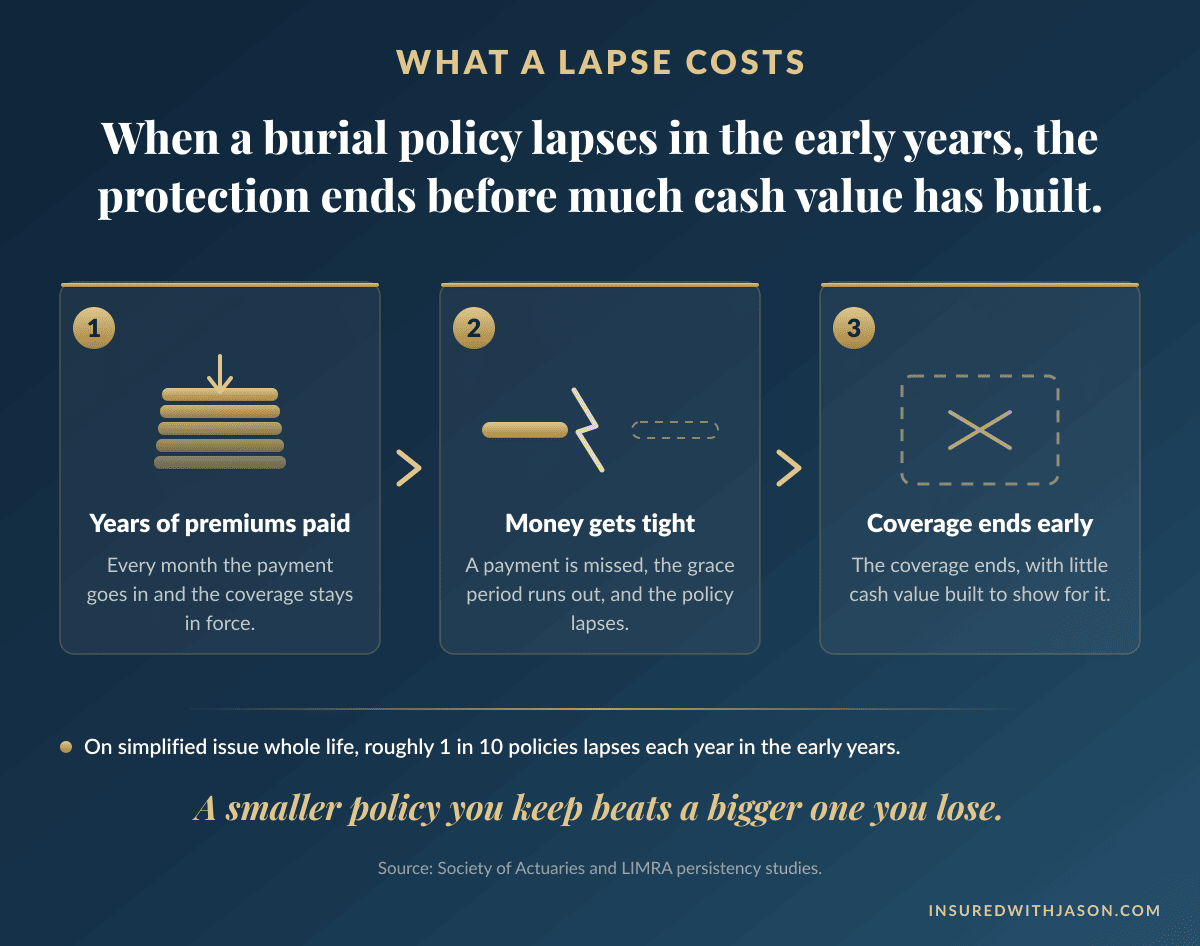
A smaller policy you keep beats a bigger one you lose.
See your exact price at your age.
Real numbers · No pressure · Takes about a minute
What happens after I buy?
Not reading the policy when it arrives
Every state gives you a free-look window, usually 10 to 30 days from the day the policy is delivered, to review it and cancel for a full refund, and skipping that review is a mistake even when you trust your broker completely. Open the envelope the day it arrives, because the clock starts at delivery.
Clients sometimes tell me they trust me and don’t need to read all that. My answer is no, and I say that as the broker. Only you know yourself, your name, your date of birth, everything else. I could very easily overlook a typo in the policy. You’d know right away if the insurance company put down the wrong Social Security number. You’d know right away if the beneficiaries are wrong, if the death benefit looks off, if the premium looks off. All of those things I’d have to look a lot harder at than you to instantly know what’s right or wrong. There is no alternative to reviewing the policy, and it’s part of the policy delivery. We go through it together, review the features, the death benefit, the beneficiaries, and make sure every piece of information is correct. That requires the both of us, not one of us.
Naming the wrong beneficiary (or none at all)
Naming a living person as your beneficiary, plus a backup, is what gets the money to your family quickly, because the alternatives all create delays. Leave the beneficiary blank or name your estate, and the payout goes through probate, where it sits in court and can be reached by creditors. Name a minor grandchild directly, and the insurer can’t pay a child, so the money waits on a court-appointed guardian. Name one person with no contingent, and the coverage has a single point of failure if that person passes before you do.
The fix takes five minutes: a living primary beneficiary, a contingent behind them, and a review after any divorce or death in the family. Then do the one thing people forget most. Tell your beneficiary the policy exists and where to find it. Full details on keeping all of this current live on the burial insurance policy maintenance page.
The insurance industry’s national policy locator has matched families with more than $10 billion in benefits they didn’t know existed.
That figure, reported by the National Association of Insurance Commissioners, represents policies that were paid for faithfully and then nearly lost because nobody told the beneficiary. One conversation with your family prevents it entirely.
Get this right the first time.
A licensed independent broker compares the whole market for you
Burial insurance mistakes: frequently asked questions
The questions people ask me most, answered plainly.
Does the government pay for funerals? +
No universal government burial program exists. The real benefits are narrow: Social Security pays a one-time $255 death payment to an eligible spouse or child, and the VA pays burial allowances for eligible veterans. Ads or calls promising a free government funeral benefit are marketing, not a program.
Is burial insurance a scam? +
No. Burial insurance is a legitimate, heavily regulated whole life insurance product. Every agent must hold a state license and every insurer answers to your state’s Department of Insurance. Verify the agent’s license, check the company’s financial ratings, and your purchase is as safe as any regulated financial product can be.
Can I avoid the two-year waiting period? +
Often, yes. Applicants in reasonable health who answer the health questions can frequently qualify for level coverage that pays in full from day one. Guaranteed issue policies, which ask no health questions, always carry a two-year waiting period for natural causes as the trade-off.
This industry is far more regulated than most people believe, and your purchase is safe when you do a little homework first.
I wrote this because I want you to know the ground you’re standing on is solid. As you get older, you naturally grow more skeptical, and that’s completely normal. You’ve seen more, you’ve done more, and you don’t want to mess this up. The truth is that a licensed agent or broker in your state, selling a company with strong financial ratings, is one of the safest purchases you can make. A little due diligence beforehand means you get this right the first time, at an affordable price, with real protection that lands in your family’s hands right when they need it most. That’s the whole job.
Avoid every one of these mistakes with one conversation
You now know the eight traps and the way around each one: buy while your age and health are on your side, compare the whole market instead of one company, know your policy’s tier before you sign, size the premium to your real budget, and read what arrives in the mail. A licensed independent broker handles all of that with you in a single conversation. Your rate is set by your age today, so the cheapest day to get your real price is the one you’re standing in.
This article is for educational purposes only and is not legal, tax, or financial advice. Coverage, costs, and rules for life insurance plans vary by person, company, and state. Please speak with a licensed professional about your specific situation before making a decision.
No spam calls. Ever.