
Free Burial Insurance: What the Government Actually Pays
The only guaranteed federal funeral benefit is $255. Here is every real program, and the honest way forward.

- Free burial insurance does not exist. No federal or state government sells or gives away burial insurance, and there is no free state burial program.
- The only guaranteed federal payment for most families is a one-time $255 from Social Security, and it can only go to an eligible spouse or child, never to a funeral home.
- Veterans get real help from the VA, including a free grave in a national cemetery, but the cash allowances are partial and usually paid back to the family after they’ve already covered the bill.
- “State-regulated program” mailers are private insurance ads. Verify any claimed state program with your state’s insurance department before you reply.
- A small whole life policy sized to real funeral costs is the dependable way to cover the roughly $8,000 gap the government leaves behind.
- Health issues? Most qualify
- Declined? Jason has next steps
- New policies up to age 85
- Fits a Social Security budget
- Free quotes, no commitment
- Just Jason, never a stranger
Your information goes to Jason. Not a call center. Not a lead list.
Free burial insurance from the government does not exist, but real help does, and this page maps all of it. Social Security pays a one-time $255. The VA pays more, but only for veterans, and mostly as a reimbursement after the family has already paid. Counties will handle a cremation for families with truly nothing, though there’s no service and no ceremony attached.





Is there such a thing as free burial insurance?
No. Free burial insurance does not exist, from the government or anyone else. No federal agency, no state, and no county sells or gives away burial insurance. The closest thing to a government life insurance product is the VA’s VALife program for disabled veterans, and even that one is paid for by the veteran, not handed out free.
What exists instead is a patchwork of small, specific benefits: a one-time payment from Social Security, partial allowances for veterans, cremation programs for families with no means, and a handful of situational funds for disasters and crime victims. Each one is real. Each one helps somebody. And every single one falls far short of what a funeral costs, which is exactly why so many advertisers have built a business around the word “free.”
Here’s the picture in two numbers.
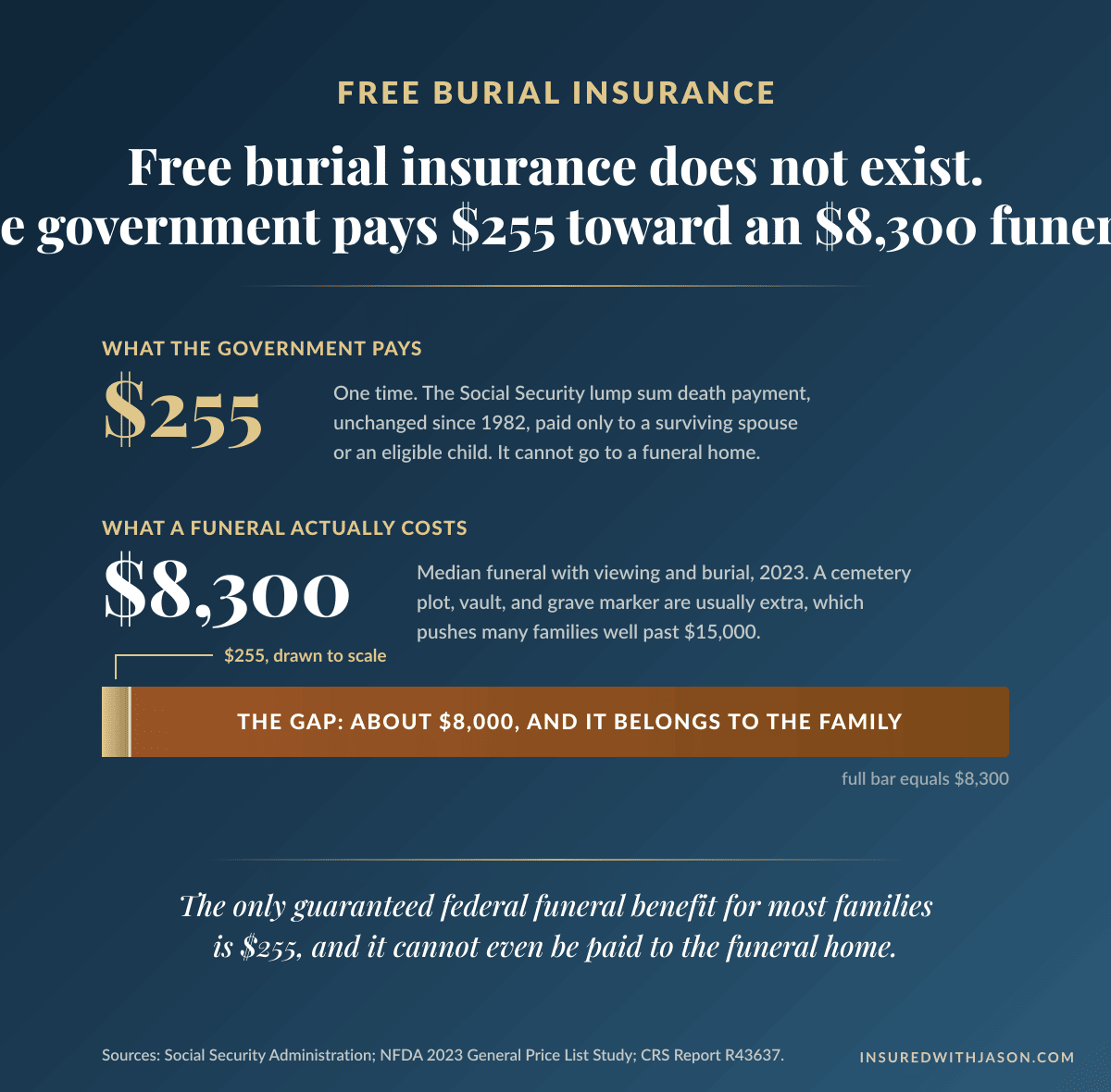
The government’s guaranteed contribution for most families is $255. The median funeral with burial is $8,300. The gap belongs to the family.
What are those free “state-regulated” burial program ads really selling?
Those mailers and social media ads are selling private life insurance, dressed up to look like a government benefit. Reply to one and you’ve joined a marketing list, and the calls follow. When an ad has no face and no name behind it, there’s usually more than one person behind the scenes, and they will be persistent about reaching you.
The trick is in the phrase itself. “State regulated” is true of every insurance policy sold in America, because every insurer must file its products with a state insurance department before selling them. The advertisers lean on that technically true phrase to make a private product sound like a state program. Read the fine print and it usually says some version of “not affiliated with or endorsed by any government agency.” That sentence is the honest part, printed in the smallest type on the page.
Regulators have noticed. State insurance regulators in New Jersey, Iowa, and North Dakota have issued cease-and-desist orders and fines running north of three hundred thousand dollars against marketers whose mailers implied a government program while soliciting life insurance. So the standard here is simple: anyone borrowing the state’s credibility without being part of the state has earned your skepticism. If you want to know whether a “state program” is real, call your state’s insurance department and ask them directly. They will tell you, for free, and they answer to you rather than to an advertiser.
And I’ll say the personal part plainly, because it’s the reason this page exists: a relationship that protects your family should start with honesty. If the introduction was engineered to mislead you, that tells you something worth knowing before any paperwork gets signed.
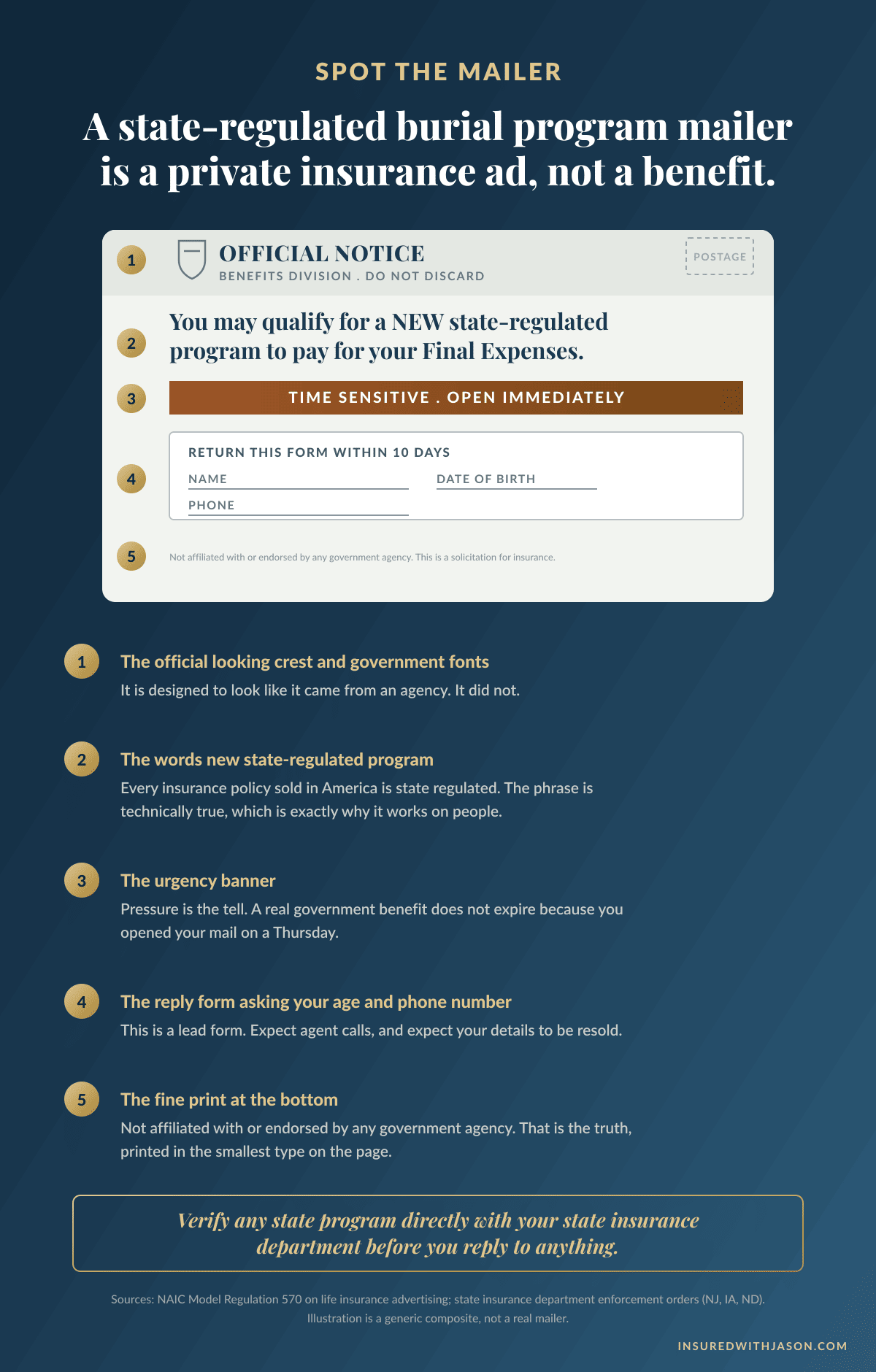
Every piece of the mailer is engineered to look official. The fine print admits it isn’t.
Believing an official-looking letter doesn’t make you gullible. The dishonesty says everything about the sender and nothing about you.
The postcard misled me, but the agent’s quote looks fair. Do I walk away?
Here’s how I think it through. The agent on that phone is almost always a legitimately licensed person, and they may never have seen the mailer at all, because the ad often comes from a separate marketing company that sells the replies as leads. But a license is the bare minimum, not the bar for trust. My own rule: once an introduction misleads me, whoever sent it has disqualified themselves from being the final word. I’d treat the quote as useful information and verify it against an honest second opinion before signing anything.
What would change my answer: nothing stops you from keeping that quote if it truly wins the comparison. Whether the dishonest doorway is a dealbreaker is your call to make, and either answer is reasonable once you’ve compared.
Want a straight answer instead of a mailer?
One independent broker · Real numbers · No pressure
Does the government pay for funerals?
The government pays for funerals only in narrow, partial ways, and there is no general program that covers one. The complete list of real government funeral help looks like this: the Social Security lump sum death payment, VA burial benefits for veterans, county and municipal programs for families with no means, FEMA funeral assistance after a federally declared disaster, crime victim compensation funds when a death results from a compensable crime, workers’ compensation death benefits for a work-related death, and a Railroad Retirement Board benefit for railroad workers.
Notice the pattern. Every program on that list is tied to who you are or how the death happened, never to how much your family needs. A veteran qualifies for VA help. A disaster victim’s family may qualify for FEMA. A family with truly nothing may qualify for a county cremation. But an ordinary family facing an ordinary death, which is most families, qualifies for exactly one thing: the $255 from Social Security. The decision tree below routes any situation to its real options.
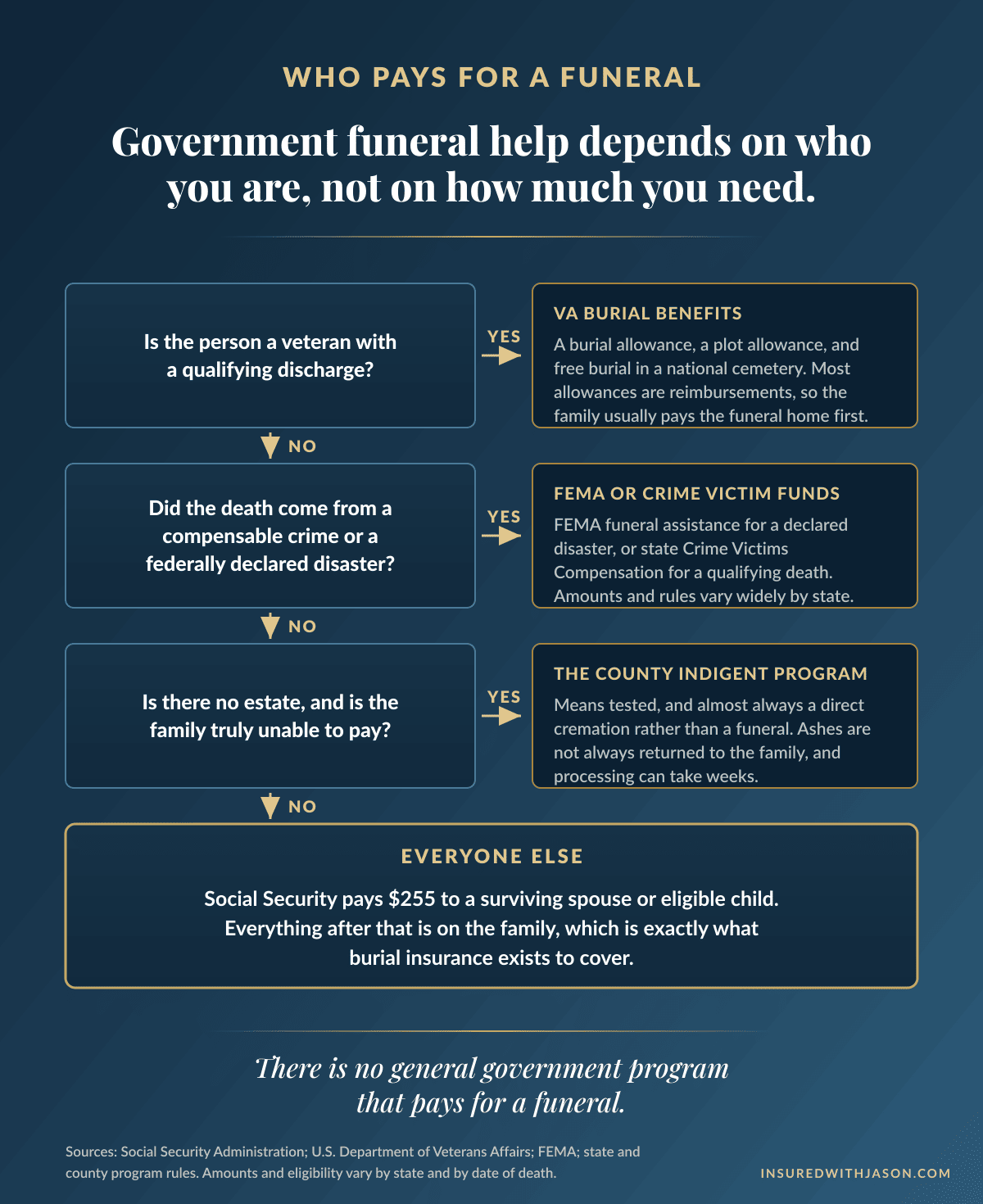
Government funeral help depends on who you are, not how much you need.
So how much help is actually out there?
How much does Social Security pay when someone dies?
Social Security pays a one-time lump sum death payment of $255. Congress capped that figure back in 1954, and since 1982 virtually every payment has been exactly that amount, which means its real value shrinks a little more every year. In 2023, the Social Security Administration paid this benefit on roughly 842,000 deaths, so it is very much a live program. It just isn’t the funeral fund people imagine.
Two details matter more than the amount, and almost nobody publishes them. First, the $255 can only be paid to an eligible surviving spouse or child, never to a funeral home, a cemetery, or anyone else. A spouse who was living with the person qualifies first; a spouse living apart qualifies if they were already eligible for benefits on the record; and if there’s no eligible spouse, an eligible child can receive it. A surviving divorced spouse cannot, even one who qualifies for monthly survivor benefits. Second, the claim has a deadline.
The one-time lump sum death payment, capped in 1954 and effectively frozen since 1982. It covers a small fraction of today’s median funeral, and it can never be paid directly to a funeral home.
Source: Social Security Administration; Congressional Research Service R43637
The $255 must be claimed within two years of the death, or it’s forfeited.
Some families skip it because it feels too small to bother with. Think of it this way: if somebody put $255 on the table and asked you to make one phone call for it, you’d make the call. Make the call.
How to claim the Social Security death payment
It takes a phone call and a little paperwork. Here’s the whole process.
- 1Report ItMake sure the death is reported to Social Security
The funeral home usually does this for you when you give them the Social Security number.
- 2Check EligibilityConfirm you’re an eligible spouse or child
The payment goes to a surviving spouse first, or to an eligible child if there’s no qualifying spouse.
- 3Call SSACall Social Security at 1-800-772-1213
This claim can’t be filed online. A phone call or a local office visit does it.
- 4Beat The ClockFile within two years of the death
After two years, the payment is gone for good.
Could the $255 death benefit go up?
There’s a proposal in Congress that would raise the lump sum death payment to around $2,900 and tie it to inflation going forward. I’m genuinely rooting for it, because it would turn the benefit into a real cost share between the government and the family, and it would put a dignified goodbye within closer reach for lower-income households especially. But say someone in good health tells me they’ll wait to buy coverage until it passes. I’d walk them through the math instead: if the need is ten thousand dollars and the proposed benefit covers about three, we can put coverage on the smaller difference today, and add a small second policy later if the law never changes. Betting the whole plan on pending legislation is the one move I wouldn’t make, because bills stall all the time and your health doesn’t wait on Congress.
See your real price at your exact age, in about a minute.
See my price →What burial benefits do veterans get from the VA?
Veterans discharged under conditions other than dishonorable can receive a layered set of real VA burial benefits, and they’re the most generous government help on this page. For deaths on or after October 1, 2025, the VA pays up to $1,002 toward burial and funeral expenses plus a matching $1,002 plot allowance for a non-service-connected death, and up to $2,000 when the death is connected to service. Those rates adjust every October 1, so always match the rate table to the date of death.
The in-kind benefits are often worth more than the cash. Burial in a VA national cemetery is free, and that includes the grave itself, opening and closing, a government headstone or marker, and perpetual care. A burial flag and a Presidential Memorial Certificate come with it. For a family choosing a private cemetery instead, the plot allowance helps, but the free national cemetery grave is the single biggest money-saver the VA offers.
Now the caution: the cash allowances are usually reimbursements. The family pays the funeral home first, then files VA Form 21P-530EZ with the death certificate, the DD-214, and the itemized bill, and non-service-connected claims must be filed within two years of the burial. So when a veteran tells me he’s covered in full because he earned it, I wouldn’t be comfortable letting him walk away believing that, and I wouldn’t be doing his family any favors by staying quiet. The numbers are the numbers, and they’re published on the VA’s own website for anyone to check. One more honest note: a service-connected disabled veteran should take a real look at the VA’s own VALife insurance program before buying any private policy, because when the cost is comparable, I believe in that program. The full picture of what the VA pays, where the gaps sit, and how to file lives on our burial insurance for veterans page.
A surviving spouse listed in VA records can be paid the burial allowance automatically, without filing a claim at all.
When the VA learns of the veteran’s death, it pays the spouse of record on its own. Everyone else files Form 21P-530EZ, and it’s worth filing even when the amount seems small.
Does Medicaid pay for funeral expenses?
No. Medicaid never pays a funeral bill. This is the most misunderstood program on the page, so let’s be precise about what Medicaid actually does with funeral money. Instead of paying anything after a death, Medicaid’s rules let a person set funeral money aside before death without that money counting against the program’s strict asset limits. A designated burial fund of up to $1,500 is excluded. One burial space per person, including the plot, vault, and marker, is excluded. And money placed in an irrevocable funeral trust doesn’t count as an asset at all, with most states capping those trusts somewhere around $15,000.
Then there’s the part families discover too late: estate recovery. Federal law requires states to seek repayment of long-term care costs from the estates of Medicaid recipients who were 55 or older. Life insurance paid to a named person generally stays out of the state’s reach, but a payout directed to “my estate,” or a policy with no living beneficiary, can be recovered against. Naming a real person as your beneficiary is one of the simplest protections in this whole subject.
When someone calls me and mentions that Medicaid is likely in their spouse’s future, I don’t tell them a policy is the wrong tool. I walk them through the policy’s cash value illustration so they understand exactly how Medicaid would count it, and we talk about whether an assignment to something like an irrevocable funeral trust makes sense. The Medicaid planning side of that conversation belongs with a professional who handles it, such as an elder law attorney, and I say so every time.
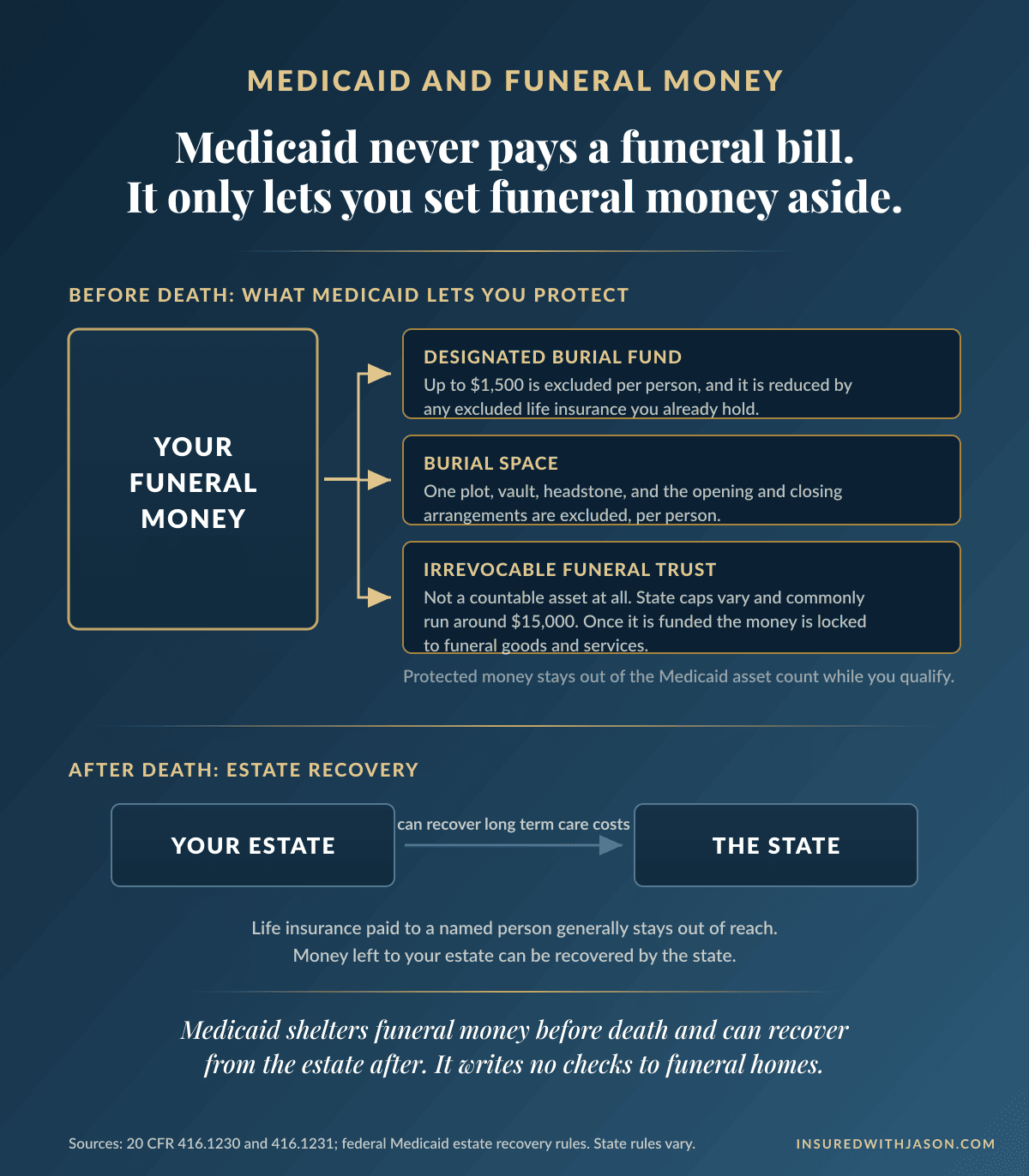
Medicaid shelters funeral money before death and can recover from the estate after. It writes no checks to funeral homes.
What county and charity programs help with burial costs?
Every state has some mechanism for the burial or cremation of people whose families truly cannot pay, and it almost always means a direct cremation rather than a funeral. The programs run through county coroners, medical examiners, public fiduciaries, or social services offices, and they are means-tested: typically the person must have no estate, no life insurance, and a family unable to contribute. What they provide varies enormously. Maine’s General Assistance caps out around $785 for cremation and $1,125 for burial. Connecticut’s program pays up to about $1,800, Colorado’s up to about $2,500, and some states offer nothing at the state level at all, leaving it entirely to counties. Processing can take weeks, and in some counties the cremated remains are held and may not be returned to the family.
I want to be very clear about what this route is, because clarity is the whole point of this page: a county program is a cremation, not a funeral. There is no service, no gathering, no ceremony. For a family that only needs the cremation handled, it’s a real and legitimate answer. But most people picturing their goodbye are picturing a dignified celebration of a life, with people in the room, and no county program pays for that.
Beyond the counties, a few genuinely free routes exist. Whole-body donation programs, when they accept a donor, typically cover transport, cremation, and the return of ashes at no cost, though acceptance isn’t guaranteed and there’s no traditional service with the body present. So the same honest question applies: are you solving for the cremation itself, or for the goodbye your family gets to have? Charities like Catholic Charities sometimes run burial assistance, benevolent societies and unions help their members, and after a federally declared disaster, FEMA funeral assistance may apply. Every one is worth a phone call for the family that needs it.
Genuinely free help, and the catch on each
Find out exactly what coverage costs at your age.
Real numbers · No mailer required · Takes a minute
What happens if nobody can pay for a burial?
When no one can pay, responsibility falls to the next of kin first, and then to the county where the person died. After notice and a waiting period, the county arranges disposition, which is almost always cremation, sometimes after first offering the body to a state anatomical program.
One thing families should know: walking away from the bill doesn’t reliably work. Several states hold the legal next of kin financially responsible for disposition and can pursue repayment from relatives who were able to pay and simply refused. Genuine inability is treated differently from unwillingness. Either way, there is no service, no ceremony, and no family choice in how it’s handled.
What’s the affordable alternative to waiting on government help?
A small whole life policy, sized to real funeral costs, is the dependable way to cover the gap the government leaves. The math from the top of this page doesn’t move: the median funeral with burial runs $8,300 according to the National Funeral Directors Association, a cremation with services runs a median of $6,280, and cemetery costs like the plot, vault, and marker often push the full bill past that. Against those numbers, the government’s guaranteed $255 is a rounding error. Final expense coverage exists to fund the difference, and it was designed for exactly the person reading this: most people who buy it haven’t set the money aside, which isn’t a failure, it’s the most common starting point there is, and it’s precisely the situation this coverage was built for.
Two doors lead in, and your health picks the door. Simplified issue coverage asks a few health questions with no medical exam, and if you’re approved, the full benefit covers you from day one. Guaranteed issue coverage asks no health questions at all and accepts most applicants in its age range, usually 50 to 85, but the trade is a waiting period: die of natural causes in the first two years and the policy typically returns the premiums paid plus around ten percent interest rather than the full benefit, though accidental death is usually covered in full from the start. That two-year window is the most important fine print in the “no one is turned down” ads, and it’s why buying while your health still qualifies you for simplified issue matters so much. Who qualifies for what is its own subject, and our final expense eligibility page walks through it.

“No one is turned down” usually means no one is paid in full for two years. Day-one coverage is what buying while healthy protects.
What does the coverage cost?
Premiums depend on your age, sex, health, and the coverage amount, and they always run as ranges until a real quote is in hand. As a labeled estimate, a $10,000 policy commonly runs somewhere between roughly $30 a month for a woman around 50 and $165 a month at the oldest ages, with most people landing well inside that spread. The premium locks in on the day you buy and never rises, and the benefit never shrinks. Because the price is set by your age right now, the cheapest version of this policy is the one you buy today. Real month-by-month numbers, and the levers that lower them, live on our final expense cost per month page, and when you’re ready to shop, the how to shop for burial insurance page shows you how to do it without landing on a lead list.
Should someone who qualifies for the county program buy a policy anyway?
Say someone calls me and their bills already outrun their income every month, and they’re going backward instead of forward. I would not recommend coverage, because a policy they can’t sustain will lapse and protect no one. If they qualify for the county route and they’re at peace with what it is, a cremation with no service, I’d support that decision fully.
What changes my answer is the family. Adult children often hear “no service” and decide to chip in so their mom or dad can have one, and that’s completely reasonable. That conversation costs nothing, and it changes everything.
Free burial insurance and government benefits: frequently asked questions
The questions people ask me most about free coverage and government help, answered plainly.
Is there free burial insurance from the government? +
No. No federal, state, or local government offers free burial insurance or a free state burial program. The only guaranteed federal payment for most families is Social Security’s one-time $255 lump sum death payment.
What is the most the government will pay toward a funeral? +
For most non-veteran families, $255 from Social Security. Eligible veterans can receive up to $2,000 for a service-connected death, or $1,002 plus a matching plot allowance for a non-service-connected death, along with a free grave in a national cemetery. Disaster and crime victim programs apply only in those specific situations.
Can the $255 Social Security death payment go straight to the funeral home? +
No. Social Security pays it only to an eligible surviving spouse or child, never to a funeral home, cemetery, or other third party. It must be claimed within two years of the death.
Does Medicaid pay for funeral expenses? +
No. Medicaid never pays funeral bills. Its rules let you set aside exempt funeral money, such as a designated burial fund, a burial space, or an irrevocable funeral trust, and after death the state may recover long-term care costs from the estate.
Are the “state-regulated burial program” ads real government programs? +
No. They are advertisements for private life insurance. “State regulated” describes every insurance policy in America, and the fine print on these mailers typically says they are not affiliated with any government agency. You can verify any claimed program with your state’s insurance department.
What if my health makes coverage hard to get? +
Simplified issue policies ask a few health questions and, if approved, cover you in full from day one. Guaranteed issue policies accept most applicants in their age range with no health questions, but the full benefit for natural causes typically begins after a two-year waiting period.
Is whole-body donation really free? +
Often, yes. Accredited programs typically cover transport, cremation, and the return of ashes at no cost if the body is accepted. Acceptance is not guaranteed, and there is no traditional funeral with the body present.
The people who never call the number are the ones I worry about.
For every person who answers a “free state burial program” ad and finds out it isn’t free, far more people just see the ad and quietly bank it, figuring their kids can look into that program when the time comes. Those folks never learn the program doesn’t exist, so they never put anything real in place, and their families find out at the worst possible moment. I wrote this page so you’d have the facts up front: some government help is real, and it’s nowhere near what most people picture. Some readers will take that in and do nothing, and that’s a fair choice honestly made. I wrote it for the ones who will change course once they know the truth. And I wrote it because I believe the person protecting your family should be honest with you from the very first sentence, so the relationship stands on trust for every decision that comes after. Honesty truly is the best policy, even if you never buy one.
Let’s cover the part the government doesn’t
Now you know exactly what’s real: $255 from Social Security, partial help for veterans, a cremation for families with nothing, and no free program anywhere. The rest is yours to plan for, and planning it is simpler than the mailers make it look. Fill out the quote form on this page and see your real numbers, from an independent broker who shops the whole market and starts the relationship the way it should start: with the truth.
This article is for educational purposes only and is not legal, tax, or financial advice. Government benefit amounts, eligibility rules, and program availability change and vary by state and situation, and coverage, costs, and rules for life insurance plans vary by person, company, and state. Please speak with a licensed professional about your specific situation before making a decision.
See your price in about a minute.